


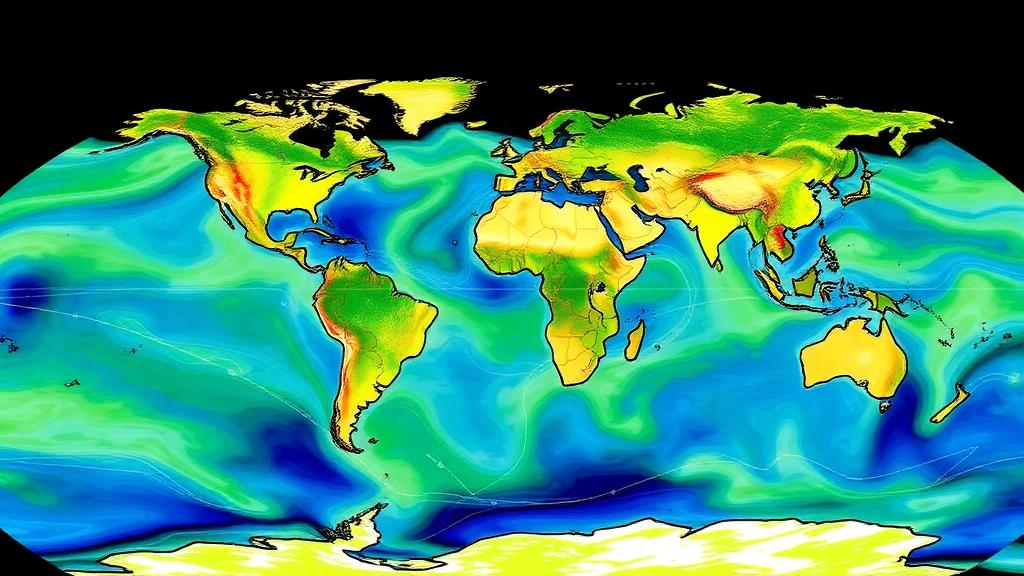
Every breath of air over a forest carries the signature of a conversation between the land and the sky. Plants pull carbon dioxide from the atmosphere through photosynthesis, release water vapor through their leaves, and in doing so reshape temperature, humidity, and even rainfall patterns across entire continents. Capturing this conversation in a climate model is one of the hardest problems in Earth system science, and a team of researchers at Nanjing University of Information Science and Technology has now delivered a major upgrade. In a study published in Geoscientific Model Development, Weijie Fu, Chenguang Tian, Xu Yue, and their colleagues present ECHAM6-iMAPLE version 1.0, a newly coupled atmosphere–ecosystem model that replaces the vegetation engine inside a leading European climate model with a far more sophisticated representation of how plants and soils exchange carbon, water, and energy with the air above them.
The host model, ECHAM6, is the sixth generation of the European Centre Hamburg general circulation model developed at the Max Planck Institute for Meteorology. It is a workhorse of European climate science and participated in the Sixth Coupled Model Intercomparison Project, the international effort that underpins the most recent assessments of the Intergovernmental Panel on Climate Change. ECHAM6 solves the primitive equations of atmospheric motion using a hybrid spectral and finite-difference framework, with turbulent mixing handled by a turbulent kinetic energy scheme and surface fluxes computed through bulk transfer coefficients. In its default configuration, land-surface processes are managed by JSBACH, the Jena Scheme for Biosphere–Atmosphere Coupling in Hamburg, which simulates vegetation dynamics and terrestrial carbon cycling across twelve plant functional types and two bare-ground classes.
JSBACH is a capable model, but like many vegetation schemes in Earth system models it simplifies key ecosystem processes. Seasonal variations in leaf area, for example, are often prescribed with empirical parameters rather than simulated as interactive responses to environmental drivers. Such simplifications matter because the uncertainties they introduce do not stay confined to the land surface. They propagate upward through land–atmosphere coupling, degrading weather forecasts and widening the error bars on climate projections. The new study tackles this weakness head-on by swapping out the carbon and water flux calculations of JSBACH for those produced by iMAPLE, the interactive Model for Air Pollution and Land Ecosystems, which evolved from the Yale Interactive terrestrial Biosphere model and was designed from the outset to represent the interplay between atmospheric chemistry and living ecosystems.
The technical heart of iMAPLE is its photosynthesis scheme, which applies the canonical Michaelis–Menten enzyme-kinetics framework to both C3 and C4 plant functional types. Total leaf photosynthesis is limited by whichever of three biochemical processes is slowest: carbon fixation constrained by the enzyme Rubisco, regeneration of the RuBP substrate driven by electron transport through the Calvin cycle, or the synthesis of end products such as starch and sucrose. These rates depend on the maximum carboxylation rate, a parameter that iMAPLE calibrates against eddy covariance measurements from more than 200 FLUXNET sites worldwide. The canopy itself is divided into up to sixteen vertical layers, each further split into sunlit and shaded fractions, allowing the model to distinguish how leaves use direct versus diffuse radiation. Phenology, the seasonal rhythm of leaf growth and loss, is simulated prognostically using temperature and soil moisture thresholds refined against satellite retrievals and thousands of ground-based phenology records.
On the water side, iMAPLE adopts the Noah-MP hydrological scheme, which resolves the full grid-scale water balance among precipitation, evapotranspiration, runoff, and changes in terrestrial water storage. Evapotranspiration is partitioned into plant transpiration, canopy evaporation, and ground evaporation, while runoff is split into surface and subsurface components. Groundwater is treated explicitly through a simple aquifer model, with the water-table depth diagnosed from aquifer storage. This tight coupling between the carbon cycle, handled by the vegetation module, and the water cycle, handled by Noah-MP, is precisely what allows the coupled system to respond realistically to drought, heat waves, and other environmental stresses.
Wiring iMAPLE into ECHAM6 required careful engineering. ECHAM6 advances its atmospheric dynamics every 7.5 minutes, while iMAPLE operates on a 60-minute clock, so the models exchange information every eight atmospheric time steps. At each coupling interval, ECHAM6 hands over hourly meteorological fields including precipitation, surface air temperature, wind speed, humidity, surface pressure, carbon dioxide concentrations, and radiation. In return, iMAPLE feeds back simulated soil temperature, soil moisture, and evapotranspiration. These variables alter the surface energy balance, changing how energy is partitioned between sensible heat, which warms the air, and latent heat, which evaporates water. Because the surface heat and moisture fluxes form the lower boundary conditions for the atmospheric column, improvements in the land surface ripple directly into near-surface climate. The team ran both ECHAM6-iMAPLE and the original ECHAM6-JSBACH configuration at T63 resolution with 47 vertical layers for the period 2000 to 2014, using identical atmospheric settings and observed sea surface temperatures, with the first five years reserved for spin-up.
The evaluation results are striking. Against the FLUXCOM benchmark, a machine-learning product trained on flux measurements from eddy covariance sites, ECHAM6-iMAPLE simulates a global annual gross primary productivity of 126.9 petagrams of carbon per year, close to the benchmark estimate of 124.1, whereas ECHAM6-JSBACH overshoots at 134.2 with pronounced positive biases over the Amazon, Central Africa, and the Indian subcontinent. The new model achieves a spatial correlation of 0.75 with observations and cuts the root mean square error to 1.51 grams of carbon per square meter per day. Leaf area index improves even more dramatically: ECHAM6-iMAPLE reaches a correlation of 0.86 against satellite retrievals from the Global LAnd Surface Satellite product, with a root mean square error of 0.73 square meters per square meter, and successfully reproduces the towering leaf area of tropical rainforests.
Water fluxes tell a similar story. Simulated evapotranspiration from ECHAM6-iMAPLE correlates at 0.86 with the FLUXCOM benchmark, and its global area-weighted mean of 45.5 millimeters per month nearly matches the observed 45.9, while ECHAM6-JSBACH underestimates it at 42.1, particularly across the arid western United States and Australia. Water use efficiency, the ratio of carbon gained to water lost, improves from a correlation of 0.20 in the old configuration to 0.52 in the new one. The seasonal cycle also sharpens: the new model places the annual peaks of carbon and water fluxes in July, matching observations, whereas the old model peaks a month early. Crucially, these land-surface gains propagate upward. Soil temperature errors shrink, the global mean warm bias in surface air temperature drops from 0.76 to 0.34 degrees Celsius, and the severe 39.1 percent overestimation of global soil moisture in the old model is brought into close agreement with the MERRA-2 reanalysis. Precipitation remains a stubborn challenge for both models, a reminder that hydrological feedbacks in the atmosphere are complex and nonlinear.
The improvements stem from rigorous calibration and more realistic biophysics, but the authors are candid about remaining limitations. iMAPLE does not yet include dynamic nitrogen and phosphorus cycles, which introduces uncertainty in how photosynthesis responds to rising carbon dioxide. Land cover is prescribed rather than simulated, so the model cannot capture vegetation shifts under disturbance, and dynamically simulated leaf area is not yet consistently used to update all land-surface parameters. Soil processes are resolved only in the upper two meters. The road ahead is ambitious: the team plans to add a process-based nitrogen cycle, strengthen the simulation of natural emissions such as wildfires and biogenic volatile organic compounds, and ultimately couple an interactive atmospheric chemistry module, enabling fully integrated simulations of climate, ecosystems, and air pollution. If those plans come to fruition, ECHAM6-iMAPLE could become a powerful tool for projecting how human activities reshape the Earth system, one leaf, one flux, and one feedback at a time.
Subject of Research: Development and evaluation of the ECHAM6-iMAPLE v1.0 coupled atmosphere–ecosystem model
Article Title: Development and evaluation of the ECHAM6-iMAPLE v1.0 coupled atmosphere–ecosystem model
Article References: Fu, W., Tian, C., Zhao, Y., Hu, Y., Huang, J., Chen, H., & Yue, X. (2026). Development and evaluation of the ECHAM6-iMAPLE v1.0 coupled atmosphere–ecosystem model. Geoscientific Model Development, 19(19), 9395-9409. https://doi.org/10.5194/gmd-19-9395-2026
Image Credits: AI Generated
Keywords: ECHAM6, iMAPLE, climate modeling, land-atmosphere interactions, carbon cycle, evapotranspiration, photosynthesis, vegetation dynamics, soil moisture, hydrology, Earth system models, Geoscientific Model Development
Cite Scienmag News
Gavin Prescott. (October 8, 2026). New coupled climate-ecosystem model sharpens global carbon and water simulations. Scienmag. https://scienmag.com/new-coupled-climate-ecosystem-model-sharpens-global-carbon-and-water-simulations/
Gavin Prescott. "New coupled climate-ecosystem model sharpens global carbon and water simulations." Scienmag, 8 October 2026, https://scienmag.com/new-coupled-climate-ecosystem-model-sharpens-global-carbon-and-water-simulations/. Accessed 8 October 2026.
Gavin Prescott. "New coupled climate-ecosystem model sharpens global carbon and water simulations." Scienmag. October 8, 2026. https://scienmag.com/new-coupled-climate-ecosystem-model-sharpens-global-carbon-and-water-simulations/


