


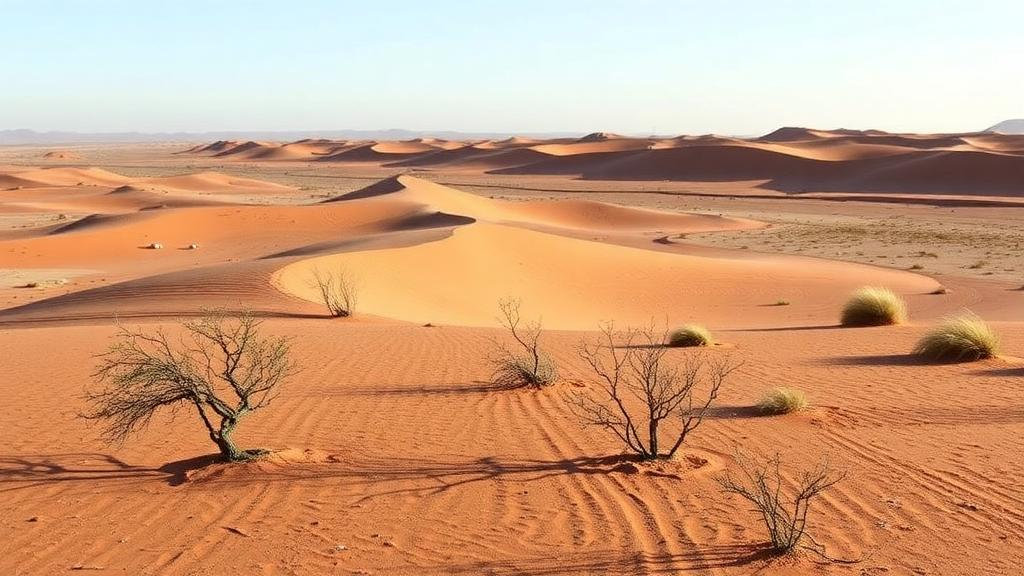
Along one of the most forbidding shorelines on Earth, where the cold Benguela Current chills the Atlantic and fog drifts inland over hyperarid gravel plains, a team of geomorphologists has untangled how desert rivers and their sediment deposits communicate across millions of years. In a study published in Earth Surface Dynamics, Joel Mohren of RWTH Aachen University and colleagues mapped and statistically analyzed 67 drainage systems along Namibia’s Skeleton Coast, asking a deceptively simple question: how faithfully do the alluvial fans at the coast reflect the catchments that feed them? The answer, distilled through cluster and partial correlation analyses, is that the geometry of the fans themselves, above all their gradient, tells the story better than climate, rock type, or catchment size ever could.
The Skeleton Coast is a natural laboratory of unusual quality. Sitting on a passive continental margin with minimal tectonic activity, and likely arid since roughly the early Cretaceous, the region preserves a Cretaceous to Miocene planation surface known as the Namib Plains. Most catchments are squeezed between the Atlantic and the Great Escarpment, the main watershed at about 1,000 meters above sea level, though larger systems such as the Ugab extend nearly 400 kilometers inland. Rainfall rises steadily from under 50 millimeters per year at the coast to 100–200 millimeters per year near the escarpment headwaters, while fog delivers a surprising supplementary water supply; measurements at Gobabeb found that fog water over 80 rainless days exceeded mean annual rainfall by a factor of about 1.3. This fog also carries salts that form gypsum crusts, armoring ancient fan surfaces against erosion.
Into this stable frame, ephemeral rivers deliver sediment from the hinterland to vast accommodation space on the coastal plain, building alluvial fans, coalescing fan complexes, and bajadas. Some of these deposits are ancient: the Horingbaai fan delta at the southern margin of the study area records progradation between roughly 2.7 and 2.2 million years ago, while the Uniab fan aggraded after about 180,000 years ago. A coast-parallel dune belt, the Skeleton Coast Erg, between roughly 19.1 and 20.4 degrees south and 6 to 20 kilometers wide, has overridden many deposits and blocks overland sediment transport toward the sea, likely forming around or after the Last Glacial Maximum. The result is a patchwork of landforms affected to very different degrees by confinement and post-depositional alteration.
To bring order to this heterogeneity, the team built a rigorous parametric dataset. They tested four digital elevation models against ICESat-2 laser altimetry and selected the Copernicus GLO-30 product, which achieved a vertical accuracy of roughly one meter root mean square error. Using satellite imagery with sub-meter resolution, they mapped 67 alluvial landforms and delineated their catchments, extracting morphometric measures such as fan and catchment area, gradient, relief, Melton’s ruggedness number, and hypsometric integral, alongside climatic variables from the CHELSA-BIOCLIM+ dataset, satellite-derived fog frequencies, Sentinel-1 radar backscatter as a proxy for surface roughness, and lithology from Geological Survey of Namibia maps. After quality filtering and outlier removal, 47 landforms entered the final statistical workflow.
The analytical strategy combined hierarchical clustering with k-means optimization and partial correlation analysis on log-transformed data. Clustering is an exploratory technique that groups systems by similarity, and here it proved essential: rather than subjectively sorting fans into categories, the researchers let the data define the groups. Outliers were first identified with single linkage fusion and removed, then the cleaned datasets were clustered with Ward’s method, validated through split-half tests that confirmed the solutions were reproducible. Both the fans and the catchments resolved into three distinct clusters, but, strikingly, the match between fan clusters and catchment clusters was limited, a first hint that the sink side of the system carries its own signal.
The three fan clusters map cleanly onto geography and process. One cluster, concentrated in the south, comprises near-coastline fans with the lowest gradients, closely tied to catchment ruggedness through the classical power-law relationship between fan gradient and Melton’s number. A second cluster, associated with the central Skeleton Coast, consists mostly of bajadas strongly influenced by the erg, where distal confinement by dunes masks simple morphometric scaling between fan and catchment area. The third cluster, spanning much of the coast but focused in the north, contains fans facing the strongest modern winds, yet paradoxically these least-confined systems show the clearest source-sink coupling of all, with robust correlations linking fan area and gradient to catchment properties and sediment connectivity.
The quantitative results place the Skeleton Coast at the unusual end of the global spectrum. The power-law exponent linking fan area to catchment area came out at just 0.24, far below the 0.66 to 0.97 range typical of dryland fan systems worldwide, and the classical correlations were weak, with coefficients of determination of 0.14, 0.49, and 0.36 for the three canonical relationships. Fan gradients average a mere 0.8 degrees, so gentle that under a recent global classification the landforms would not even qualify as alluvial fans but rather as fluvial distributive systems. Melton’s ruggedness numbers run an order of magnitude below those of other dryland settings, indicating that fluvial processes, not debris flows, dominate sediment delivery. Notably, the anticipated link between basalt-derived smectite and steeper fans, proposed in earlier work, did not hold at the regional scale.
What emerges instead is that fan confinement, whether by the ocean, by coalescing neighbors, or by the erg, is the master variable governing source-sink relationships. Fan morphometry proved more decisive than catchment properties, with fan gradient, normally distributed across the dataset and reliably below one degree on average, serving as the most meaningful discriminator. No robust lithological or modern climatic control on fan morphometry could be identified, although the radar data offered a tantalizing clue: gypsum-encrusted, stable fan surfaces appear more frequently south of the erg, suggesting that the southern portion of the coast has provided the most favorable conditions for long-term archive preservation. The Horingbaai fan delta, with its dissected but heavily encrusted Pliocene-Pleistocene sediments, exemplifies this antiquity.
The implications reach beyond Namibia. Alluvial deposits can store time-integrated information about environmental conditions from sediment detachment in the source to deposition in the sink, and in settings of long-term stability like the Skeleton Coast, they may evolve into persistent geomorphic archives registering environmental change through subtle shifts in sediment routing. Offshore drill-core records indicate that over the past 300,000 years, glacial stages brought less arid conditions and stronger winds to the Namibian coast, while interglacials were more arid; the terrestrial fans likely responded to such pulses. Knowing which fans preserve the cleanest source-sink signal is therefore the prerequisite for reading them as paleoenvironmental recorders.
The study’s practical guidance is correspondingly clear: the least-confined fans, particularly those south of the Skeleton Coast Erg, offer the strongest coupling and should be prioritized for paleoenvironmental reconstruction, while the low-dynamics character of the whole margin, with bedrock erosion rates below two meters per million years, means these archives may extend far deeper into the Quaternary than their counterparts in tectonically active deserts like the Atacama. In a landscape where fog, not rain, often dominates the water budget and dunes can dam entire rivers, the humble slope of a fan turns out to be the most honest witness to how land, water, and time interact at the dry limit of Earth’s surface processes.
Subject of Research: Source-sink relationships between catchments and alluvial fans along the hyperarid Skeleton Coast of northern Namibia
Article Title: Fluvio-alluvial source-sink relationships at the Skeleton Coast of northern Namibia: a parametric analysis
Article References: Mohren, J., Walk, J., Krieger, J., Römer, W., Nguno, A., & Lehmkuhl, F. (2026). Fluvio-alluvial source-sink relationships at the Skeleton Coast of northern Namibia: a parametric analysis. Earth Surface Dynamics, 14(5), 685-728. https://doi.org/10.5194/esurf-14-685-2026
Image Credits: AI Generated
DOI: 10.5194/esurf-14-685-2026
Keywords: Skeleton Coast, Namibia, alluvial fans, geomorphology, source-sink coupling, drylands, cluster analysis, fan gradient, Skeleton Coast Erg, paleoenvironmental archives, hyperarid desert, remote sensing
Cite Scienmag News
Violet Maxwell. (October 8, 2026). Namibia’s Skeleton Coast reveals how desert fans record ancient climate clues. Scienmag. https://scienmag.com/namibias-skeleton-coast-reveals-how-desert-fans-record-ancient-climate-clues/
Violet Maxwell. "Namibia’s Skeleton Coast reveals how desert fans record ancient climate clues." Scienmag, 8 October 2026, https://scienmag.com/namibias-skeleton-coast-reveals-how-desert-fans-record-ancient-climate-clues/. Accessed 8 October 2026.
Violet Maxwell. "Namibia’s Skeleton Coast reveals how desert fans record ancient climate clues." Scienmag. October 8, 2026. https://scienmag.com/namibias-skeleton-coast-reveals-how-desert-fans-record-ancient-climate-clues/


