


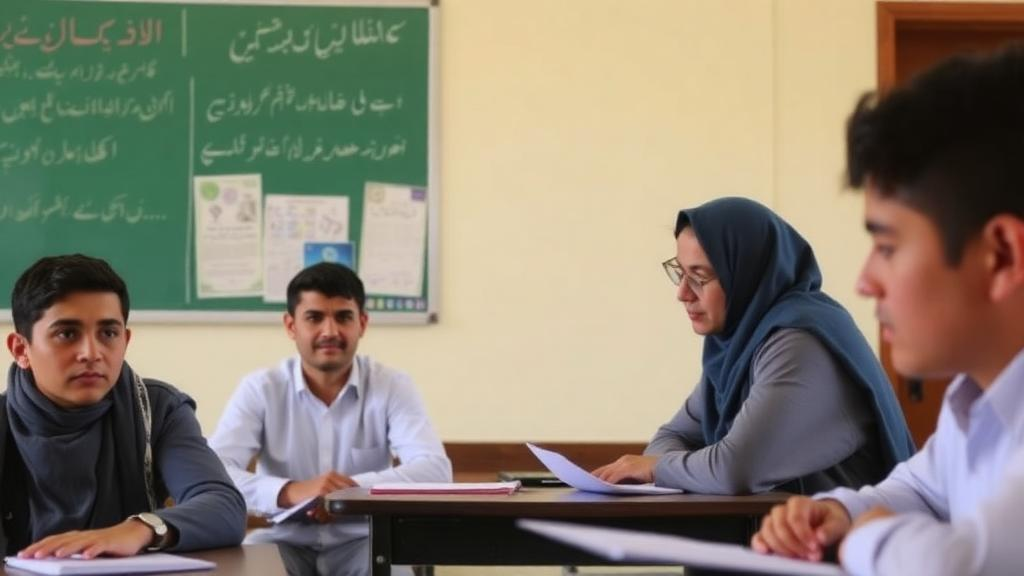
Outcome-based education, or OBE, has been promoted worldwide as a way to make universities more accountable and more focused on what students can actually do rather than what they have been told. Instead of measuring success by the number of chapters covered, OBE asks institutions to define clear learning outcomes, then align curriculum, teaching and assessment so that every student can demonstrably achieve them. Yet a new qualitative study from Afghanistan suggests that in severely under-resourced, centrally controlled higher education systems, the reform can collapse into a paper exercise, adopted on official documents but barely changing what happens in classrooms.
The study, published in Discover Education by Mohammad Qasim Farooqi and Najibullah Habibi of Badghis University, explored how English as a Foreign Language (EFL) teachers at three Afghan public universities experience the implementation of OBE. The researchers conducted semi-structured interviews with nine male EFL teachers who were purposively selected because they had served both as OBE trainers and as university lecturers. Female teachers could not be recruited because, following the regime change, they were no longer teaching in Afghan higher education. Interviews were held online via WhatsApp audio calls in October and November 2023, lasted roughly fifty minutes each, and were conducted in English or Persian depending on the participant’s preference. The researchers stopped recruiting after the ninth interview because no new themes emerged, a sign that data saturation had been reached.
The interviews were analyzed using Braun and Clarke’s six-phase reflexive thematic analysis, interpreted through the lens of institutional theory. That theoretical framework, developed by organizational sociologist W. Richard Scott, describes institutional environments in terms of three pillars: regulative structures such as laws and policies, normative structures such as professional values, and cultural-cognitive structures such as shared assumptions about what is feasible. When a new reform clashes with these pillars, organizations often engage in what scholars call decoupling, formally adopting a policy to gain legitimacy while quietly continuing established routines. That concept proved strikingly apt for the Afghan case.
The most salient barrier the teachers described was resource inadequacy. Classrooms lacked projectors, libraries and basic technological infrastructure, forcing instructors back into traditional, content-delivery modes of teaching regardless of their enthusiasm for outcome-based principles. One participant, identified as T2, asked how a system can be implemented when there is no library, no LCD display and no working projector. The shortage was reported to be even more severe in remote provinces such as Badghis, Ghor and Farah, which the teachers described as an institutional inequity: OBE appeared to be designed, implicitly, for well-equipped universities in central provinces while being imposed everywhere.
Training emerged as a second, deeply ironic obstacle. The OBE workshops teachers attended were described as largely theoretical, lecture-based and compliance-oriented, lasting about ten days with long daily sessions running from early morning to late afternoon. Participants said the sessions raised awareness without building capacity, offering no guided practice, classroom simulations, model lessons or follow-up observation. One teacher noted that trainees were given certificates and then everything was finished, even though most did not understand what OBE actually required of them. The researchers highlight the performative contradiction here: a reform meant to promote active, student-centered learning was transmitted through passive, teacher-centered instruction, effectively socializing teachers into the very pedagogy OBE seeks to replace.
Curricular constraints compounded the problem. The national syllabus produced by the Ministry of Higher Education was perceived as misaligned with OBE principles, and the teachers who periodically revised it were seen as subject-matter experts rather than specialists in outcome-based design. Teachers reported having only about thirty percent freedom to adapt the syllabus to their departments’ needs, a ceiling the study interprets as a symbolic limit on professional autonomy. In OBE theory, curriculum content and learning experiences should be selected only after outcomes have been clearly defined, following frameworks such as Spady’s original formulation and the SMART criteria for writing specific, measurable, actionable, relevant and time-bound outcomes. In practice, Afghan teachers faced the reverse: a fixed content list to which outcomes had to be retrofitted.
Policy misalignment tied these barriers together. Institutional regulations mandated the number of pages to be covered per session, and teachers who fell behind were questioned by their department heads. Assessment rules heavily favored summative examinations, reportedly accounting for the overwhelming majority of evaluation, while OBE calls for rich formative assessment aligned with intended outcomes. Examination regulations requiring a fixed number of written questions were described as incompatible with skill-based courses, since speaking and writing competencies demand performance-based and extended tasks rather than knowledge-recall papers. The result, the authors argue, is a double bind: teachers are officially encouraged to pursue outcome-oriented pedagogy while the incentive structure punishes exactly the practices it requires.
A shortage of human resources ran through all of these accounts. Only a handful of OBE master trainers served the entire country, traveling to eight or ten provinces for ten-day workshops, and some trainers sent abroad for training came from disciplines such as computer science and biology with little background in pedagogy. Many teachers in remote universities had never received any OBE training at all. The participants argued that future trainers should be selected from educators holding master’s or doctoral degrees in education, whose expertise in teaching methodology would allow them to grasp and transmit OBE principles more effectively.
From these diagnoses, the teachers built a tripartite solution framework that the authors present as the study’s central practical contribution. First, deep professionalization: expanding the pool of master trainers, selecting them from education specialists, and replacing one-off workshops with sustained, practice-based development that builds assessment literacy and curriculum-design skill. Second, dedicated resource allocation: training a curriculum team in each department to design OBE-aligned syllabi, and investing in technological infrastructure, libraries and modern equipment. Third, institutional realignment: reforming teaching and assessment policies so that they reward rather than penalize outcome-based practices, or at minimum granting teachers the professional space to follow OBE rules where existing policy conflicts with them.
Crucially, the participants insisted that these three components are interdependent. Trained teachers without resources cannot enact the reform; resources without professional competence sit unused; and professionalism plus resources without supportive policy still leaves teachers unable to implement OBE. The authors conclude that reform failure in such contexts is rarely a matter of poor technique but of incompatible systemic logics, and that the Afghan pattern, resource scarcity, prescriptive curricula, ineffective training and contradictory assessment policy reinforcing one another, offers a diagnostic lens for stalled outcome-based reforms in other under-resourced, centrally governed systems. The study’s limitations are acknowledged: a small, purposive, all-male sample from three universities, potential trainer bias among participants, and the sensitivity of the political context, all of which call for larger and more diverse follow-up research before the proposed framework is scaled up.
Subject of Research: Implementation challenges and solutions for outcome-based education among EFL teachers in Afghan public universities
Article Title: Perceived challenges and potential solutions of outcome-based education in an under-resourced context
Article References: Farooqi, M. Q., & Habibi, N. (2026). Perceived challenges and potential solutions of outcome-based education in an under-resourced context. Discover Education, 5(1), Article 1110. https://doi.org/10.1007/s44217-026-02202-5
Image Credits: AI Generated
DOI: 10.1007/s44217-026-02202-5
Keywords: outcome-based education, Afghanistan, higher education, EFL teachers, qualitative research, thematic analysis, teacher training, curriculum alignment, assessment policy, institutional theory, educational reform, under-resourced contexts
Cite Scienmag News
Courtney Benton. (October 8, 2026). Teachers in Afghanistan Reveal Why Outcome-Based Education Fails to Take Root. Scienmag. https://scienmag.com/teachers-in-afghanistan-reveal-why-outcome-based-education-fails-to-take-root/
Courtney Benton. "Teachers in Afghanistan Reveal Why Outcome-Based Education Fails to Take Root." Scienmag, 8 October 2026, https://scienmag.com/teachers-in-afghanistan-reveal-why-outcome-based-education-fails-to-take-root/. Accessed 8 October 2026.
Courtney Benton. "Teachers in Afghanistan Reveal Why Outcome-Based Education Fails to Take Root." Scienmag. October 8, 2026. https://scienmag.com/teachers-in-afghanistan-reveal-why-outcome-based-education-fails-to-take-root/


