


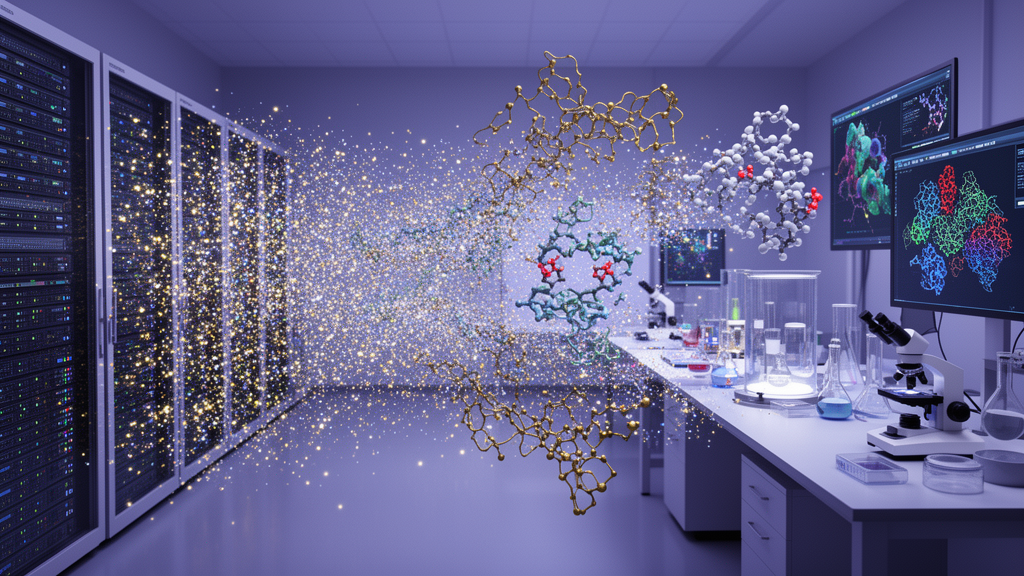
A virtual biotechnology company staffed by 37,000 artificial-intelligence agents has analyzed about 50,000 clinical trials, identified molecular features associated with better drug-development outcomes, and proposed an antibody-drug conjugate for lung cancer that was later independently developed by a pharmaceutical company. The work, described in a peer-reviewed paper in Science, demonstrates how multiple specialized AI systems can operate like divisions of a drug company, from target discovery and molecular analysis to therapeutic design and clinical-trial planning.
The project was created by James Zou, an associate professor of biomedical data science at Stanford Medicine, and Harrison Zhang, a graduate student and the paper’s lead author. Zou is also the principal investigator of a virtual laboratory launched in 2025, where AI scientists emulate researchers working across an academic lab. The company expands that concept by giving the agents the organizational structure of an established biotechnology firm: a chief science officer agent oversees specialized teams that work in parallel on parts of the drug-development pipeline. According to the release, the company has no human employees, laboratory space, lunch breaks or payroll.
Rather than sending general-purpose agents loose across scientific literature, the researchers assigned individual agents to specific clinical trials. Each agent was responsible for retrieving and analyzing information on a trial’s safety and effectiveness. In less than a week, the system analyzed and catalogued roughly 50,000 trials, a scale the researchers said could have required years of human work. The analysis was experimental and retrospective: it examined existing trial and molecular data to identify patterns that might guide the design of future drug candidates.
The agents paired trial outcomes with molecular measurements, including single-cell gene-activity data where available. They developed two scores. The first assessed target specificity by asking how selectively a drug acted on a particular cell type rather than broadly affecting many cell types. The second measured “bimodality,” a property indicating whether expression of a targeted gene behaved more like an on-off switch, with distinct active and inactive states, or like a dimmer with a more continuous range of activity. Trials whose drugs received high scores on both measures tended to have better results.
Relative to drugs with broader activity, candidates targeting switch-like genes were reported to be 40% more likely to advance from phase 1 to phase 2 trials, 48% more likely to reach the market and to have 32% fewer adverse events. These associations were observed across several disease categories, including cancers, brain diseases, heart disease, and kidney and lung conditions. The paper presents an observational relationship rather than proof that switching genes or achieving cell-type specificity will cause a drug to succeed. The proposed explanation is that targets with sharply separated activity states and focused cellular effects may be easier to modulate and control, which could contribute to both efficacy and safety.
To test whether the virtual organization could move beyond analysis into therapeutic design, the researchers asked the agents to work on B7-H3, a protein of interest in lung cancer research. Drawing on studies and biomedical repositories, the system found high B7-H3 expression in fibroblasts, connective-tissue cells that often sit near tumor cells. It also examined cell-to-cell communication and spatial-transcriptomic data, which reveal gene activity in particular cellular locations. The agents inferred that B7-H3-expressing fibroblasts might send signals that suppress nearby immune cells, potentially allowing tumors to evade normal immune defenses.
Based on that analysis, the AI scientists designed an antibody-drug conjugate for B7-H3. Such a therapy combines an antibody that recognizes a molecular target with a cytotoxic chemotherapy payload, allowing the drug to deliver the toxic agent directly to cells carrying abundant copies of the target. The system used information available before January 2025 for this design, according to the release, making the subsequent development an external comparison rather than a retrospective reconstruction using later information.
In August 2025, an established private pharmaceutical company independently arrived at the same general antibody-drug conjugate strategy against B7-H3. The company’s therapy subsequently received a Food and Drug Administration breakthrough therapy designation, which the release describes as a program intended to accelerate promising treatments after evidence of effectiveness in a human study. Zou characterized the convergence as independent, third-party validation consistent with the virtual biotech’s proposed effects and design. The comparison does not mean that the virtual company tested a drug in people, generated clinical-trial data or established that its proposed construct was identical in every technical detail to the pharmaceutical company’s therapy; no physical candidate from the virtual company entered a clinical study.
The researchers are not pursuing B7-H3 further because another company is already advancing a therapy against that target. They say the virtual system has surfaced additional candidate targets using a similar design approach, but those proposals still require experimental evaluation. The next stage is to transfer the findings into physical laboratories, where researchers can test whether the biological relationships identified from existing data hold in real biological systems and whether proposed therapeutics retain their intended activity and safety. Human scientists and experimentation therefore remain the validation route through which the AI-generated hypotheses could affect medicine. The study was supported by a Knight-Hennessy Scholarship, National Institutes of Health grant T32-GM145402, the National Science Foundation, Chan Zuckerberg Biohub and Stanford’s Department of Biomedical Data Science, with researchers from PHD Biosciences also contributing.
Subject of Research: A multi-agent artificial-intelligence framework for analyzing clinical trials and designing therapeutic candidates
Article Title: Virtual biotech company puts thousands of AI scientist agents to work on drug discovery
Article References: Virtual biotech company puts thousands of AI scientist agents to work on drug discovery. Original publication (Bibliographic details unavailable.)
Image Credits: AI Generated
DOI: Not provided
Keywords: artificial intelligence, drug discovery, AI agents, clinical trials, single-cell analysis, B7-H3, antibody-drug conjugates, lung cancer, therapeutic development, Stanford Medicine, Virtual, biotech
Cite Scienmag News
Louis Brooks. (October 26, 2026). Virtual biotech deploys 37,000 AI agents across drug discovery. Scienmag. https://scienmag.com/virtual-biotech-deploys-37000-ai-agents-across-drug-discovery/
Louis Brooks. "Virtual biotech deploys 37,000 AI agents across drug discovery." Scienmag, 26 October 2026, https://scienmag.com/virtual-biotech-deploys-37000-ai-agents-across-drug-discovery/. Accessed 26 October 2026.
Louis Brooks. "Virtual biotech deploys 37,000 AI agents across drug discovery." Scienmag. October 26, 2026. https://scienmag.com/virtual-biotech-deploys-37000-ai-agents-across-drug-discovery/


