

Monday, October 26, 2026
Science
No Result
View All Result
  • Login
  • HOME
  • SCIENCE NEWS
  • CONTACT US
  • HOME
  • SCIENCE NEWS
  • CONTACT US
No Result
View All Result
Scienmag
No Result
View All Result
Home Science News Chemistry

Researchers Create First Three-Dimensional Carbon Allotrope

October 26, 2026
in Chemistry
Bethany Barker
By Bethany Barker Scienmag Editorial Profile - Catalysis
Reading Time: 2 mins read
0
Researchers Create First Three-Dimensional Carbon Allotrope

Researchers Create First Three-Dimensional Carbon Allotrope

65
SHARES
587
VIEWS
Share on FacebookShare on Twitter
ADVERTISEMENT

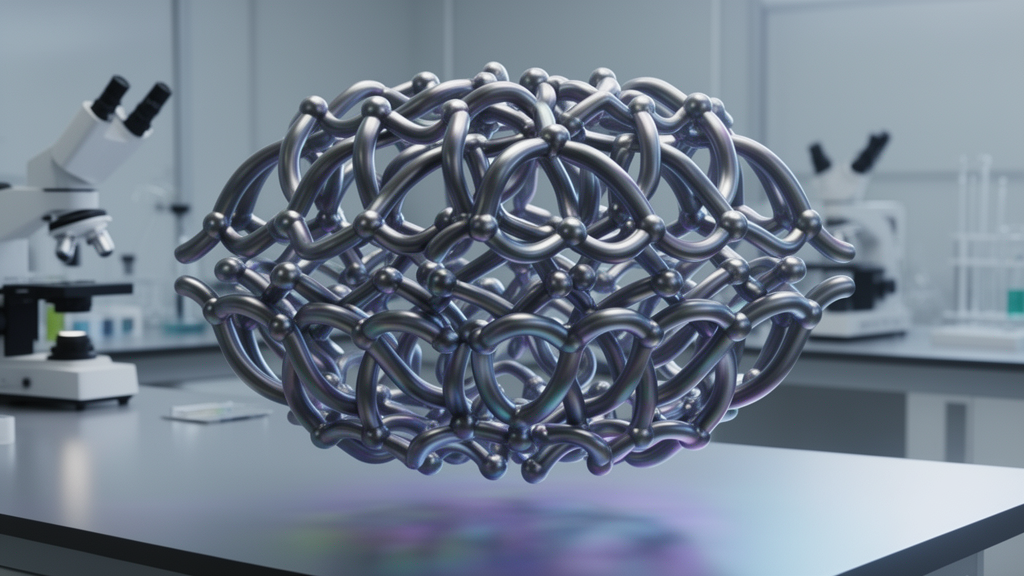
Researchers at the University of Gothenburg have created diamondiyne, a new carbon allotrope with a three-dimensional structure that the team describes as a porous diamond. The material forms as a thin film where two liquids meet, using relatively inexpensive equipment. Carbon atoms are connected by triple bonds and arranged as tetrahedra joined corner to corner in all three dimensions, producing a repeating structure with voids between the tetrahedra. The work was published in Angewandte Chemie under the title “Diamondiyne: A 3D Carbon Allotrope With Mixed sp–sp3 Hybridization.”

Diamondiyne was first described theoretically 35 years ago, and the University of Gothenburg team’s experimental study marks the first reported creation of the allotrope. Professor Karl Börjesson said the result followed years of work on porous materials made from carbon-based molecules without metal ions. “It has taken us an incredibly long time, but we finally succeeded,” he said. The broader project concerns carbon-based frameworks, or COFs, and the team’s achievement was to establish the proposed carbon structure experimentally rather than only on paper.

Electron microscopy at Stockholm University confirmed the crystal structure in patches on the surface of the film. The researchers also observed repeating diamondiyne patterns in a volume measuring 10 nanometres on each side, and said the images corresponded well with theoretical models. Because formation can fail in several ways, the study’s evidence is based on localized structural confirmation rather than a demonstration that the entire film consists of a single continuous crystal. The work was a collaboration between Börjesson’s research group and colleagues at Stockholm University and Chalmers University of Technology.

The new material differs from conventional diamond in the conditions used to bond its carbon atoms. In diamondiyne, the atoms can bond without the high pressure required to form ordinary diamond, according to the research team. Its three-dimensional arrangement also distinguishes it from familiar carbon allotropes. For much of modern physical chemistry, carbon allotropes were largely represented by diamond, graphite, fullerene, carbon nanotubes and graphene; more recent years have brought numerous additional allotropes, but the team said none had previously been created with a three-dimensional structure. The porous architecture may allow several diamondiyne structures to interweave through one another’s voids, a possibility the researchers said they will investigate along with the material’s other properties and potential applications.

Subject of Research: Experimental creation and structural characterization of a three-dimensional porous carbon allotrope

Article Title: New porous diamond created by researchers

Article References: New porous diamond created by researchers. Original publication (Bibliographic details unavailable.)

Image Credits: AI Generated

DOI: Not provided

Keywords: diamondiyne, carbon allotropes, porous materials, crystal structure, electron microscopy, carbon chemistry, University of Gothenburg, Angewandte Chemie, COFs, tetrahedral frameworks, porous, diamond

Cite Scienmag News

Bethany Barker. (October 26, 2026). Researchers Create First Three-Dimensional Carbon Allotrope. Scienmag. https://scienmag.com/researchers-create-first-three-dimensional-carbon-allotrope/

Bethany Barker. "Researchers Create First Three-Dimensional Carbon Allotrope." Scienmag, 26 October 2026, https://scienmag.com/researchers-create-first-three-dimensional-carbon-allotrope/. Accessed 26 October 2026.

Bethany Barker. "Researchers Create First Three-Dimensional Carbon Allotrope." Scienmag. October 26, 2026. https://scienmag.com/researchers-create-first-three-dimensional-carbon-allotrope/


Tags: 3D carbon allotrope developmentadvanced carbon nanomaterialsAngewandte Chemiecarbon allotrope with triple bondscarbon allotropescarbon chemistrycarbon frameworks with voidscarbon-based porous materialsCOFscrystal structurediamonddiamondiynediamondiyne synthesiselectron microscopyelectron microscopy of carbon structuresexperimental creation of novel carbon frameworksfirst synthesis of three-dimensional carbon allotropehybridization in carbon allotropesporousporous diamond materialporous materialstetrahedral carbon structurestetrahedral frameworksUniversity of Gothenburg
Share26Tweet16
Previous Post

Review maps planned behaviour research in household waste management

Next Post

Virtual biotech deploys 37,000 AI agents across drug discovery

Related Posts

Tin Diselenide Injects Charge Into Two Types of Ultrathin Semiconductors
Chemistry

Tin Diselenide Injects Charge Into Two Types of Ultrathin Semiconductors

October 26, 2026
One catalyst enables two asymmetric routes to complex molecules
Chemistry

One catalyst enables two asymmetric routes to complex molecules

October 26, 2026
Primordial black holes challenge assumptions about natural dark matter models
Chemistry

Primordial black holes challenge assumptions about natural dark matter models

October 26, 2026
Tiny piezoelectric mirror steers and refocuses light at microsecond speeds
Chemistry

Tiny piezoelectric mirror steers and refocuses light at microsecond speeds

October 26, 2026
Rapid Cooling Can Weaken Ice’s Grip on Conductive Surfaces
Chemistry

Rapid Cooling Can Weaken Ice’s Grip on Conductive Surfaces

October 26, 2026
New MRI index maps blood flow to brain cell energy needs
Chemistry

New MRI index maps blood flow to brain cell energy needs

October 26, 2026
Next Post
Virtual biotech deploys 37,000 AI agents across drug discovery

Virtual biotech deploys 37,000 AI agents across drug discovery

  • Mothers who receive childcare support from maternal grandparents show more optimized

    Mothers who receive childcare support from maternal grandparents show more parental warmth, finds NTU Singapore study

    27656 shares
    Share 11059 Tweet 6912
  • University of Seville Breaks 120-Year-Old Mystery, Revises a Key Einstein Concept

    1061 shares
    Share 424 Tweet 265
  • Bee body mass, pathogens and local climate influence heat tolerance

    682 shares
    Share 273 Tweet 171
  • Researchers record first-ever images and data of a shark experiencing a boat strike

    546 shares
    Share 218 Tweet 137
  • Groundbreaking Clinical Trial Reveals Lubiprostone Enhances Kidney Function

    531 shares
    Share 212 Tweet 133
Science

Embark on a thrilling journey of discovery with Scienmag.com—your ultimate source for cutting-edge breakthroughs. Immerse yourself in a world where curiosity knows no limits and tomorrow’s possibilities become today’s reality!

RECENT NEWS

  • Ethiopia climate model maps diverging future for Moringa stenopetala
  • Delhi parents describe burnout, stigma and support barriers
  • Virtual biotech deploys 37,000 AI agents across drug discovery
  • Researchers Create First Three-Dimensional Carbon Allotrope

Categories

  • Agriculture
  • Anthropology
  • Archaeology
  • Athmospheric
  • Biology
  • Biotechnology
  • Blog
  • Bussines
  • Cancer
  • Chemistry
  • Climate
  • Earth Science
  • Editorial Policy
  • Marine
  • Mathematics
  • Medicine
  • Pediatry
  • Policy
  • Psychology & Psychiatry
  • Science Education
  • Science News
  • Social Science
  • Space
  • Technology and Engineering

Subscribe to Blog via Email

Enter your email address to subscribe to this blog and receive notifications of new posts by email.

Join 5,151 other subscribers

© 2025 Scienmag - Science Magazine

Welcome Back!

Login to your account below

Forgotten Password?

Retrieve your password

Please enter your username or email address to reset your password.

Log In
No Result
View All Result
  • HOME
  • SCIENCE NEWS
  • CONTACT US

© 2025 Scienmag - Science Magazine

Discover more from Science

Subscribe now to keep reading and get access to the full archive.

Continue reading