

Monday, October 26, 2026
Science
No Result
View All Result
  • Login
  • HOME
  • SCIENCE NEWS
  • CONTACT US
  • HOME
  • SCIENCE NEWS
  • CONTACT US
No Result
View All Result
Scienmag
No Result
View All Result
Home Science News Agriculture

Ethiopia climate model maps diverging future for Moringa stenopetala

October 26, 2026
in Agriculture
Sloane Callahan
By Sloane Callahan Scienmag Editorial Profile - Climate Mitigation
Reading Time: 3 mins read
0
Ethiopia climate model maps diverging future for Moringa stenopetala

Ethiopia climate model maps diverging future for Moringa stenopetala

65
SHARES
587
VIEWS
Share on FacebookShare on Twitter
ADVERTISEMENT

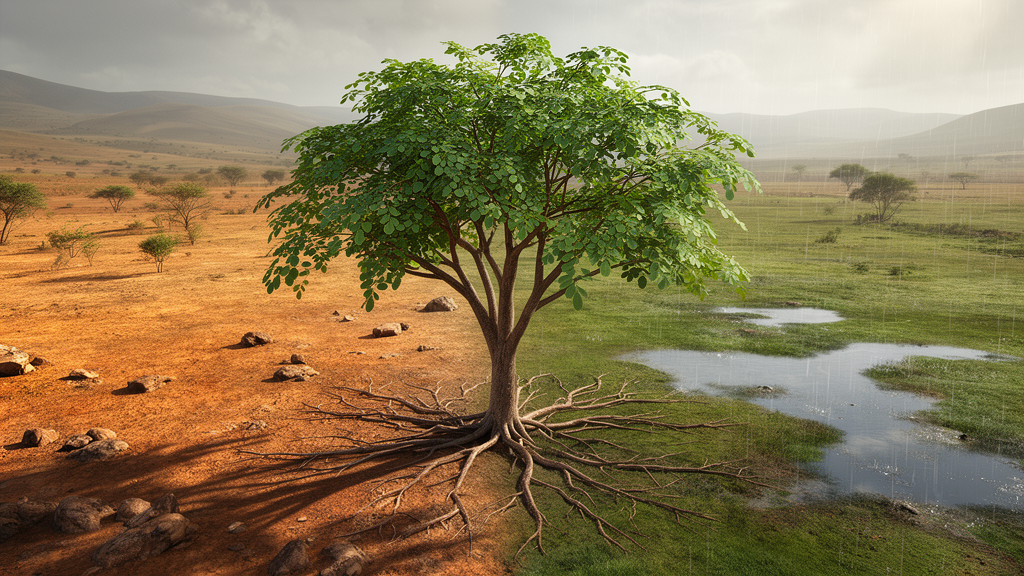
A national ensemble model of climate and soil conditions estimates that suitable habitat for the multipurpose tree Moringa stenopetala in Ethiopia could contract sharply under high greenhouse-gas emissions but expand under a moderate-emissions pathway. The projections identify southern highlands as areas of reduced suitability and parts of the central lowlands, including the Great Ethiopian Rift Valley, as potential zones of newly suitable climate. These are model-based estimates rather than observed changes in tree abundance, and the researchers note that cultivation decisions must also account for land use, management and socioeconomic conditions.

The study, published in BMC Plant Biology, assessed the current and future habitat suitability of M. stenopetala, a species valued for its nutritional, medicinal and socioeconomic uses but still underutilized despite widespread use by communities in southern Ethiopia. Its natural distribution is described as relatively restricted, with the principal range in southern Ethiopia and northern Kenya. The analysis used seven species distribution modelling algorithms: boosted regression trees, random forest, generalized linear model, generalized additive model, maximum entropy, support vector machine and multivariate adaptive regression splines.

These algorithms were combined in an ensemble model and evaluated through five-fold cross-validation. The ensemble achieved a mean area under the curve of 0.97 and a mean true skill statistic of 0.85, measures that indicate strong performance in distinguishing suitable from unsuitable environmental conditions within the modelling framework. Precipitation seasonality, precipitation during the coldest quarter, soil pH and isothermality emerged as the most influential predictors. The results therefore point to both seasonal moisture patterns and soil chemistry, rather than temperature alone, as central variables associated with the modelled distribution of the tree.

Under current climate conditions, the researchers estimated suitable habitat at 40,136.80 square kilometres, equivalent to approximately 3.6% of Ethiopia’s total land area. Future estimates differed markedly among emissions pathways. Under the high-emissions scenario, suitable habitat was projected to decrease to 28,182.45 square kilometres by the 2070s, while the moderate-emissions scenario produced an increase to 44,219.28 square kilometres. The contrasting outcomes show that a single forecast of climate-driven habitat change would obscure the substantial uncertainty associated with future greenhouse-gas emissions.

Spatially, the projections indicated declining suitability across parts of the southern highlands and the emergence of new suitable areas in the central lowlands, particularly within the Great Ethiopian Rift Valley. The authors describe this information as a potential basis for conservation, agroforestry development and climate-informed investment planning because it identifies areas where environmental conditions may remain favorable for M. stenopetala cultivation. The findings are also relevant to proposed uses of the species in agroforestry systems, where implementation could involve food security, rural livelihoods and sustainable land management. However, the modelling results do not by themselves establish improvements in any of those outcomes, nor do they show that trees will naturally migrate into newly suitable areas.

Subject of Research: Climate-driven habitat suitability of Moringa stenopetala in Ethiopia

Article Title: Current and future habitat suitability of Moringa stenopetala (Bak.f.) Cuf. (Moringaceae) in Ethiopia under climate change: implications for agroforestry and investment planning

Article References: Melese, D., Kufa, C. A., & Ahmed, A. S. (2026). Current and future habitat suitability of Moringa stenopetala (Bak.f.) Cuf. (Moringaceae) in Ethiopia under climate change: implications for agroforestry and investment planning. BMC Plant Biology. https://doi.org/10.1186/s12870-026-09798-8

Image Credits: AI Generated

DOI: 10.1186/s12870-026-09798-8

Keywords: Moringa stenopetala, climate change, species distribution modelling, Ethiopia, agroforestry, habitat suitability, emissions scenarios, conservation, Current, future, habitat, suitability

Cite Scienmag News

Sloane Callahan. (October 26, 2026). Ethiopia climate model maps diverging future for Moringa stenopetala. Scienmag. https://scienmag.com/ethiopia-climate-model-maps-diverging-future-for-moringa-stenopetala/

Sloane Callahan. "Ethiopia climate model maps diverging future for Moringa stenopetala." Scienmag, 26 October 2026, https://scienmag.com/ethiopia-climate-model-maps-diverging-future-for-moringa-stenopetala/. Accessed 26 October 2026.

Sloane Callahan. "Ethiopia climate model maps diverging future for Moringa stenopetala." Scienmag. October 26, 2026. https://scienmag.com/ethiopia-climate-model-maps-diverging-future-for-moringa-stenopetala/


Tags: agroforestryclimate and soil condition projections in Ethiopiaclimate changeconservationcurrentemissions scenariosensemble species distribution models for climate impact assessmentEthiopiaEthiopia climate change impact on Moringa stenopetalafuturefuture habitat suitability modeling for multipurpose treesGreat Ethiopian Rift Valley potential new Moringa habitathabitathabitat suitabilityhigh greenhouse gas emissions effects on Ethiopian vegetationland use and socioeconomic factors in climate adaptationmoderate emissions climate scenarios for plant habitat expansionMoringa stenopetalanutritional and medicinal valuesouthern Ethiopian highlands climate suitability declinespecies distribution modellingsuitabilityuse of machine learning algorithms in ecological modeling
Share26Tweet16
Previous Post

Delhi parents describe burnout, stigma and support barriers

Next Post

Research report: Application of case-based scenario simulation teaching in cardiopulmonary resuscitation training for medical and nursing interns

Related Posts

Stacking deep learning reaches 97.2% accuracy for olive disease images
Agriculture

Stacking deep learning reaches 97.2% accuracy for olive disease images

October 26, 2026
Hairy-root perilla yields more shikonin and comparable luteolin
Agriculture

Hairy-root perilla yields more shikonin and comparable luteolin

October 26, 2026
Time-course transcriptomics reveals MeJA-responsive genes in ginseng roots
Agriculture

Time-course transcriptomics reveals MeJA-responsive genes in ginseng roots

October 26, 2026
Metallic nanoparticles and magnetic pellets optimize purslane in green walls
Agriculture

Metallic nanoparticles and magnetic pellets optimize purslane in green walls

October 26, 2026
Melatonin helps Tartary buckwheat tolerate cadmium stress in controlled experiments
Agriculture

Melatonin helps Tartary buckwheat tolerate cadmium stress in controlled experiments

October 26, 2026
Validated reference genes support RT-qPCR in Cuphea hookeriana
Agriculture

Validated reference genes support RT-qPCR in Cuphea hookeriana

October 26, 2026
Next Post
Research report: Application of case-based scenario simulation teaching in cardiopulmonary resuscitation training for medical and nursing interns

Research report: Application of case-based scenario simulation teaching in cardiopulmonary resuscitation training for medical and nursing interns

  • Mothers who receive childcare support from maternal grandparents show more optimized

    Mothers who receive childcare support from maternal grandparents show more parental warmth, finds NTU Singapore study

    27656 shares
    Share 11059 Tweet 6912
  • University of Seville Breaks 120-Year-Old Mystery, Revises a Key Einstein Concept

    1061 shares
    Share 424 Tweet 265
  • Bee body mass, pathogens and local climate influence heat tolerance

    682 shares
    Share 273 Tweet 171
  • Researchers record first-ever images and data of a shark experiencing a boat strike

    546 shares
    Share 218 Tweet 137
  • Groundbreaking Clinical Trial Reveals Lubiprostone Enhances Kidney Function

    531 shares
    Share 212 Tweet 133
Science

Embark on a thrilling journey of discovery with Scienmag.com—your ultimate source for cutting-edge breakthroughs. Immerse yourself in a world where curiosity knows no limits and tomorrow’s possibilities become today’s reality!

RECENT NEWS

  • Alerting Cues Shape Memory Boost in Depression-Prone Students
  • AI pilot reconstructs breast cancer staging logic in low-resource settings
  • Adaptive voxel method sharpens satellite interference localization in noisy conditions
  • Research report: Application of case-based scenario simulation teaching in cardiopulmonary resuscitation training for medical and nursing interns

Categories

  • Agriculture
  • Anthropology
  • Archaeology
  • Athmospheric
  • Biology
  • Biotechnology
  • Blog
  • Bussines
  • Cancer
  • Chemistry
  • Climate
  • Earth Science
  • Editorial Policy
  • Marine
  • Mathematics
  • Medicine
  • Pediatry
  • Policy
  • Psychology & Psychiatry
  • Science Education
  • Science News
  • Social Science
  • Space
  • Technology and Engineering

Subscribe to Blog via Email

Enter your email address to subscribe to this blog and receive notifications of new posts by email.

Join 5,151 other subscribers

© 2025 Scienmag - Science Magazine

Welcome Back!

Login to your account below

Forgotten Password?

Retrieve your password

Please enter your username or email address to reset your password.

Log In
No Result
View All Result
  • HOME
  • SCIENCE NEWS
  • CONTACT US

© 2025 Scienmag - Science Magazine

Discover more from Science

Subscribe now to keep reading and get access to the full archive.

Continue reading