


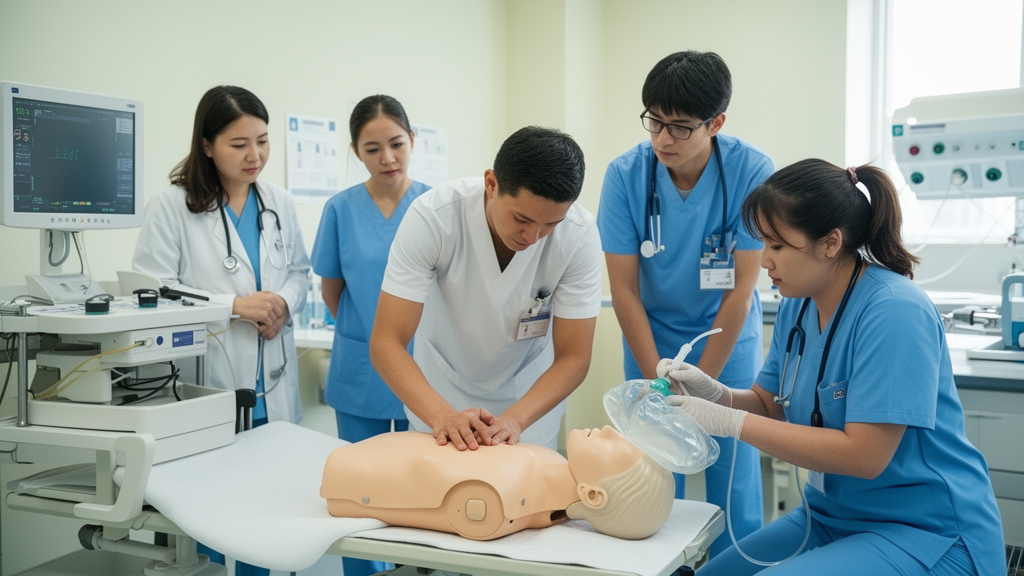
A single-center randomized controlled trial found that medical and nursing interns who received cardiopulmonary resuscitation training through case-based scenario simulation achieved higher theoretical knowledge scores, stronger practical assessment performance and greater satisfaction than peers who received conventional instruction. The study enrolled 69 interns rotating at one hospital from September 2024 to November 2025, assigning 34 to a control group and 35 to an intervention group. Participants were randomly allocated using a random number table, with 35 interns assigned to the intervention group and 34 to the control group.
The intervention used case-based scenario simulation for CPR teaching, while the control group received conventional instruction. The trial was designed to compare the two approaches through theoretical assessments, Mini-CEX scores and questionnaire surveys. Its single-center setting, modest sample and focus on immediate outcomes limit how broadly the results can be generalized to other hospitals, specialties or training environments.
Practical performance was assessed with the Mini-CEX across four reported domains: knowledge mastery, operational skills, clinical judgment and team collaboration. The intervention group scored 7.97 ± 1.04 for knowledge mastery versus 4.82 ± 1.24 in the control group, and 8.00 ± 0.64 for operational skills versus 4.88 ± 1.59. Clinical-judgment scores were 7.91 ± 0.78 versus 4.24 ± 1.30, while team-collaboration scores were 8.14 ± 0.91 versus 4.50 ± 1.10.
Each of these domain comparisons was reported as statistically significant at P < 0.05. Clinical judgment had a reported mean difference of 3.67 points between the groups, with a 95% confidence interval of 3.10 to 4.24 and P < 0.001. Summed across the four Mini-CEX domains, the intervention group obtained a total score of 32.03 ± 2.18, compared with 18.44 ± 2.45 for the control group, with the overall difference reported at P < 0.05.
These measurements show better demonstrated performance under the trial’s assessment conditions. The abstract did not report follow-up testing, retention of CPR skills after the course, or clinical outcomes such as survival after cardiac arrest, so the results cannot establish lasting benefits for patients. Questionnaire responses also showed greater satisfaction among intervention participants with course content, course resources, classroom interaction and teaching methods, with each comparison reaching statistical significance at P < 0.05.
The two groups did not differ significantly in reported learning burden, for which P was greater than 0.05. The trial was registered retrospectively as NCT07803861 on August 27, 2026, and the article was published in BMC Medical Education on September 10, 2026. Overall, the randomized comparison supports the association between case-based scenario simulation and stronger immediate CPR knowledge, higher assessed practical performance and greater learner satisfaction compared with conventional instruction, without a detectable difference in perceived learning burden.
Subject of Research: Immediate cardiopulmonary resuscitation training outcomes for medical and nursing interns
Article Title: Application of case-based scenario simulation teaching in cardiopulmonary resuscitation training for medical and nursing interns
Article References: Xiaoyan, L., Sha, C., Chunna, J., & Li, W. (2026). Application of case-based scenario simulation teaching in cardiopulmonary resuscitation training for medical and nursing interns. BMC Medical Education. https://doi.org/10.1186/s12909-026-10371-y
Image Credits: AI Generated
DOI: 10.1186/s12909-026-10371-y
Keywords: cardiopulmonary resuscitation, simulation training, case-based learning, medical education, nursing education, clinical judgment, teamwork, randomized controlled trial, intern training, practical assessment, Application, case-based
Cite Scienmag News
Courtney Benton. (October 26, 2026). Research report: Application of case-based scenario simulation teaching in cardiopulmonary resuscitation training for medical and nursing interns. Scienmag. https://scienmag.com/research-report-application-of-case-based-scenario-simulation-teaching-in-cardiopulmonary-resuscitation-training-for-medical-and-nursing-interns/
Courtney Benton. "Research report: Application of case-based scenario simulation teaching in cardiopulmonary resuscitation training for medical and nursing interns." Scienmag, 26 October 2026, https://scienmag.com/research-report-application-of-case-based-scenario-simulation-teaching-in-cardiopulmonary-resuscitation-training-for-medical-and-nursing-interns/. Accessed 26 October 2026.
Courtney Benton. "Research report: Application of case-based scenario simulation teaching in cardiopulmonary resuscitation training for medical and nursing interns." Scienmag. October 26, 2026. https://scienmag.com/research-report-application-of-case-based-scenario-simulation-teaching-in-cardiopulmonary-resuscitation-training-for-medical-and-nursing-interns/


