

Monday, October 26, 2026
Science
No Result
View All Result
  • Login
  • HOME
  • SCIENCE NEWS
  • CONTACT US
  • HOME
  • SCIENCE NEWS
  • CONTACT US
No Result
View All Result
Scienmag
No Result
View All Result
Home Science News Science Education

Blended FAST Training Shows Noninferior EMT Performance in Prospective Study

October 26, 2026
in Science Education
Courtney Benton
By Courtney Benton Scienmag Editorial Profile - Science and Technology Policy
Reading Time: 2 mins read
0
Blended FAST Training Shows Noninferior EMT Performance in Prospective Study

Blended FAST Training Shows Noninferior EMT Performance in Prospective Study

65
SHARES
587
VIEWS
Share on FacebookShare on Twitter
ADVERTISEMENT

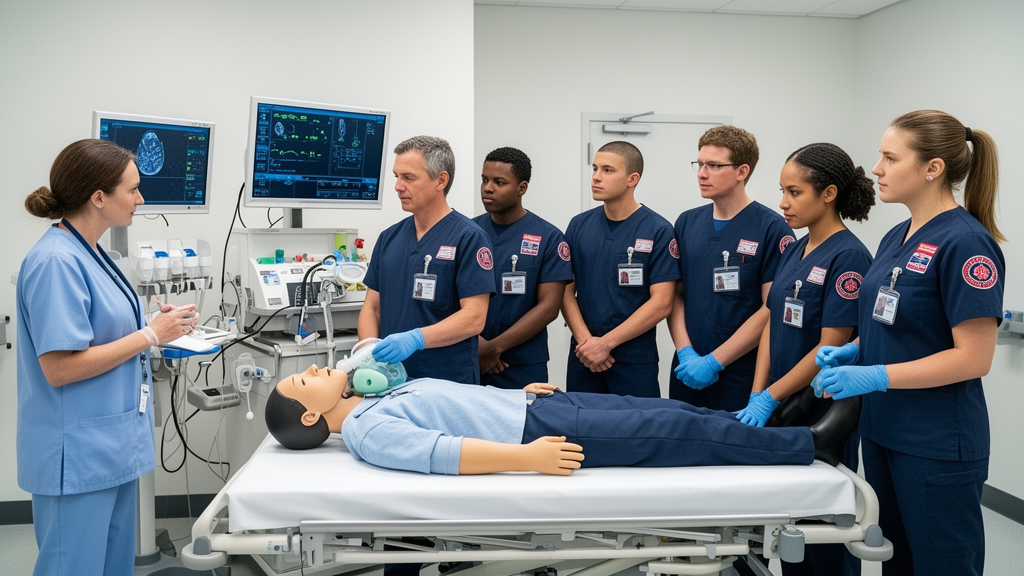
Emergency medical technicians without prior ultrasound certification met a prespecified noninferiority criterion for focused assessment with sonography in trauma, or FAST, image acquisition after a standardized blended training program, compared with junior resident physicians. The prospective observational study included 20 emergency medical technicians and 20 postgraduate year 1 or 2 junior resident physicians who completed the same curriculum. Across four sequential sessions, EMTs’ mean task-specific checklist scores were statistically consistent with the residents’ scores within a prespecified 5-point noninferiority margin, with 95% confidence intervals remaining within that margin and all associated one-sided p-values below 0.001.

The training combined online instruction with brief, practical phantom-based sessions. Investigators evaluated performance using a task-specific checklist and total examination time, with mean checklist score as the primary outcome. The study therefore compared the two groups under one defined training sequence rather than testing whether one teaching format worked better than another. Because the design was prospective and observational, the results describe performance under the tested curriculum and do not establish that the training program caused the observed differences.

Overall noninferiority did not mean that every individual view was scored identically. Residents performed better on the Douglas pouch view, with a reported p-value of 0.002, while scores for the other site-specific views were comparable between the groups. EMTs initially required longer examinations than residents, a difference associated with a reported p-value of 0.003, but their examination times converged by the final session. The analysis also found that EMTs had a significantly more rapid learning curve across the four-session sequence, indicating faster improvement in their measured learning trajectory. These findings are limited to the skills, assessment method, training sessions, and participant groups included in the study.

Questionnaire-based evaluations showed that EMTs reported greater satisfaction and higher self-efficacy regarding the online learning program than residents. Those measures captured participants’ own perceptions of the digital component and are separate from the objectively recorded checklist and timing results. Taken together, the study reports that EMTs achieved FAST image-acquisition performance that met the prespecified noninferiority threshold relative to junior resident physicians following blended online and practical training, while also showing a site-specific advantage for residents and an early timing disadvantage for EMTs that narrowed during the course of training.

Subject of Research: Comparative evaluation of blended FAST ultrasound training for emergency medical technicians and junior resident physicians

Article Title: Effectiveness of blended E-Learning for FAST ultrasound training: a comparative study of emergency medical technicians and junior resident physicians: a prospective observational study

Article References: Kuriyama, C., Ageta, K., Maki, J., Ohira, A., Sakata, S., Mitsuhashi, T., Takasaki, Y., Sakurai, J., Maeda, Y., & Masuyama, H. (2026). Effectiveness of blended E-Learning for FAST ultrasound training: a comparative study of emergency medical technicians and junior resident physicians: a prospective observational study. BMC Medical Education. https://doi.org/10.1186/s12909-026-10313-8

Image Credits: AI Generated

DOI: 10.1186/s12909-026-10313-8

Keywords: FAST ultrasound, blended learning, emergency medical technicians, junior resident physicians, medical education, phantom-based training, image acquisition, noninferiority, prehospital care, Effectiveness, blended, E-Learning

Cite Scienmag News

Courtney Benton. (October 26, 2026). Blended FAST Training Shows Noninferior EMT Performance in Prospective Study. Scienmag. https://scienmag.com/blended-fast-training-shows-noninferior-emt-performance-in-prospective-study/


Courtney Benton. "Blended FAST Training Shows Noninferior EMT Performance in Prospective Study." Scienmag, 26 October 2026, https://scienmag.com/blended-fast-training-shows-noninferior-emt-performance-in-prospective-study/. Accessed 26 October 2026.

Courtney Benton. "Blended FAST Training Shows Noninferior EMT Performance in Prospective Study." Scienmag. October 26, 2026. https://scienmag.com/blended-fast-training-shows-noninferior-emt-performance-in-prospective-study/

Tags: blendedblended education programs for EMS providersblended learninge-learningEffectivenessEmergency medical technician ultrasound trainingemergency medical techniciansEMS training curriculum effectivenessFAST ultrasoundFAST ultrasound proficiency in prehospital careimage acquisitionimpact of training modality on ultrasound performancejunior resident physiciansMedical Educationnoninferioritynoninferiority study of EMT ultrasound skillsonline and practical ultrasound training for first respondersphantom-based trainingphantom-based ultrasound training methodsprehospital careprospective observational studies in EMS educationultrasound competency development for emergency personnelultrasound image acquisition performance comparisonultrasound skill assessment in trauma care
Share26Tweet16
Previous Post

Mouse aging-rate indicators could speed anti-aging drug screening

Next Post

Hepatitis B prevalence reaches 41.9% in Ethiopian chronic liver disease patients

Related Posts

Cross-sectional study finds poor sleep common among medical trainees
Science Education

Cross-sectional study finds poor sleep common among medical trainees

October 26, 2026
Dental students welcome AI but remain wary of diagnosis, privacy and trust
Science Education

Dental students welcome AI but remain wary of diagnosis, privacy and trust

October 26, 2026
Escape-room training linked to airway knowledge and teamwork readiness
Science Education

Escape-room training linked to airway knowledge and teamwork readiness

October 26, 2026
Combined video-selfie and gerontological materials improve nursing skills in Tanzanian students
Science Education

Combined video-selfie and gerontological materials improve nursing skills in Tanzanian students

October 26, 2026
Protected research blocks linked to higher medical student output
Science Education

Protected research blocks linked to higher medical student output

October 26, 2026
UK medical students rate bedside teaching above online seminars
Science Education

UK medical students rate bedside teaching above online seminars

October 26, 2026
Next Post
Hepatitis B prevalence reaches 41.9% in Ethiopian chronic liver disease patients

Hepatitis B prevalence reaches 41.9% in Ethiopian chronic liver disease patients

  • Mothers who receive childcare support from maternal grandparents show more optimized

    Mothers who receive childcare support from maternal grandparents show more parental warmth, finds NTU Singapore study

    27656 shares
    Share 11059 Tweet 6912
  • University of Seville Breaks 120-Year-Old Mystery, Revises a Key Einstein Concept

    1061 shares
    Share 424 Tweet 265
  • Bee body mass, pathogens and local climate influence heat tolerance

    682 shares
    Share 273 Tweet 171
  • Researchers record first-ever images and data of a shark experiencing a boat strike

    546 shares
    Share 218 Tweet 137
  • Groundbreaking Clinical Trial Reveals Lubiprostone Enhances Kidney Function

    531 shares
    Share 212 Tweet 133
Science

Embark on a thrilling journey of discovery with Scienmag.com—your ultimate source for cutting-edge breakthroughs. Immerse yourself in a world where curiosity knows no limits and tomorrow’s possibilities become today’s reality!

RECENT NEWS

  • Deep learning outperforms classical methods for early weed detection
  • Rapid Cooling Can Weaken Ice’s Grip on Conductive Surfaces
  • Hybrid AI model reports strong macro-financial policy classification performance
  • New MRI index maps blood flow to brain cell energy needs

Categories

  • Agriculture
  • Anthropology
  • Archaeology
  • Athmospheric
  • Biology
  • Biotechnology
  • Blog
  • Bussines
  • Cancer
  • Chemistry
  • Climate
  • Earth Science
  • Editorial Policy
  • Marine
  • Mathematics
  • Medicine
  • Pediatry
  • Policy
  • Psychology & Psychiatry
  • Science Education
  • Science News
  • Social Science
  • Space
  • Technology and Engineering

Subscribe to Blog via Email

Enter your email address to subscribe to this blog and receive notifications of new posts by email.

Join 5,151 other subscribers

© 2025 Scienmag - Science Magazine

Welcome Back!

Login to your account below

Forgotten Password?

Retrieve your password

Please enter your username or email address to reset your password.

Log In
No Result
View All Result
  • HOME
  • SCIENCE NEWS
  • CONTACT US

© 2025 Scienmag - Science Magazine

Discover more from Science

Subscribe now to keep reading and get access to the full archive.

Continue reading