


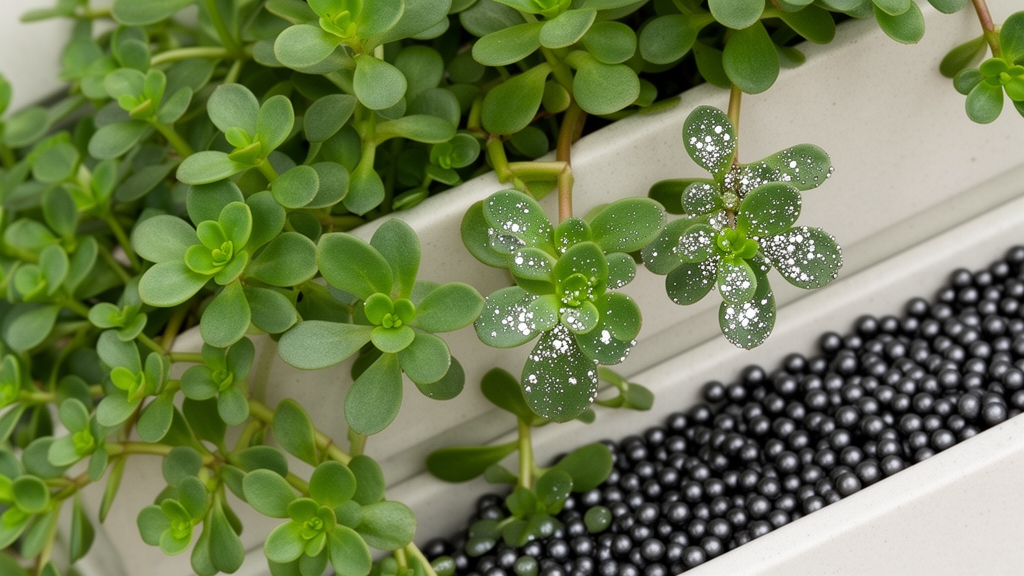
In an outdoor green-wall experiment, metallic nanoparticles and magnetic pellets produced distinct improvements in the growth, biochemical performance, canopy coverage, survival duration and visual quality of Portulaca oleracea L., or purslane. The study compared silver nanoparticles, titanium dioxide nanoparticles, a combined nanoparticle treatment, two levels of magnetic pellets and control conditions. Most evaluated plant traits were significantly influenced by the interaction between the two treatment types.
Researchers assessed the morphophysiological, biochemical and antioxidant responses of purslane grown in an outdoor green wall. The nanoparticle treatments were designated N1 for silver, N2 for titanium dioxide and N3 for the combined application. Magnetic-pellet treatments comprised Level 1, designated M1, and Level 2, designated M2, while M3 was the control pellet condition.
The significant nanoparticle-by-pellet interaction showed that performance depended on the particular pairing rather than only on whether nanoparticles or pellets were present independently. The N1M1 pairing, combining silver nanoparticles with Level 1 magnetic pellets, produced the highest growth index at 25,000 cm³. This was 595% greater than the lowest-performing combination, N3M3, which registered 3,598 cm³.
N3M1, consisting of the combined nanoparticle treatment and Level 1 magnetic pellets, produced the maximum root surface area of 99.27 cm² and the maximum root dry weight of 1.96 g. These were measured outcomes from the outdoor experiment and add an underground component to the comparison among treatment pairs. Proline accumulation provided a contrasting biochemical result.
Silver nanoparticles without magnetic pellets, N1M3, produced the highest proline concentration at 1.60 mg g⁻¹ fresh weight. The authors interpreted this as an emergency adaptive response to nanoparticle-induced stress. When Level 1 magnetic pellets were added to the silver treatment, creating N1M1, proline decreased to 1.40 mg g⁻¹ fresh weight.
The authors associated this change with metabolic energy being redirected toward vegetative growth. TiO₂ nanoparticles paired with Level 1 magnetic pellets produced the most balanced overall vegetative performance. The N2M1 treatment achieved the highest total chlorophyll content at 9.73 μg mg⁻¹, the maximum total biomass of 22.96 g and the highest total soluble-protein content.
It also had the lowest reported malondialdehyde concentration, 0.17 μmol g⁻¹ fresh weight, which the researchers used as an indicator of lipid peroxidation. Thus, N2M1 combined high biomass and chlorophyll measurements with low measured lipid peroxidation, while N1M1 achieved the largest growth index. Other physiological indicators were associated with magnetic-pellet application.
The study reports improved relative water content, reduced electrolyte leakage and optimized activities of superoxide dismutase and guaiacol peroxidase. This result shows that the most prominent biochemical outcome varied among specific treatment pairings. At the plant-canopy level, combined applications markedly improved canopy coverage, survival duration and visual quality compared with the control.
The investigators identified high biomass production, prolonged leaf greenness and delayed cellular senescence as important characteristics in green-wall engineering. Within the conditions tested, the evidence points to N2M1 as the most balanced treatment, combining titanium dioxide nanoparticles with Level 1 magnetic pellets, and N1M1 as the treatment with the highest growth index. The findings are specific to the reported outdoor experiment on purslane and do not by themselves establish how the treatments would perform in other green-wall systems.
The authors nevertheless identified synergistic nanoparticle and magnetic-pellet application as an effective strategy for improving plant health, durability and visual quality in urban vertical green infrastructure.
Subject of Research: Effects of metallic nanoparticles and magnetic pellets on purslane grown in outdoor vertical green walls.
Article Title: Metallic nanoparticles and magnetic pellets synergistically optimize growth, antioxidant defense, and visual quality of Portulaca oleracea L. in urban vertical green walls
Article References: Jozay, M., Tehranifar, A., Berahmand, A., & Feizi, H. (2026). Metallic nanoparticles and magnetic pellets synergistically optimize growth, antioxidant defense, and visual quality of Portulaca oleracea L. in urban vertical green walls. BMC Plant Biology. https://doi.org/10.1186/s12870-026-09794-y
Image Credits: AI Generated
DOI: 10.1186/s12870-026-09794-y
Keywords: purslane, vertical green walls, titanium dioxide nanoparticles, silver nanoparticles, magnetic pellets, plant growth, chlorophyll, antioxidant defense, lipid peroxidation, urban greening, Metallic, nanoparticles
Cite Scienmag News
Alan Morgan. (October 26, 2026). Metallic nanoparticles and magnetic pellets optimize purslane in green walls. Scienmag. https://scienmag.com/metallic-nanoparticles-and-magnetic-pellets-optimize-purslane-in-green-walls/
Alan Morgan. "Metallic nanoparticles and magnetic pellets optimize purslane in green walls." Scienmag, 26 October 2026, https://scienmag.com/metallic-nanoparticles-and-magnetic-pellets-optimize-purslane-in-green-walls/. Accessed 26 October 2026.
Alan Morgan. "Metallic nanoparticles and magnetic pellets optimize purslane in green walls." Scienmag. October 26, 2026. https://scienmag.com/metallic-nanoparticles-and-magnetic-pellets-optimize-purslane-in-green-walls/


