


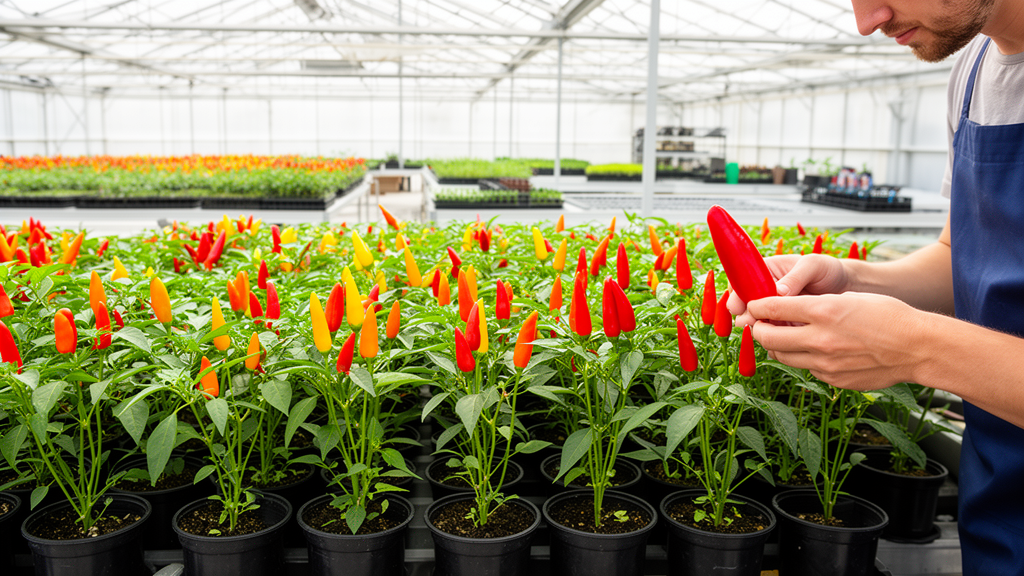
Ornamental cayenne breeding lines can be judged by more than yield: a study of fifth-generation F5 material combined agronomic evaluation with consumer preference testing and identified G25 as the strongest candidate. G25 recorded a fitness-weighted absolute score of 0.78, compared with 0.46 for G13 and 0.44 for Bara, the best check variety. In the separate assessment, G25 also received the highest preference score, 0.75, among six lines recommended for further testing. The findings point to G25 as a promising line for yield-potential evaluation and multi-location trials, while the consumer results remain preliminary.
The experiment compared 25 genotypes selected from the F4 generation with three check varieties, creating 28 combinations per replicate in an alpha-lattice design. Plants were grown in two replicates, with three incomplete blocks in each replicate. Agronomic data were analyzed first with Best Linear Unbiased Prediction, or BLUP, under the alpha-lattice design. Researchers then examined correlations among traits, transformed the correlated traits into family indices and fitness values, and combined principal component analysis with the Weighted Average of Absolute Scores, known as WAAS, to produce an agronomic index for each selected line. This procedure allowed agronomic performance and traits associated with overall fitness to be assessed together rather than treating one measurement as the sole selection criterion.
Four traits were identified as especially important for selection: canopy width, stem diameter, fruit number and yield. Each showed high heritability, a finding the researchers considered important for fitness-WAAS selection because the analysis depended on distinguishing useful differences among the evaluated lines. G25 and G13 produced the strongest fitness-WAAS indices among the selected materials, with G25’s value of 0.78 exceeding G13’s 0.46 and Bara’s 0.44. These figures describe the results of this trial and its statistical analysis; they do not establish that the same ordering will occur in other growing environments or for different plant materials.
Consumer appeal was then assessed by 45 panelists, who evaluated the visual appeal of lines selected through the agronomic analysis. Six lines were recommended when preference performance was expressed relative to the standard deviation of the check variety. G25 ranked first with a preference score of 0.75, followed by five other lines. The panel therefore supplied a separate measure of the visual qualities valued by consumers, complementing rather than replacing the agronomic evaluation. Because this was a single preference assessment conducted with 45 panelists, the study provides an initial indication of which ornamental characteristics were favored, not a definitive description of consumer preferences across wider markets.
Overall, the study offers a systematic breeding framework that integrates field performance with a panel-based judgment of ornamental appeal. The authors recommend that the selected lines be assessed for yield potential and tested across multiple locations through a participatory breeding approach. They also note that further refinement may require metabolomic, transcriptomic and molecular analyses. Those additional analyses were not part of the reported experiment, so the immediate evidence is limited to the alpha-lattice agronomic trial, the WAAS-based ranking and the preliminary visual-preference assessment. Within that scope, G25 performed best in both the reported agronomic index and the consumer ranking, making it the clearest candidate for the next stage of evaluation.
Subject of Research: Agronomic and consumer-preference evaluation of F5 ornamental cayenne breeding lines
Article Title: What makes ornamental cayenne truly desirable? Revealing consumer-preferred traits through agronomic and preference assessment of F5 cayenne breeding lines
Article References: Anshori, M. F., Miftah, N., Farid, M., Azrai, M., Yusniwati, Y., Putri, N. E., Siaga, E., Amier, N., Baharuddin, A. K., Ashar, J. R., Alebidi, A., Ali, N., Seleiman, M. F., & Alenazi, M. M. (2026). What makes ornamental cayenne truly desirable? Revealing consumer-preferred traits through agronomic and preference assessment of F5 cayenne breeding lines. BMC Plant Biology. https://doi.org/10.1186/s12870-026-09879-8
Image Credits: AI Generated
DOI: 10.1186/s12870-026-09879-8
Keywords: ornamental cayenne, pepper breeding, consumer preference, agronomic traits, heritability, fitness-WAAS, alpha-lattice design, F5 breeding lines, visual appeal, crop improvement, makes, ornamental
Cite Scienmag News
Alan Morgan. (October 26, 2026). G25 tops ornamental cayenne lines in agronomic and consumer evaluation. Scienmag. https://scienmag.com/g25-tops-ornamental-cayenne-lines-in-agronomic-and-consumer-evaluation/
Alan Morgan. "G25 tops ornamental cayenne lines in agronomic and consumer evaluation." Scienmag, 26 October 2026, https://scienmag.com/g25-tops-ornamental-cayenne-lines-in-agronomic-and-consumer-evaluation/. Accessed 26 October 2026.
Alan Morgan. "G25 tops ornamental cayenne lines in agronomic and consumer evaluation." Scienmag. October 26, 2026. https://scienmag.com/g25-tops-ornamental-cayenne-lines-in-agronomic-and-consumer-evaluation/


