

Monday, October 26, 2026
Science
No Result
View All Result
  • Login
  • HOME
  • SCIENCE NEWS
  • CONTACT US
  • HOME
  • SCIENCE NEWS
  • CONTACT US
No Result
View All Result
Scienmag
No Result
View All Result
Home Science News Chemistry

One catalyst enables two asymmetric routes to complex molecules

October 26, 2026
in Chemistry
Bethany Barker
By Bethany Barker Scienmag Editorial Profile - Catalysis
Reading Time: 3 mins read
0
One catalyst enables two asymmetric routes to complex molecules

One catalyst enables two asymmetric routes to complex molecules

65
SHARES
587
VIEWS
Share on FacebookShare on Twitter
ADVERTISEMENT

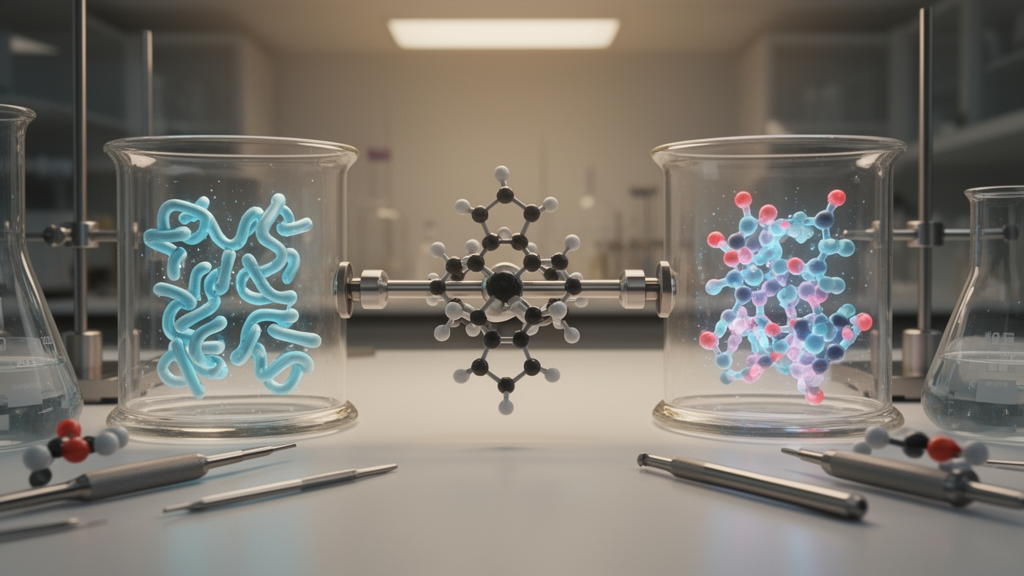
Researchers at Sungkyunkwan University have developed two asymmetric catalytic methods for assembling complex molecules with precise control over reaction sites and three-dimensional structure. Led by chemistry professor Do Hyun Ryu, the team showed that a single chiral organic catalyst can promote two distinct carbon–carbon bond-forming reactions with high selectivity. In a separate study, the researchers designed a reaction that builds tetrahydrofuran rings containing multiple stereocenters from simple starting materials. Both peer-reviewed studies were published in Angewandte Chemie International Edition.

The first method, developed with a team led by Hyunwoo Kim at the Korea Advanced Institute of Science and Technology, provides a unified catalytic platform for asymmetric allylation and Mukaiyama aldol reactions involving 1,2-dicarbonyl compounds. The same chiral catalyst could direct both transformations, including a highly selective asymmetric allylation reaction that had previously been difficult to control. According to the university’s news release, the catalyst selectively activates the intended reaction site while controlling the arrangement of atoms in the resulting chiral products.

Beyond the direct formation of the reaction products, the researchers demonstrated that the resulting compounds could be converted into a variety of further useful molecules. The method was also applied to the synthesis of the biologically active natural product (+)-dimethyl citramalate. Density functional theory calculations supported the proposed explanation for how the catalyst governs both site selectivity and the three-dimensional configuration of the products. These results are laboratory demonstrations of synthetic methodology, rather than evidence that the reactions are ready for scaled pharmaceutical production.

The second study addresses a different challenge: constructing a five-membered ring containing one oxygen atom, known as a tetrahydrofuran, with several stereocenters. Such ring systems are important structural frameworks in many biologically active natural products and pharmaceuticals. Conventional approaches to complex three-dimensional structures often depended on starting materials that already possessed a particular stereochemical arrangement. Ryu’s team instead used a chiral organic catalyst to form multiple stereocenters from simple starting materials without pre-existing stereocenters.

The resulting tetrahydrofuran compounds could be transformed into more complex structures, and the researchers applied the reaction to prepare a synthetic intermediate for (+)-altholactone, a natural product reported to have anticancer activity. That application demonstrates a route to a specific natural-product intermediate; it does not by itself establish anticancer efficacy in humans or constitute a clinical evaluation of a therapeutic candidate. Together, the two studies show how catalyst design can alter which bonds form and how molecular architecture develops during synthesis.

The broader significance lies in the strategy of controlling several stereochemical features at once, a persistent difficulty in organic synthesis. The first platform emphasizes reuse of one catalyst across two different reaction classes, while the second emphasizes assembling a stereochemically rich ring from comparatively simple inputs. The research was supported by National Research Foundation of Korea and Korea Basic Science Institute grants funded by Korean government ministries. Ryu said the approaches may be extended to a wider range of asymmetric reactions, although that expansion remains a prospect rather than a demonstrated result of the studies.

Subject of Research: Development of chiral organocatalysts for highly selective asymmetric synthesis of complex molecules

Article Title: SKKU developing new asymmetric catalytic reactions for the synthesis of complex molecules

Article References: SKKU developing new asymmetric catalytic reactions for the synthesis of complex molecules. Original publication (Bibliographic details unavailable.)

Image Credits: AI Generated

DOI: Not provided

Keywords: asymmetric synthesis, chiral organocatalysis, carbon–carbon bonds, stereocenters, tetrahydrofuran rings, allylation reactions, aldol reactions, natural products, density functional theory, Sungkyunkwan University, SKKU, developing

Cite Scienmag News

Bethany Barker. (October 26, 2026). One catalyst enables two asymmetric routes to complex molecules. Scienmag. https://scienmag.com/one-catalyst-enables-two-asymmetric-routes-to-complex-molecules/

Bethany Barker. "One catalyst enables two asymmetric routes to complex molecules." Scienmag, 26 October 2026, https://scienmag.com/one-catalyst-enables-two-asymmetric-routes-to-complex-molecules/. Accessed 26 October 2026.

Bethany Barker. "One catalyst enables two asymmetric routes to complex molecules." Scienmag. October 26, 2026. https://scienmag.com/one-catalyst-enables-two-asymmetric-routes-to-complex-molecules/


Tags: aldol reactionsallylation reactionsapplicationasymmetric allylation and Mukaiyama aldol reactionsasymmetric catalysis for complex molecule synthesisasymmetric synthesiscarbon–carbon bondschiral organic catalysts for selective carbon–carbon bond formationchiral organocatalysiscontrol of three-dimensional molecular structures in synthesisdensity functional theoryDevelopingdevelopment of unified catalytic platforms for multiple reactionsdual asymmetric reaction pathways using a single catalystnatural product synthesis using asymmetric catalysisnatural productssite-selective catalysis in complex molecule assemblySKKUstereocentersstereocontrolled tetrahydrofuran ring constructionSungkyunkwan Universitysynthesis of stereocenters in organic chemistrytetrahydrofuran rings
Share26Tweet16
Previous Post

Multimodal AI security systems promise smarter, more private smart homes

Next Post

Tin Diselenide Injects Charge Into Two Types of Ultrathin Semiconductors

Related Posts

Researchers Create First Three-Dimensional Carbon Allotrope
Chemistry

Researchers Create First Three-Dimensional Carbon Allotrope

October 26, 2026
Tin Diselenide Injects Charge Into Two Types of Ultrathin Semiconductors
Chemistry

Tin Diselenide Injects Charge Into Two Types of Ultrathin Semiconductors

October 26, 2026
Primordial black holes challenge assumptions about natural dark matter models
Chemistry

Primordial black holes challenge assumptions about natural dark matter models

October 26, 2026
Tiny piezoelectric mirror steers and refocuses light at microsecond speeds
Chemistry

Tiny piezoelectric mirror steers and refocuses light at microsecond speeds

October 26, 2026
Rapid Cooling Can Weaken Ice’s Grip on Conductive Surfaces
Chemistry

Rapid Cooling Can Weaken Ice’s Grip on Conductive Surfaces

October 26, 2026
New MRI index maps blood flow to brain cell energy needs
Chemistry

New MRI index maps blood flow to brain cell energy needs

October 26, 2026
Next Post
Tin Diselenide Injects Charge Into Two Types of Ultrathin Semiconductors

Tin Diselenide Injects Charge Into Two Types of Ultrathin Semiconductors

  • Mothers who receive childcare support from maternal grandparents show more optimized

    Mothers who receive childcare support from maternal grandparents show more parental warmth, finds NTU Singapore study

    27656 shares
    Share 11059 Tweet 6912
  • University of Seville Breaks 120-Year-Old Mystery, Revises a Key Einstein Concept

    1061 shares
    Share 424 Tweet 265
  • Bee body mass, pathogens and local climate influence heat tolerance

    682 shares
    Share 273 Tweet 171
  • Researchers record first-ever images and data of a shark experiencing a boat strike

    546 shares
    Share 218 Tweet 137
  • Groundbreaking Clinical Trial Reveals Lubiprostone Enhances Kidney Function

    531 shares
    Share 212 Tweet 133
Science

Embark on a thrilling journey of discovery with Scienmag.com—your ultimate source for cutting-edge breakthroughs. Immerse yourself in a world where curiosity knows no limits and tomorrow’s possibilities become today’s reality!

RECENT NEWS

  • Researchers Create First Three-Dimensional Carbon Allotrope
  • Review maps planned behaviour research in household waste management
  • Stacking deep learning reaches 97.2% accuracy for olive disease images
  • Scoping review links international health education partnerships to varied outcomes

Categories

  • Agriculture
  • Anthropology
  • Archaeology
  • Athmospheric
  • Biology
  • Biotechnology
  • Blog
  • Bussines
  • Cancer
  • Chemistry
  • Climate
  • Earth Science
  • Editorial Policy
  • Marine
  • Mathematics
  • Medicine
  • Pediatry
  • Policy
  • Psychology & Psychiatry
  • Science Education
  • Science News
  • Social Science
  • Space
  • Technology and Engineering

Subscribe to Blog via Email

Enter your email address to subscribe to this blog and receive notifications of new posts by email.

Join 5,151 other subscribers

© 2025 Scienmag - Science Magazine

Welcome Back!

Login to your account below

Forgotten Password?

Retrieve your password

Please enter your username or email address to reset your password.

Log In
No Result
View All Result
  • HOME
  • SCIENCE NEWS
  • CONTACT US

© 2025 Scienmag - Science Magazine

Discover more from Science

Subscribe now to keep reading and get access to the full archive.

Continue reading