


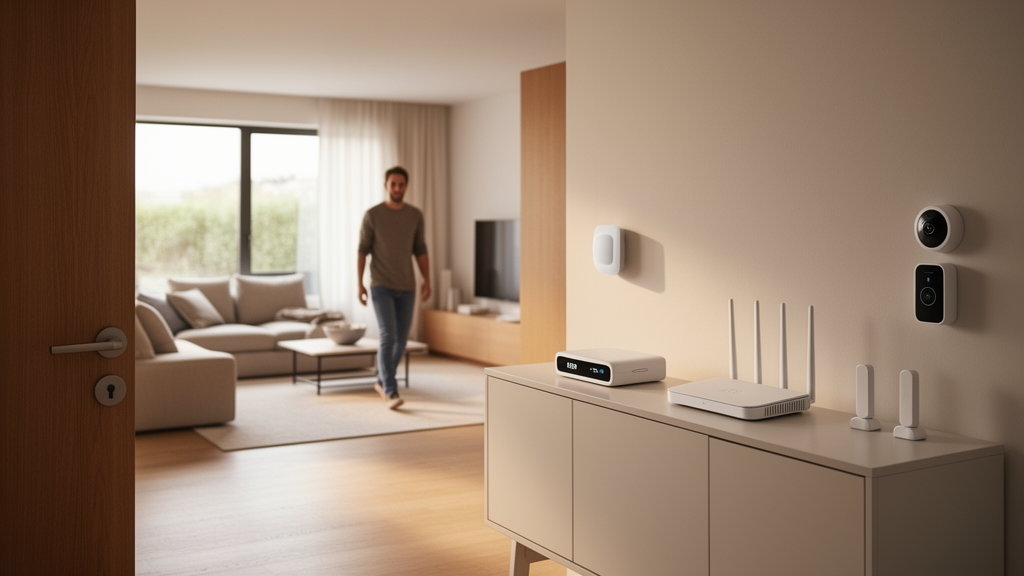
A systematic review of 87 studies finds that AI-powered smart home security has advanced rapidly across sensors, machine learning and edge computing, but the pieces still operate more like disconnected instruments than a unified system. Researchers identified five persistent gaps: multimodal fusion, continual adaptation, on-device inference, privacy protection and explainability are rarely optimized together, limiting how reliably today’s systems could handle changing household behavior, failed sensors and adversarial interference in real homes.
The review, published in 2026, synthesized research from January 2018 through March 2026 across IEEE Xplore, Scopus, Web of Science, ScienceDirect and Google Scholar. It examined 10 sensing modalities, including RGB and thermal cameras, passive infrared sensors, millimeter-wave radar, WiFi Channel State Information, acoustics, smart locks, wearables and environmental monitors. The authors also appraised fusion methods, adaptive-learning mechanisms, resource-constrained edge hardware, privacy techniques and associated cybersecurity risks. Of 326 records initially identified, 87 studies were retained for analysis, with 2023 and 2024 accounting for nearly 43.7% of the corpus.
The central technical idea is that no single sensor can reliably describe what is happening inside a residence. RGB cameras offer rich visual detail but depend on lighting and can expose intimate activity, while thermal cameras work in poor light but cost more and have limited spatial resolution. Passive infrared sensors are inexpensive and energy efficient, yet they cannot distinguish people from pets and may respond to environmental changes. Millimeter-wave radar can detect presence, small movements, respiration and falls even in darkness, smoke or partial occlusion, although signal processing and hardware costs remain barriers. WiFi sensing can infer occupancy and activity without a wearable, but its accuracy depends on room layout, antenna placement and calibration. Acoustic detectors can reveal breaking glass or forced entry, while microphones are vulnerable to background noise and continuous audio monitoring carries obvious privacy costs.
The review classified fusion approaches as early, late, hybrid, attention-based and transformer-based. Early fusion combines sensor features before learning and can capture fine relationships between streams, but it is fragile when one input is missing. Late fusion combines separate model outputs and can continue operating when a sensor fails, although it discards some interactions between modalities. Hybrid systems combine feature- and decision-level integration, while attention mechanisms dynamically weight whichever sources are most informative under current conditions. The review reported that hybrid and attention-based methods consistently performed better than single-stage approaches in the studies it assessed, although many of those experiments used human activity recognition datasets rather than security-specific events.
Transformer models offer another route to combining video frames, audio, radar, WiFi measurements, access logs and environmental readings while modeling long-range temporal and cross-modal dependencies. In one study reviewed, a hybrid CNN-RNN-Transformer architecture for cyber-physical threat detection achieved an area under the curve of 0.96 and an end-to-end inference latency of 23 milliseconds on edge hardware. Transformer-based WiFi and wearable fusion also improved multi-user activity recognition over convolutional and recurrent baselines. These results show promise rather than general proof of residential effectiveness: self-attention becomes more computationally demanding as sequence length grows, large annotated datasets remain scarce, and full-size transformers can exceed the budgets of embedded home devices.
Adaptive systems attempt to keep pace with households whose routines, occupants and surroundings change. Context-aware models combine events with time, location, device status and resident behavior, while anomaly detectors identify activity that departs from learned patterns. Continual and online learning can incorporate new observations without complete retraining, and personalized models can learn household-specific thresholds and routines. One reviewed study using temporal and spatial context reported a 23.4% reduction in false alarms relative to context-free baselines, again in a residential activity-recognition dataset. Such results may not transfer directly to intrusion detection, where the target is rare and adversarial. Continual updates also create a vulnerability: if an attacker can manipulate incoming sensor data, the system may gradually learn to treat an intrusion as normal behavior.
Edge AI addresses latency, connectivity and data exposure by preprocessing signals, extracting features and generating threat assessments on gateways, embedded processors, smart cameras or other local hardware. Only compact features, model updates or selected event records need be synchronized with cloud services, which can continue to support longer-term analytics and distributed model management. Quantization, pruning, knowledge distillation, compact transformer designs and TinyML frameworks can reduce memory, energy and bandwidth demands. The challenge is that compression may produce larger accuracy losses when a model encounters a residential environment unlike its training data. Standardized benchmarks that jointly measure detection performance, latency, energy use, privacy and robustness to missing sensors are also lacking, making comparisons across studies difficult.
Privacy is especially difficult because combining modest data streams can reveal more than any one stream alone. Video, audio, occupancy patterns, access histories and physiological signals may expose relationships, routines or health conditions. The review highlighted federated learning, which shares model updates rather than raw household data; differential privacy, which adds calibrated noise to updates or queries; homomorphic encryption, which permits computation on encrypted information; secure multiparty computation; trusted hardware; and local processing. Yet the literature’s thematic coverage was uneven: sensing appeared in 89% of studies, multimodal fusion in 52%, edge deployment in 41% and adaptive learning in 34%, while privacy appeared in 28% and explainability in just 18%. Most privacy methods were assessed mainly on unimodal systems, leaving risks caused by correlations among multiple modalities insufficiently characterized.
The security weaknesses are equally interconnected. Connected locks, cameras and sensors create entry points for attackers, while default credentials and missing automatic updates leave devices vulnerable. Adversarial examples can cause models to misclassify crafted visual, acoustic or time-series inputs, and coordinated spoofing may produce plausible but physically impossible readings across several sensors. Physical consistency checks offer one potential defense: genuine human presence should leave related signatures in radar, motion and wireless data. Explainability methods such as SHAP and LIME can also show which inputs drove an alert, while adversarially gated updates can attempt to prevent suspicious observations from corrupting adaptive models. None is yet a complete solution, particularly when attackers can influence several sensors at once or when legitimate behavioral change resembles manipulation.
The review’s proposed destination is a unified architecture in which synchronized and privacy-aware sensor data feed dynamically weighted fusion, continual learning and edge inference together. Important components include cross-modal imputation and modality-dropout training for failed sensors, adversarial robustness for both inputs and learning updates, federated personalization across homes, and compact foundation models that can adapt without centralizing sensitive records. Digital twins could generate controlled synthetic data for rare intrusions and combined failure scenarios, while longer longitudinal datasets could capture seasonal routines and changes in household composition. Human-centered design remains essential: residents need understandable alerts, ways to challenge automated decisions and control over data collection. The evidence supports a direction for smarter and potentially more private homes, but not a finished security product. The central conclusion is that the next breakthrough lies not in a more elaborate single sensor or model, but in integrating perception, adaptation, privacy, local computation and human oversight into one trustworthy system.
Subject of Research: AI-powered smart home security combining multimodal sensor fusion, edge intelligence, adaptive learning and privacy-preserving computation
Article Title: A systematic review of AI powered adaptive smart home security using multimodal sensor fusion edge intelligence and privacy preserving architectures
Article References: Lazrak, Z., Bouayad, A., & Boumaiz, M. (2026). A systematic review of AI powered adaptive smart home security using multimodal sensor fusion edge intelligence and privacy preserving architectures. Discover Artificial Intelligence, 6(1), Article 1097. https://doi.org/10.1007/s44163-026-02157-4
Image Credits: AI Generated
DOI: 10.1007/s44163-026-02157-4
Keywords: smart home security, multimodal sensor fusion, edge AI, adaptive learning, privacy-preserving AI, transformer models, WiFi sensing, millimeter-wave radar, anomaly detection, federated learning, systematic, review
Cite Scienmag News
Denise Maddox. (October 26, 2026). Multimodal AI security systems promise smarter, more private smart homes. Scienmag. https://scienmag.com/multimodal-ai-security-systems-promise-smarter-more-private-smart-homes/
Denise Maddox. "Multimodal AI security systems promise smarter, more private smart homes." Scienmag, 26 October 2026, https://scienmag.com/multimodal-ai-security-systems-promise-smarter-more-private-smart-homes/. Accessed 26 October 2026.
Denise Maddox. "Multimodal AI security systems promise smarter, more private smart homes." Scienmag. October 26, 2026. https://scienmag.com/multimodal-ai-security-systems-promise-smarter-more-private-smart-homes/


