


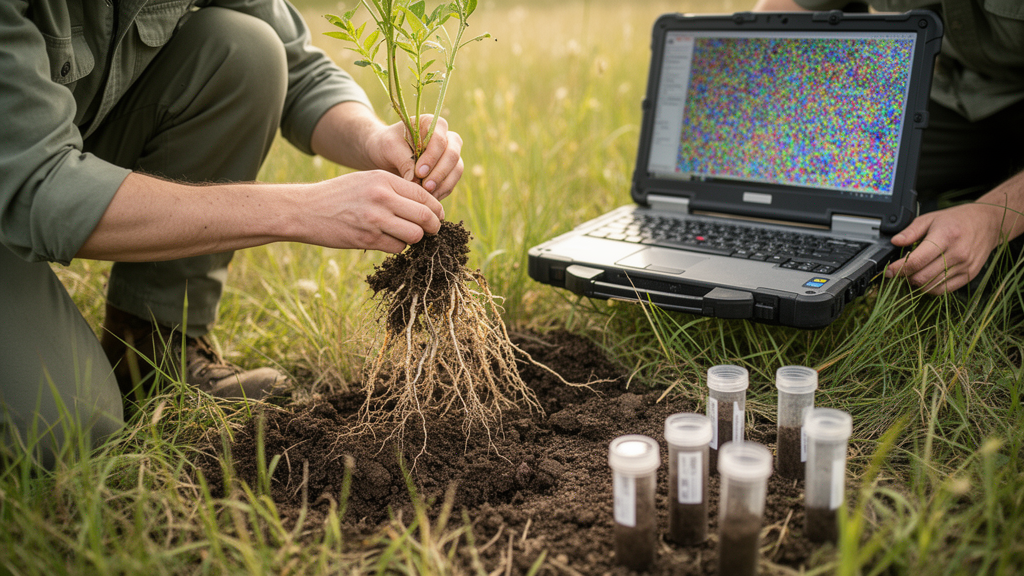
A systematic review and meta-analysis finds that artificial intelligence can quantify and predict mycorrhizal colonization in seedlings and afforestation systems, but most of the evidence comes from controlled laboratory or greenhouse settings rather than operational fields. The authors examined 33 peer-reviewed articles and one preprint, finding strong performance from convolutional neural networks and Mask R-CNN for analyzing digital root images, as well as useful predictive results from models combining plant, soil and environmental variables. Yet only 26.5% of the studies reported external validation, indicating that the models’ ability to transfer across laboratories, nurseries and ecosystems remains largely untested.
Mycorrhizal fungi form associations with plant roots and can improve nutrient acquisition, soil functioning and ecosystem resilience. In arbuscular mycorrhizal symbiosis, plants supply carbon compounds to fungal partners, while fungal hyphae extend the effective root zone and facilitate the movement of nutrients and water. The abundance and distribution of fungal structures inside roots may help indicate the extent of the association, making accurate colonization measurements important in seedling production, agriculture and afforestation. Estimating colonization poorly can complicate inoculation plans and management decisions, which is why automated, scalable assessment has become a priority for applied ecology.
Conventional measurements generally depend on microscopy, sometimes supported by molecular assays such as quantitative PCR and reverse-transcription quantitative PCR. Cleared and stained roots are examined for structures including arbuscules, vesicles and hyphae, with gridline-intersect methods used to calculate colonization scores. Although these approaches provide essential biological information, they can be destructive, labor-intensive and slow. They also usually sample only a small part of a root system at a single time point, making it difficult to capture spatial distribution, arbuscule turnover or responses to environmental stress. Differences among trained observers assessing the same samples have also exceeded 20% in some comparisons.
Deep learning offers a different route by treating root colonization as a pattern-recognition problem. Convolutional neural networks can identify fungal structures in image collections, while Mask R-CNN extends this capability by assigning boundaries to objects, allowing measurements of the size, shape and spatial arrangement of arbuscules, vesicles and hyphae. Across controlled datasets, reported coefficients of determination for these architectures reached 0.82–0.98, indicating strong agreement with manual scores under the conditions in which they were developed. One Mask R-CNN analysis of sorghum roots reconstructed colonization-related signals associated with more than 95% of the explained variation, but explained variation is not identical to absolute detection accuracy and does not guarantee performance in unfamiliar environments.
Frameworks such as AMFinder illustrate the potential for automated microscopy. The system can recognize different colonization structures across plant species and may detect subtle morphological or genetic differences overlooked by manual protocols. MycorrhizaFinder, in turn, used transfer learning to adapt to new image types with relatively few additional training examples. These developments could increase throughput and improve consistency, particularly when large collections of high-quality images are available. Their success nevertheless depends on training data that reflect the staining quality, root morphology, lighting and debris encountered outside the laboratory. Models trained on idealized images may perform less reliably on variable nursery, agricultural or forest samples, where image quality is less consistent.
Image analysis is only one part of the emerging field. Feature-based machine-learning models combine plant characteristics, soil chemistry, management practices and environmental conditions to predict colonization and identify its likely drivers. A Random Forest model applied to a medicinal plant reportedly achieved about 85% predictive accuracy, with root surface area and soil phosphorus identified as important predictors. Other work using gradient boosting distinguished colonized from non-colonized roots and examined patterns in gene expression. Such models can process multidimensional variables, including pH, fertilization, rainfall and microbial-community composition, and may reveal relationships that are difficult to identify through conventional statistical analysis alone.
Hybrid systems represent the review’s most developed technical direction. In these models, a deep-learning component extracts detailed features from root images, and those features are then incorporated into statistical or machine-learning models alongside soil, climate and experimental variables. This arrangement can link visible fungal architecture to predicted colonization and plant performance while retaining more biological interpretability than an image score by itself. Reported fits for some systems exceed 90% or explain more than 95% of observed variation, but the numerical results are not directly interchangeable because studies use different outcomes and evaluation measures. Performance therefore cannot be ranked from headline percentages alone; data quality, validation design and biological relevance also determine how useful a model is.
The review identifies a substantial field-validation gap. Internal validation appeared in 14 of the 34 studies, or 41.2%, and another three studies, or 8.8%, performed field or greenhouse validation of internally tested models. Eight studies, representing 23.5%, reported external validation using independent, benchmark or cross-regional data, while two studies, or 5.9%, used external databases without model validation. The remaining seven studies, or 20.6%, were reviews, conceptual analyses or database-oriented efforts without formal predictive validation. These figures show that controlled-environment performance dominates the literature, whereas cross-ecosystem testing and independent field evaluation are comparatively uncommon.
Research is nevertheless expanding beyond close-up root images. Models are beginning to integrate genetic markers, root architecture, soil chemistry, microbiome composition, climatic variables and information about inoculant viability to estimate colonization under local conditions. Global resources such as FungalRoot and MycoDB, together with open image collections, offer opportunities to train systems on broader environmental variation. At landscape scale, airborne sensors and machine learning have distinguished arbuscular- from ectomycorrhizal trees with more than 90% success in an analysis of canopy data from more than 112,000 trees in Hawaii. This approach inferred below-ground associations from spectral patterns rather than directly imaging roots, but it could help map where different mycorrhizal types occur.
For seedling production and afforestation, the immediate prospects are therefore promising but conditional. AI-assisted image analysis could speed colonization scoring and make assessments more reproducible, while models integrating environmental information could support site-specific decisions about inoculation and management. Most current systems nevertheless analyze static images, so they cannot directly follow root growth, hyphal expansion or arbuscule turnover. The review identifies standardized imaging and annotation protocols, larger and more diverse datasets, temporal models, multi-site field trials and external validation as priorities. With those advances, AI is more likely to complement microscopy and molecular methods than replace them, providing faster and more consistent measurement while biological validation remains essential for reliable use in forestry, agriculture and ecosystem restoration.
Subject of Research: Artificial intelligence for measuring and predicting mycorrhizal colonization in plants
Article Title: Artificial intelligence-based prediction for mycorrhizal colonization efficiency in seedlings and afforestation systems: a systematic review and meta-analysis
Article References: Habtemariam, A. A., Menelih, A., & Beletew, D. (2026). Artificial intelligence-based prediction for mycorrhizal colonization efficiency in seedlings and afforestation systems: a systematic review and meta-analysis. Discover Artificial Intelligence, 6(1), Article 1106. https://doi.org/10.1007/s44163-026-02177-0
Image Credits: AI Generated
DOI: 10.1007/s44163-026-02177-0
Keywords: artificial intelligence, mycorrhizal fungi, root colonization, deep learning, seedling production, afforestation, image analysis, field validation, machine learning, ecosystem restoration, Artificial, intelligence-based
Cite Scienmag News
Blake Davidson. (October 26, 2026). AI predicts mycorrhizal colonization, but field validation lags. Scienmag. https://scienmag.com/ai-predicts-mycorrhizal-colonization-but-field-validation-lags/
Blake Davidson. "AI predicts mycorrhizal colonization, but field validation lags." Scienmag, 26 October 2026, https://scienmag.com/ai-predicts-mycorrhizal-colonization-but-field-validation-lags/. Accessed 26 October 2026.
Blake Davidson. "AI predicts mycorrhizal colonization, but field validation lags." Scienmag. October 26, 2026. https://scienmag.com/ai-predicts-mycorrhizal-colonization-but-field-validation-lags/


