

Monday, October 26, 2026
Science
No Result
View All Result
  • Login
  • HOME
  • SCIENCE NEWS
  • CONTACT US
  • HOME
  • SCIENCE NEWS
  • CONTACT US
No Result
View All Result
Scienmag
No Result
View All Result
Home Science News Technology and Engineering

Vision decline linked with greater coronary event risk in older adults

October 26, 2026
in Technology and Engineering
Beatrice Stafford
By Beatrice Stafford Scienmag Editorial Profile - Chronobiology
Reading Time: 2 mins read
0
Vision decline linked with greater coronary event risk in older adults

Vision decline linked with greater coronary event risk in older adults

65
SHARES
587
VIEWS
Share on FacebookShare on Twitter
ADVERTISEMENT

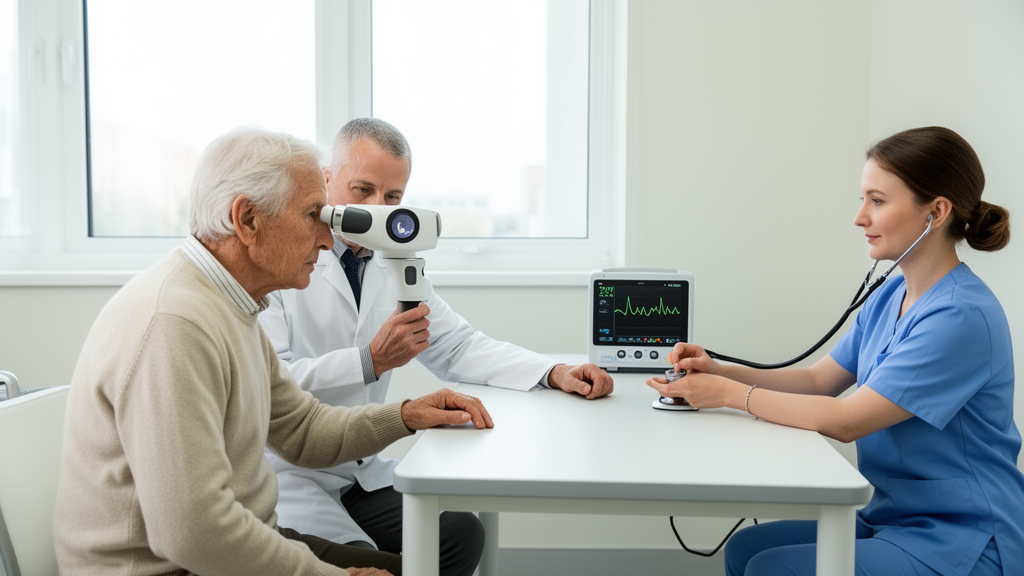
In a prospective study of 6,906 adults aged 50 or older, poorer self-reported vision and worsening vision during follow-up were associated with a higher subsequent risk of coronary heart disease. Participants with vision impairment at the study’s baseline had a 40% higher risk of an incident coronary event, while those whose vision deteriorated between two assessment waves had a 55% higher subsequent risk. These findings describe an association, not proof that vision loss causes coronary disease.

Researchers used data from the English Longitudinal Study of Ageing collected between 2004 and 2023. The analysis examined baseline self-reported vision and changes in vision between Waves 2 and 3 in relation to incident coronary heart disease. During a median follow-up of 12 years, the study identified 502 coronary events among the 6,906 participants. The long observation period allowed investigators to compare participants’ initial and changing vision status with coronary events occurring later.

The statistical results showed a graded relationship between measured vision and risk. Compared with participants without baseline vision impairment, those classified as impaired had a hazard ratio of 1.40 for coronary heart disease, with a 95% confidence interval of 1.08–1.80. A deterioration in vision between the two assessment waves was associated with a hazard ratio of 1.55, with a 95% confidence interval of 1.12–2.15. Each one-point increase in mean vision score corresponded to a 21% lower estimated risk, represented by a hazard ratio of 0.79 and a 95% confidence interval of 0.69–0.90. Because the cohort study relied on self-reported vision and observational data, factors other than vision could contribute to the observed relationships.

The researchers also conducted exploratory mediation analyses to determine whether depressive symptoms statistically explained part of the link between baseline vision impairment and coronary events. The results suggested that depressive symptoms accounted for only a modest proportion of the baseline vision impairment–coronary heart disease association. This does not mean that depression itself was established as a cause of coronary events, nor does it rule out psychological or other shared factors. The finding instead indicates that changes in mood alone were unlikely to account for the full relationship observed between poorer vision and later cardiovascular risk.

Overall, the study suggests that worsening perceived vision may be a marker of broader vulnerability in later life. A person reporting reduced sight or experiencing a decline in vision may be more likely to face subsequent cardiovascular risk than a peer with better and stable vision, although the analysis cannot establish the mechanism or show that improving vision would prevent coronary disease. The research was published as an accepted, open-access article in Scientific Reports and is subject to further edits before the final version of record.

Subject of Research: Associations of self-reported vision impairment and decline with incident coronary heart disease in older adults

Article Title: Vision impairment, depressive symptoms, and risk of incident coronary events: a prospective cohort study

Article References: Liu, Y., Ling, J., Sun, G., Yu, F., & Zhu, J. (2026). Vision impairment, depressive symptoms, and risk of incident coronary events: a prospective cohort study. Scientific Reports. https://doi.org/10.1038/s41598-026-75981-4

Image Credits: AI Generated

DOI: 10.1038/s41598-026-75981-4

Keywords: vision impairment, coronary heart disease, older adults, depressive symptoms, prospective cohort, cardiovascular risk, English Longitudinal Study of Ageing, vision decline, statistical mediation, Vision, impairment, depressive

Cite Scienmag News

Beatrice Stafford. (October 26, 2026). Vision decline linked with greater coronary event risk in older adults. Scienmag. https://scienmag.com/vision-decline-linked-with-greater-coronary-event-risk-in-older-adults/

Beatrice Stafford. "Vision decline linked with greater coronary event risk in older adults." Scienmag, 26 October 2026, https://scienmag.com/vision-decline-linked-with-greater-coronary-event-risk-in-older-adults/. Accessed 26 October 2026.

Beatrice Stafford. "Vision decline linked with greater coronary event risk in older adults." Scienmag. October 26, 2026. https://scienmag.com/vision-decline-linked-with-greater-coronary-event-risk-in-older-adults/


Tags: aging and eye healthaging population health risksassociation between vision loss and coronary eventscardiovascular riskcoronary heart diseasecoronary heart disease risk factorsdepressivedepressive symptomsEnglish Longitudinal Study of Ageingimpact of visual health on cardiovascular riskimpairmentlong-term health outcomes in older adultslongitudinal study on vision and heart diseaseolder adultsprospective aging health researchprospective cohortself-reported vision impairmentstatistical mediationvisionvision declinevision decline in older adultsvision deterioration and cardiovascular riskvision impairment
Share26Tweet16
Previous Post

Cross-sectional Toronto study links mental health, housing to substance outcomes

Next Post

Pediatric glioma proteogenomics identifies age-linked targets, not therapies

Related Posts

Supervised meta-model improves human alignment of Arabic AI explanations
Technology and Engineering

Supervised meta-model improves human alignment of Arabic AI explanations

October 26, 2026
Pyramid vision transformer cuts attention cost and boosts image classification
Technology and Engineering

Pyramid vision transformer cuts attention cost and boosts image classification

October 26, 2026
Fuzzy autoencoder improves containment of adversarial malware
Technology and Engineering

Fuzzy autoencoder improves containment of adversarial malware

October 26, 2026
Causal AI improves cross-domain dance scoring in 125-dancer study
Technology and Engineering

Causal AI improves cross-domain dance scoring in 125-dancer study

October 26, 2026
Attention pooling trims batch-one GPU memory by 62% in transformer hashing
Technology and Engineering

Attention pooling trims batch-one GPU memory by 62% in transformer hashing

October 26, 2026
Chicago taxi-demand model reports higher spatial equity with modest accuracy cost
Technology and Engineering

Chicago taxi-demand model reports higher spatial equity with modest accuracy cost

October 26, 2026
Next Post
Pediatric glioma proteogenomics identifies age-linked targets, not therapies

Pediatric glioma proteogenomics identifies age-linked targets, not therapies

  • Mothers who receive childcare support from maternal grandparents show more optimized

    Mothers who receive childcare support from maternal grandparents show more parental warmth, finds NTU Singapore study

    27656 shares
    Share 11059 Tweet 6912
  • University of Seville Breaks 120-Year-Old Mystery, Revises a Key Einstein Concept

    1061 shares
    Share 424 Tweet 265
  • Bee body mass, pathogens and local climate influence heat tolerance

    682 shares
    Share 273 Tweet 171
  • Researchers record first-ever images and data of a shark experiencing a boat strike

    546 shares
    Share 218 Tweet 137
  • Groundbreaking Clinical Trial Reveals Lubiprostone Enhances Kidney Function

    531 shares
    Share 212 Tweet 133
Science

Embark on a thrilling journey of discovery with Scienmag.com—your ultimate source for cutting-edge breakthroughs. Immerse yourself in a world where curiosity knows no limits and tomorrow’s possibilities become today’s reality!

RECENT NEWS

  • TALIS multilevel study links teacher and school factors to innovativeness
  • Machine learning identifies leukemia drug candidates and vulnerable target
  • Pediatric glioma proteogenomics identifies age-linked targets, not therapies
  • Vision decline linked with greater coronary event risk in older adults

Categories

  • Agriculture
  • Anthropology
  • Archaeology
  • Athmospheric
  • Biology
  • Biotechnology
  • Blog
  • Bussines
  • Cancer
  • Chemistry
  • Climate
  • Earth Science
  • Editorial Policy
  • Marine
  • Mathematics
  • Medicine
  • Pediatry
  • Policy
  • Psychology & Psychiatry
  • Science Education
  • Science News
  • Social Science
  • Space
  • Technology and Engineering

Subscribe to Blog via Email

Enter your email address to subscribe to this blog and receive notifications of new posts by email.

Join 5,151 other subscribers

© 2025 Scienmag - Science Magazine

Welcome Back!

Login to your account below

Forgotten Password?

Retrieve your password

Please enter your username or email address to reset your password.

Log In
No Result
View All Result
  • HOME
  • SCIENCE NEWS
  • CONTACT US

© 2025 Scienmag - Science Magazine

Discover more from Science

Subscribe now to keep reading and get access to the full archive.

Continue reading