


Cities are often imagined as solid, finished machines: roads carry traffic, pipes move water, buildings shelter people and power lines deliver electricity. But between these major systems lies a vast and frequently overlooked realm of leftover, hidden and contested space—narrow verges, service corridors, drainage channels, vacant plots, underused rooftops, transport edges and the gaps between buildings. A 2026 study in npj Urban Sustainability argues that these spaces could become central to the next generation of urban infrastructure. In “The urban interstitium: infrastructure design for resilient and regenerative urban futures,” L. Supple presents the urban interstitium as a design territory where cities can absorb shocks, restore ecological functions and generate new social and environmental value.
The term “interstitium” is borrowed from biology, where it describes the fluid-filled spaces between cells and tissues. In the urban context, it points to the connective tissue between formal systems rather than to a single type of site. These spaces may be physically small, but collectively they form an extensive network. A strip of land beside a railway, a drainage easement, a neglected courtyard or the roof of a public building can all act as interfaces between urban infrastructure, ecosystems and communities. Supple’s framework shifts attention away from infrastructure as a collection of isolated megaprojects and toward the relationships that allow water, energy, organisms, materials and people to move through the city.
That shift matters because the most serious urban risks rarely remain confined to one system. Intense rainfall can overwhelm drainage networks, flood roads and disrupt electricity. Extreme heat can raise temperatures across neighborhoods while increasing demand for cooling and stressing power supplies. Drought can reduce water availability, weaken vegetation and intensify wildfire risks at the urban edge. Conventional infrastructure often responds to each threat separately, using large engineered assets designed for a narrow function. The urban interstitium approach instead asks whether spaces between those assets can provide multiple layers of protection at once, combining stormwater storage, shade, habitat, food production, mobility and public access.
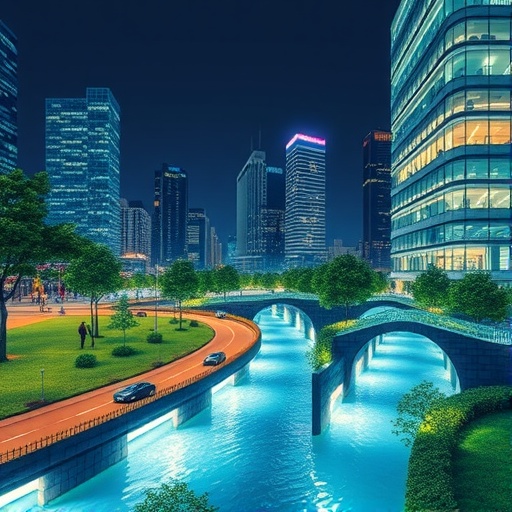
Technically, this means treating interstitial land as part of a distributed infrastructure network. Rain gardens, constructed wetlands, permeable surfaces and planted drainage channels can slow runoff and allow water to infiltrate into soil rather than rushing immediately into pipes. Trees and layered vegetation can reduce surface temperatures through shade and evapotranspiration, the process by which plants release water vapor and cool their surroundings. Green roofs can retain rainfall, improve building insulation and create habitat above densely developed districts. When these elements are connected, they can function as decentralized systems that reduce pressure on centralized treatment plants, flood defenses and energy networks.
The regenerative dimension of the concept goes beyond making cities less vulnerable. Resilience generally describes the ability to withstand disruption and recover, while regeneration suggests improving the ecological and social conditions that support urban life. An interstitial project might therefore do more than prevent flooding: it could rebuild soil, restore biodiversity, improve air quality, create cooler walking routes and provide space for community activity. This is significant because urban land is increasingly expected to perform several jobs simultaneously. A corridor once reserved for utilities might also become a pollinator route, a cycling connection, a linear park and a monitored zone for managing stormwater.
The framework also challenges the assumption that infrastructure must be monumental to be effective. Large dams, tunnels, highways and treatment plants remain important, but they are expensive, spatially fixed and vulnerable to cascading failures. Distributed interventions can create redundancy: if one rain garden or retention basin fails, other components may continue functioning. From an engineering perspective, a network with many smaller storage and filtration points can reduce peak flows and avoid concentrating risk in a single facility. From an urban-design perspective, it can make infrastructure visible and accessible, turning systems that are normally buried or fenced off into useful public spaces.
Yet interstitial spaces are not automatically available for transformation. They may be governed by different agencies, divided among private owners or constrained by safety regulations and underground utilities. A narrow corridor may appear empty while carrying fiber-optic cables, gas lines or stormwater infrastructure. Soil contamination, invasive species, maintenance costs and competing demands for development can also limit what is possible. The study’s emphasis on design is therefore inseparable from governance. Creating regenerative urban systems requires coordination across transport, water, energy, housing, parks and public-health authorities, as well as long-term agreements over who maintains and monitors the spaces.
Data and sensing could play an important role in making these networks work. Sensors can measure soil moisture, water levels, temperature, air quality and electricity demand, allowing managers to determine whether an intervention is performing as intended. Geographic information systems can map fragmented parcels and identify where small projects might connect larger ecological or mobility networks. Digital models can estimate how a chain of permeable surfaces or detention areas would alter runoff during a storm. However, technology alone cannot decide which neighborhoods receive investment or whose needs define success. Technical performance must be evaluated alongside access, affordability, safety and the risk that environmental improvements could accelerate displacement.
That social dimension makes the urban interstitium particularly relevant to the politics of climate adaptation. Underused spaces are often found in places that have historically received fewer public investments, but projects can also increase land values and reshape who is able to remain in a neighborhood. A regenerative intervention that creates shade, cleaner air and attractive public space may deliver substantial health benefits, yet it can become exclusionary if residents are not involved in its design or if new amenities are followed by rising rents. Supple’s concept places infrastructure within a broader question: how can cities distribute environmental protection and ecological repair fairly rather than treating resilience as a technical upgrade detached from social life?
The study arrives as cities worldwide search for ways to adapt without endlessly expanding hard, resource-intensive infrastructure. Its central proposition is visually simple but potentially far-reaching: the spaces between urban systems are not merely residual land. They are opportunities to reconnect fragmented ecological processes, diversify infrastructure and make adaptation part of everyday urban experience. If planners can identify, link and govern these spaces as a network, the ordinary gaps of the city—its edges, seams and overlooked surfaces—could become active components of a cooler, safer and more regenerative future. The urban interstitium may ultimately prove that the next major infrastructure revolution will not always be built above ground as a landmark project, but assembled incrementally in the places cities have learned to ignore.
Cite Scienmag News
Courtney Benton. (August 21, 2026). Urban Interstitium: Designing Infrastructure for Resilient, Regenerative Cities. Scienmag. https://scienmag.com/urban-interstitium-designing-infrastructure-for-resilient-regenerative-cities/
Courtney Benton. "Urban Interstitium: Designing Infrastructure for Resilient, Regenerative Cities." Scienmag, 21 August 2026, https://scienmag.com/urban-interstitium-designing-infrastructure-for-resilient-regenerative-cities/. Accessed 3 September 2026.
Courtney Benton. "Urban Interstitium: Designing Infrastructure for Resilient, Regenerative Cities." Scienmag. August 21, 2026. https://scienmag.com/urban-interstitium-designing-infrastructure-for-resilient-regenerative-cities/


