


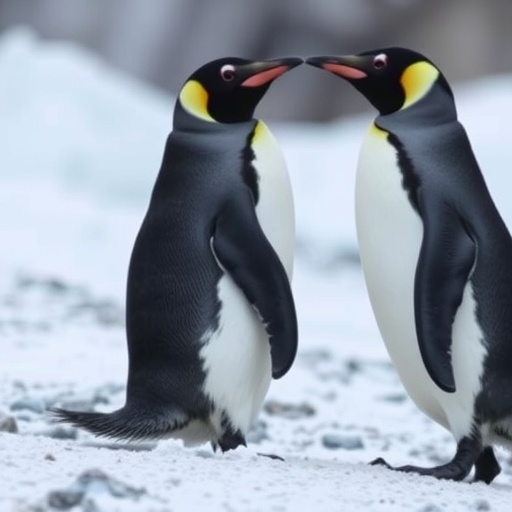
In the remote, icy expanse of Antarctica, Adélie penguins embark on their tireless journeys from bustling colonies to the rich, yet unpredictable, coastal feeding grounds. These penguins, scientifically known as Pygoscelis adeliae, display remarkable social behaviors that have long intrigued researchers seeking to understand the evolutionary advantages of group living among seabirds. Recent groundbreaking research unveils how these resilient birds navigate the oceanic labyrinth, exploiting both personal experience and social cues to optimize foraging during the critical chick-rearing season.
Group living in animals, particularly among seabirds, is a phenomenon fraught with paradoxes. The proximity in colonies intensifies resource competition and heightens risks of disease spread, yet the repeated independent emergence of coloniality across species testifies to significant, adaptive benefits. Central to these benefits is the potential for social information transfer—whereby individuals learn from conspecifics about resource locations, thus enhancing foraging efficiency and, ultimately, reproductive success.
Prior studies have largely been speculative or limited in scope when addressing which individuals serve as reliable sources of social information in wild seabird populations, or precisely when such information is leveraged. Addressing this knowledge gap, a team of researchers focused on a colony of Adélie penguins located in Torinosu Cove, Lützow-Holm Bay, Antarctica. This colony, consisting of 135 breeding pairs, became the epicenter for an extensive observational study employing state-of-the-art biologging technology to monitor the movements and behaviors of nearly half its active breeders.
Biologging devices—miniature GPS units coupled with depth sensors—were meticulously attached to 96 to 116 penguins over multiple breeding seasons. This enabled the continuous, simultaneous tracking of approximately 35.6% to 43.0% of breeders, a sample unprecedented in size and resolution for this species. In total, movement data from 653 distinct foraging excursions were amassed, providing an unparalleled lens through which penguin foraging dynamics could be dissected with exceptional granularity.
Analysis of the movement trajectories revealed a nuanced strategy underpinning penguin foraging behavior. Notably, penguins frequently returned to feeding sites exploited in previous trips, illustrating the use of personal memory and experience to capitalize on known resource patches. However, a deeper pattern emerged: groups of penguins often departed simultaneously, moving in concert from the colony toward hunting locations. This coordinated departure hints at more than mere chance, suggesting a mechanism of social information transfer during group travel.
Delving further, it was observed that some individuals in these traveling groups targeted feeding grounds previously utilized by their co-departing conspecifics during past foraging trips. This behavior indicates that group formation at departure functions not only as a social congregation but as a critical vector for acquiring social cues about profitable foraging sites. Essentially, penguins leverage the knowledge of their peers to expand their foraging repertoire beyond solely personal experience.
Complementing GPS data, dive-depth profiles served as proxies for foraging success, providing insights into whether individuals found adequate prey during their excursions. Intriguingly, penguins experiencing subpar success in one trip were statistically more inclined to alter their foraging destinations on subsequent ventures. This behavioral plasticity underscores an adaptive “win-stay, lose-shift” foraging strategy, where successful sites are revisited, but unsuccessful foraging prompts the seeking of new locations.
Such dynamic use of social and personal information likely enhances overall food acquisition across the breeding season, conferring survival and reproductive advantages. By integrating data on movement patterns and foraging outcomes, the researchers elucidate the potent interplay between individual learning and social facilitation in a challenging environment.
From an ecological and evolutionary perspective, this study sheds crucial light on the collective problem-solving capacities within animal groups. The findings implicate colony size and structure as potential modulators of information flow and foraging success, raising provocative questions about how environmental variability might shape social foraging strategies.
Future investigations, building upon this work, could examine penguin colonies across diverse geographic locales and environmental contexts to determine the universality and variability of these behaviors. Such endeavors would integrate ecological data with genetic and behavioral analyses to unravel the proximate and ultimate drivers underpinning social information use.
At the intersection of behavioral ecology, conservation biology, and animal cognition, these insights into Adélie penguin foraging strategies underscore the sophistication of animal societies and their adaptive responses to environmental uncertainties. As climate change continues to alter polar habitats, understanding how social mechanisms mediate resource acquisition becomes increasingly vital to predicting species resilience.
This research not only enriches our comprehension of penguin ecology but also contributes broadly to the discourse on collective behavior in the animal kingdom, highlighting the evolutionary significance of information sharing as a catalyst for survival in the natural world.
Cite Scienmag News
Gavin Prescott. (June 9, 2026). Unsuccessful Penguins Rely on Social Learning to Choose Foraging Sites. Scienmag. https://scienmag.com/unsuccessful-penguins-rely-on-social-learning-to-choose-foraging-sites/
Gavin Prescott. "Unsuccessful Penguins Rely on Social Learning to Choose Foraging Sites." Scienmag, 9 June 2026, https://scienmag.com/unsuccessful-penguins-rely-on-social-learning-to-choose-foraging-sites/. Accessed 3 September 2026.
Gavin Prescott. "Unsuccessful Penguins Rely on Social Learning to Choose Foraging Sites." Scienmag. June 9, 2026. https://scienmag.com/unsuccessful-penguins-rely-on-social-learning-to-choose-foraging-sites/


