


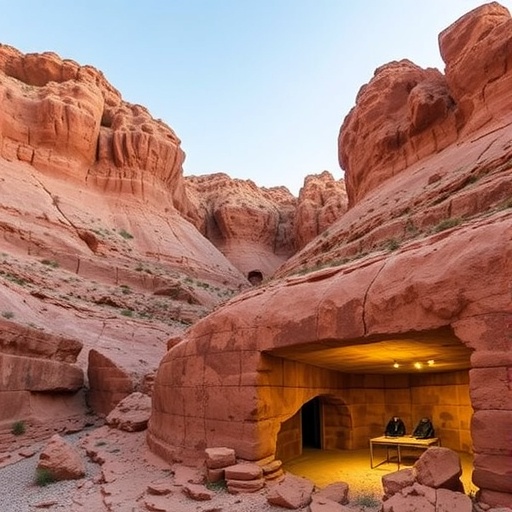
In the realm of archaeology, understanding the past is often as much about the context of artifacts as it is about the artifacts themselves. A pioneering study conducted by Di Matteo and Rotunno explores the intricacies of archaeofaunal taphonomy in Saharan Holocene rock shelters, shedding light on the formation processes of these historical sites. As new insights emerge from rigorous analyses, the veil over ancient human activities in the Sahara begins to lift, revealing a narrative that intertwines environmental factors, human behavior, and time.
Rock shelters, often seen as mere temporary refuges for ancient populations, serve as rich archaeological deposits. They encapsulate evidence of human habitation, burial practices, and a wealth of faunal remains. Di Matteo and Rotunno’s work challenges previous assumptions about these sites by providing a site-specific analysis of archaeofaunal remains found in Saharan shelters. Their research goes beyond merely cataloging bones; it delves into understanding how these remains were influenced by both natural and anthropogenic processes over millennia.
Critical to anthropological studies is the concept of taphonomy, which examines how remains decay and are preserved over time. The researchers emphasize that distinguishing between natural processes — such as weathering, sedimentation, and erosion — and those induced by human activity is key to unraveling the site’s history. By scrutinizing the relationship between sediments and bones, Di Matteo and Rotunno aim to disentangle the complex tapestry of events that led to the current state of these shelters.
Digging deeper into the various factors influencing the preservation of faunal remains, the researchers highlight the significance of the environment. The Saharan climate, characterized by extreme temperatures and aridity, plays a vital role in both the preservation and destruction of archaeological materials. Understanding how climatic variations impact these processes can provide insights into the behavior of ancient human populations that inhabited these areas, particularly their adaptation strategies to an often-hostile environment.
Moreover, the study emphasizes the importance of using a multidisciplinary approach to taphonomy. By integrating traditional archaeological methods with modern scientific techniques, such as isotope analysis and radiocarbon dating, Di Matteo and Rotunno bring a depth of information that extends beyond mere surface analysis. This convergence of disciplines allows for a more nuanced understanding of the human-animal interactions that occurred within these rock shelters.
One of the most striking conclusions of the study is the revelation of distinct patterns in the bone assemblages across various shelters. These assemblages provide a window into the dietary habits and subsistence strategies of the ancient inhabitants. By analyzing the types of animals present and the conditions under which they were preserved, the researchers unveil the complexities of hunting, gathering, and resource utilization in a context defined by limited availability and harsh conditions.
The findings underscore the dynamic relationship between humans and their environment, suggesting that ancient populations were not merely passive recipients of environmental changes but actively engaged in shaping their landscapes. This insight reshapes our understanding of socio-ecological interactions, positioning humans as integral players in the ecological dramas of the past.
As the study illuminates the processes behind the formation of archaeological deposits, it also serves as a call to reevaluate how modern archaeology interprets site formation. The authors argue for the necessity of acknowledging the unique contexts of each site, advocating for a shift in focus from generalized models to detailed, site-specific case studies. This approach not only enriches the field of archaeology but also enhances our understanding of cultural evolution over time.
The implications of this research extend beyond the Sahara, as it offers a framework for investigating similar sites worldwide. By drawing parallels between different sites and archaeological contexts, the study encourages cross-disciplinary collaboration that could yield broader insights into human history and prehistory.
In sum, Di Matteo and Rotunno’s study presents a groundbreaking analysis of archaeofaunal taphonomy in the Saharan Holocene rock shelters, inviting us to reimagine the past. As we decipher the delicate interplay between humans, animals, and their environment, we gain a deeper appreciation for the resilience of ancient populations and the enduring legacies they left behind.
As this research garners attention in the archaeological community, it promises to inspire new methodologies and future investigations that will continue to unfold the stories hidden within the sands of time. The Sahara, often viewed as a barren landscape, transforms into a vibrant tapestry of interactions, innovations, and adaptations shaped by the forces of nature and humanity alike.
In conclusion, this study is not just a testament to the intricate science of taphonomy; it is a celebration of the narratives waiting to be uncovered in rock shelters everywhere. The ongoing exploration of these ancient sites will continue to provide invaluable insights, bridging the gap between our present and the distant past, and enriching our understanding of human history.
Cite Scienmag News
Courtney Benton. (November 21, 2025). Unraveling Taphonomy in Saharan Holocene Rock Shelters. Scienmag. https://scienmag.com/unraveling-taphonomy-in-saharan-holocene-rock-shelters/
Courtney Benton. "Unraveling Taphonomy in Saharan Holocene Rock Shelters." Scienmag, 21 November 2025, https://scienmag.com/unraveling-taphonomy-in-saharan-holocene-rock-shelters/. Accessed 4 September 2026.
Courtney Benton. "Unraveling Taphonomy in Saharan Holocene Rock Shelters." Scienmag. November 21, 2025. https://scienmag.com/unraveling-taphonomy-in-saharan-holocene-rock-shelters/


