


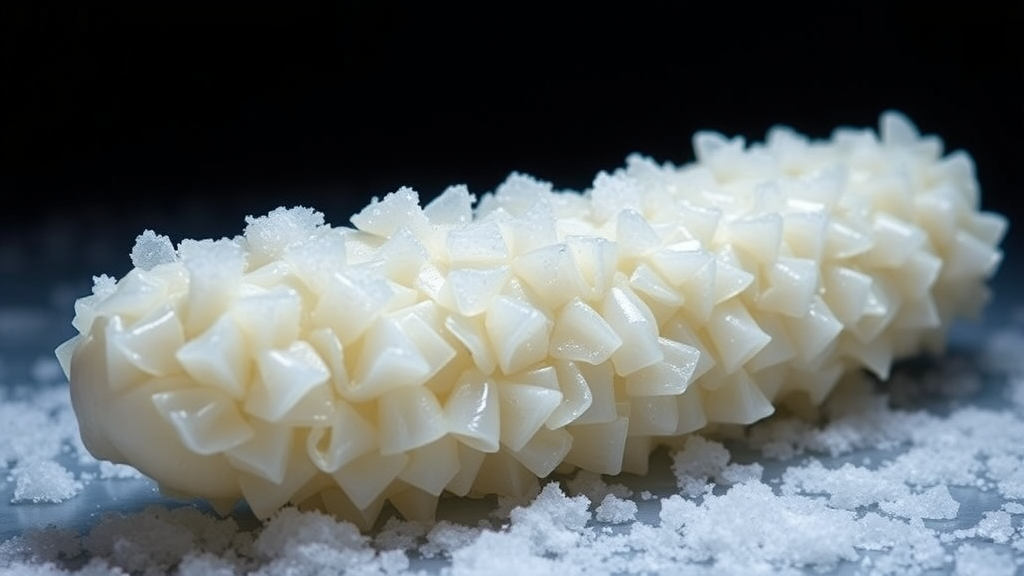
Sea cucumbers are among the most prized delicacies in East Asian cuisine, valued not only for their distinctive texture but also for their exceptional nutritional profile, which is dominated by protein and, above all, collagen. Collagen makes up roughly seventy percent of the total protein in the sea cucumber body wall, and it is this structural protein that largely determines whether a ready-to-eat sea cucumber feels firm and springy on the plate or disappointingly soft and watery. A new study published in the Journal of Agriculture and Food Research by Xuran Chi of Dalian Polytechnic University and colleagues now offers compelling evidence that the way these animals are frozen can make or break collagen quality over months of storage, and that ultrasound may be the key to keeping them in prime condition.
The commercial stakes are considerable. By 2026, the market for ready-to-eat sea cucumbers in China had reached 15 billion yuan, growing at roughly ten percent year on year. Because the body wall of the sea cucumber deteriorates rapidly under ambient or refrigerated conditions, frozen storage has become the backbone of the industry, and freezing technology is effectively the gatekeeper of product quality. The problem is that conventional freezing is a blunt instrument. When water freezes slowly, it forms large, irregular ice crystals that puncture and squeeze delicate tissue, disrupt the collagen network that gives the body wall its integrity, and set off a cascade of protein denaturation and water loss that continues long after the product leaves the freezer chamber.
Even low-temperature quick freezing, the industry standard that cools samples rapidly in a blast chamber at minus thirty degrees Celsius, has its limits. Rapid cooling promotes ice nucleation, but it can also generate temperature gradients within the sample, producing an uneven distribution of ice crystals and localized damage in collagen-rich tissue. Chi’s team set out to compare three freezing strategies head to head: conventional low-temperature quick freezing, freezing assisted by a low-voltage electrostatic field of 2,500 volts per meter, and ultrasound-assisted freezing performed at 200 watts and 25 kilohertz with 95 percent ethanol as the circulating refrigerant. Vacuum-sealed samples were frozen by each method, stored for three months at minus eighteen degrees Celsius, and then analyzed at regular intervals for texture, water retention, microstructure, and the oxidation, degradation, and conformational state of collagen.
The freezing curves told the first story. All samples pass through what food scientists call the zone of maximum ice crystal formation, spanning roughly minus one to minus five degrees Celsius, where about eighty percent of the water undergoes its phase transition. The time spent in this zone is a decisive determinant of ice crystal size. Ultrasound-assisted freezing swept samples through it in just 3.18 minutes, compared with 3.88 minutes for the electrostatic field treatment and 5.75 minutes for conventional quick freezing. The researchers attribute the speed of the ultrasound treatment to acoustic cavitation and mechanical microstreaming, which enhance heat transfer and multiply the number of nucleation sites, so the water freezes into many small crystals rather than a few large ones.
The consequences of that difference rippled through every quality measurement. After three months of storage, ultrasound-treated sea cucumbers retained a hardness of 408.47 grams-force, significantly higher than the electrostatic field group at 386.12 and the conventionally frozen group at 374.01, with the same pattern holding for chewiness. Water retention followed suit. Thawing loss after three months was lowest in the ultrasound group at 18.67 percent, compared with 19.21 percent for the electrostatic treatment and 22.29 percent for conventional freezing, and both centrifugal and cooking losses showed the same hierarchy. Low-field nuclear magnetic resonance and magnetic resonance imaging revealed that ultrasound-frozen samples maintained more tightly bound water and a more uniform proton density throughout the body wall, while conventionally frozen samples showed pronounced water migration and heterogeneous, dark regions signaling severe moisture loss.
Microscopy made the physical mechanism vividly visible. Under light microscopy and scanning electron microscopy, conventionally frozen samples displayed numerous large voids, fissures, and extensive collagen fiber breakage after three months of storage. Ultrasound-treated samples, by contrast, kept a comparatively compact and continuous microstructure with smooth surfaces, tightly arranged fibers, and small pores. Because the sensory identity of a sea cucumber depends on the dense collagen lattice of its body wall, these structural images effectively predict what a consumer would taste, and they explain why the ultrasound group scored best on texture even as all groups inevitably softened over time.
At the molecular level, collagen in the conventionally frozen group fared worst across every marker the team measured. Carbonyl content, a signature of protein oxidation, climbed from about 8.1 to 14.95 nanomoles per milligram in the conventional group over three months, but reached only 12.86 in the ultrasound group. Total sulfhydryl groups, which are consumed as oxidation converts them to disulfide bonds, fell furthest in the conventional group to 13.51 nanomoles per milligram, while the ultrasound group held 15.75. Dityrosine fluorescence, another oxidative marker, was similarly highest in the conventionally frozen samples. The researchers argue that slower freezing causes large ice crystals to mechanically damage protein structures, exposing amino acid side chains to reactive oxygen species and accelerating oxidation, whereas the fine, uniform crystals produced under ultrasound limit this exposure.
Collagen denaturation and degradation showed the same pattern. After three months, the ultrasound group retained the highest solubility at 73.82 percent, the lowest turbidity at 0.63 NTU, the smallest particle size, and the best-preserved surface hydrophobicity, all indicating less aggregation and unfolding. Free hydroxyproline, a biomarker of collagen backbone cleavage, rose by 56.27 micrograms per gram in the conventional group but only 47.06 in the ultrasound group, while free amino nitrogen, an index of protein hydrolysis, followed the same trend. Fourier transform infrared spectroscopy of the amide I band showed that the ultrasound group preserved the highest alpha-helix content, 44.90 percent, with the lowest beta-sheet fraction, whereas conventional freezing drove a marked shift toward beta-sheet and random coil conformations that signal irreversible denaturation. Intrinsic fluorescence revealed the smallest redshift in the ultrasound group, meaning the hydrophobic microenvironment around tryptophan residues stayed intact, and confocal imaging confirmed the most continuous protein network.
The authors synthesize these findings into a protective cascade: ultrasound shortens the time in the maximum ice crystal formation zone, producing fine and evenly distributed crystals; this limits mechanical puncture and extrusion of the collagen fibrillar network; preserved structure in turn restricts the release of pro-oxidant metal ions and free radicals, slowing oxidation; and conformational stability shields protease-sensitive cleavage sites, delaying both denaturation-induced aggregation and enzymatic hydrolysis. In essence, ultrasound-assisted freezing mitigates the physical intensity of freezing stress rather than altering collagen’s intrinsic chemical resilience, and that physical regulation cascades downward into biochemical preservation. The electrostatic field treatment performed respectably in most assays, typically ranking between the other two methods, confirming earlier reports that electrostatic fields can influence water molecule clustering and inhibit crystal growth.
There are caveats, and the researchers are candid about them. The ultrasound system used circulating ethanol as the refrigerant while the other two treatments used air blast freezing, a difference in heat transfer that could confound the comparison, and the team notes that future work will hold the medium constant while varying only the ultrasound parameters. The authors also point out that systematic research on the economic viability of ultrasound-assisted freezing, a critical factor for commercialization, remains limited. Even so, the study is the first to systematically link assisted freezing technologies to collagen oxidation, degradation, and conformational change in ready-to-eat sea cucumbers, and it delivers a clear message for a 15-billion-yuan industry: sound waves, applied at the right frequency and power, can coax water into freezing gently, and in doing so preserve the collagen architecture that defines one of the ocean’s most valued foods.
Subject of Research: Effects of ultrasound-assisted freezing on collagen quality and physicochemical properties of ready-to-eat sea cucumbers during frozen storage
Article Title: Evaluating the effects of ultrasound-assisted freezing on the physicochemical properties and collagen quality of ready-to-eat sea cucumbers during storage
Article References: Chi, X., Gao, Z., Luan, H., Zhu, W., Bu, Y., Li, X., & Li, J. (2026). Evaluating the effects of ultrasound-assisted freezing on the physicochemical properties and collagen quality of ready-to-eat sea cucumbers during storage. Journal of Agriculture and Food Research, 31, Article 103311. https://doi.org/10.1016/j.jafr.2026.103311
Image Credits: AI Generated
DOI: 10.1016/j.jafr.2026.103311
Keywords: sea cucumber, ultrasound-assisted freezing, collagen, frozen storage, protein oxidation, ice crystals, food texture, water holding capacity, electrostatic field freezing, protein denaturation, food preservation, aquatic food quality
Cite Scienmag News
Alan Morgan. (September 22, 2026). Ultrasound-Assisted Freezing Preserves Collagen Quality in Sea Cucumbers During Storage. Scienmag. https://scienmag.com/ultrasound-assisted-freezing-preserves-collagen-quality-in-sea-cucumbers-during-storage/
Alan Morgan. "Ultrasound-Assisted Freezing Preserves Collagen Quality in Sea Cucumbers During Storage." Scienmag, 22 September 2026, https://scienmag.com/ultrasound-assisted-freezing-preserves-collagen-quality-in-sea-cucumbers-during-storage/. Accessed 5 October 2026.
Alan Morgan. "Ultrasound-Assisted Freezing Preserves Collagen Quality in Sea Cucumbers During Storage." Scienmag. September 22, 2026. https://scienmag.com/ultrasound-assisted-freezing-preserves-collagen-quality-in-sea-cucumbers-during-storage/


