


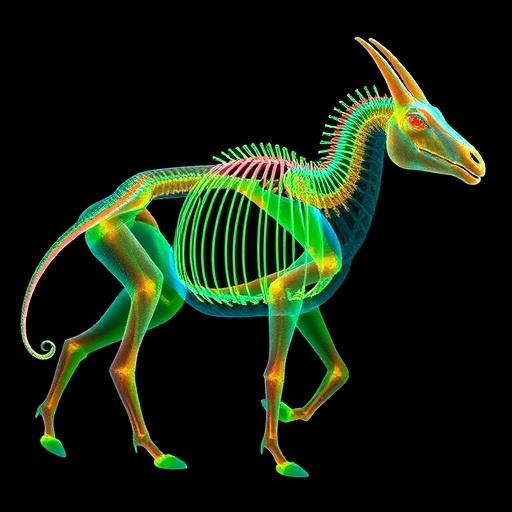
In a groundbreaking exploration into the evolutionary history of ungulates, researchers have unveiled compelling evidence highlighting two pivotal ecological shifts that dramatically influenced the faunal evolution of these hoofed mammals over the past 60 million years. This comprehensive study, recently published in Nature Communications, sheds light on how environmental transformations have served as crucial catalysts driving adaptive radiations, extinctions, and morphological innovations within this mammalian group, which includes horses, deer, and cattle, among others. By integrating fossil data with advanced ecological modeling techniques, the investigation offers an unprecedented glimpse into the deep-time dynamics that have sculpted one of the most diverse and ecologically significant mammalian clades on Earth.
Ungulates have long been a focus of evolutionary biology due to their extensive fossil record and ecological diversity, spanning a vast array of terrestrial habitats across continents. However, until now, the large-scale ecological processes underpinning their evolutionary trajectories remained only partially understood. The new findings decisively illustrate how two major ecological transitions—not just isolated events—set the stage for evolutionary shifts by restructuring habitats and resource availability, thereby influencing ungulate diversity and distribution patterns through geologic epochs.
The first major ecological shift identified by the study occurred approximately 34 million years ago during the transition from the Late Eocene to the Early Oligocene epoch. This period was marked by profound global climate cooling and the emergence of more open, grass-dominated ecosystems replacing closed-canopy forests. The corresponding faunal response in ungulates was profound, favoring the rise of grazing specialists adapted to exploit expanding grasslands characterized by abrasive vegetation and seasonal resource fluctuations. Morphological adaptations such as hypsodont (high-crowned) teeth and limb modifications for cursorial (running) locomotion became widespread, illustrating an evolutionary trajectory tightly coupled with the changing paleoenvironmental parameters.
Fast forward to around 10 million years ago, the second major ecological shift took place during the Late Miocene epoch, a time correlated with further cooling and increased aridification, especially across mid-latitude continents. This climatic transition precipitated the development of more heterogeneous landscapes featuring a mosaic of savannas, woodlands, and open steppes. The study reveals that these heterogenous habitats imposed new selective pressures that led to distinct evolutionary pathways among ungulate lineages, with some groups specializing in navigating dense vegetation while others became more adapted to open, grass-dominated terrains. This nuanced environmental complexity not only drove diversification but also triggered localized extinctions, reshaping community assemblages and triggering biogeographic redistributions.
Crucially, the research harnessed an integrative methodological framework combining paleontological data with refined ecological niche modeling and phylogenetic reconstructions. This multidisciplinary approach allowed the team to simulate past environmental conditions and evaluate how shifts in vegetation types, precipitation patterns, and temperature regimes correlated with morphological and taxonomic changes in ungulate populations. The temporal scale and depth of analysis presented give a holistic understanding of evolutionary dynamics that were previously fragmented across smaller spatial or temporal scopes.
One of the more intriguing facets unfolded through the detailed examination of faunal turnover rates and lineage origination patterns. During the epochs encompassing the two highlighted ecological shifts, certain ungulate clades experienced explosive diversification—often termed as adaptive radiations—that enabled them to colonize novel ecological niches. Conversely, other lineages faced significant bottlenecks and extinctions due to their inability to cope with rapidly changing environments or increased interspecific competition. This dynamic interplay underscores the non-linear and complex nature of evolutionary processes, conditioned by both abiotic factors and biotic interactions.
Further insights into evolutionary innovation were uncovered as the study delved into morphological traits linked with dietary specializations and locomotor abilities. Teeth and limb bone analyses revealed how functional adaptations were fine-tuned to exploit specific environmental resources and escape predators in vastly changed landscapes. For instance, the evolution of more complex dental morphologies allowed some ungulates to efficiently process tougher, silica-rich grasses, while modifications in limb structure facilitated faster, more energy-efficient movement across open terrains. Such traits serve as tangible evidence of evolutionary tinkering catalyzed by environmental pressures and ecological opportunities alike.
The utility of fossilised remains within this study cannot be overstated. By collating a vast dataset of fossil specimens spanning numerous geographic regions and temporal slices, the research team was able to reconstruct detailed phylogenetic trees that trace lineage divergence back to the root of the ungulate family. The integration of fossil data with geological proxies allowed for temporal calibration of evolutionary events, providing insights into how geological phenomena such as orogeny and global temperature fluctuations interplayed with adaptive trajectories.
Beyond pure evolutionary significance, the findings have profound implications for contemporary conservation biology. Understanding how ungulate lineages historically responded to large-scale environmental changes offers valuable predictive frameworks for assessing their resilience or vulnerability under current anthropogenic climatic perturbations. It suggests that latitudinal shifts in vegetation and habitat fragmentation could potentially replicate ecological scenarios reminiscent of past epochs, where only highly adaptable species persevere while others decline. Hence, recognizing patterns in past faunal restructuring equips scientists and policymakers with knowledge instrumental for future biodiversity management.
Moreover, the study challenges traditional views of ungulate evolution as a relatively steady and gradual process, positing instead a punctuated model characterized by episodic bursts of innovation and extinction aligned with major ecological upheavals. This paradigm shift invites broader reconsideration of how macroevolutionary patterns are interpreted across other mammalian groups and ecosystems. The elucidation of ecological thresholds—points beyond which rapid evolutionary or ecological shifts occur—could become a central theme in evolutionary research moving forward.
Emphasizing the global scale of these findings, the research reviewed ungulate faunas from multiple continents, revealing convergent evolutionary trends despite regional environmental differences. Such parallelism highlights the universal influence of climatic and ecological forces transcending geographic barriers. Mountain-building events, oceanic circulation changes, and vegetation transformations together acted as agents of selection, sculpting anatomical and behavioral traits repeatedly in different ungulate faunas and contributing to their impressive evolutionary success.
In crafting this detailed evolutionary narrative, the collaboration between paleontologists, ecologists, and evolutionary biologists was paramount. The interdisciplinary nature of the work enabled leveraging diverse analytical tools and datasets, ranging from isotope geochemistry to biomechanical modeling. This synthesis not only enriches the findings but also exemplifies the evolving nature of scientific inquiry itself, where integration across fields yields answers to complex questions about life’s history on Earth.
The researchers also speculated about the potential influences of external events such as asteroid impacts, volcanic activity, and tectonic shifts facilitating or amplifying the ecological transformations documented. While these factors remain subjects for further investigation, their possible roles accentuate the multifactorial underpinnings of evolutionary processes. Understanding the interaction between sudden catastrophic events and gradual climatic changes could yield nuanced perspectives on faunal responses and recovery mechanisms.
This landmark study opens numerous avenues for future research, including more refined temporal analyses at regional scales and exploration of interaction networks between ungulates and sympatric fauna, such as predators and competitors. Investigating co-evolutionary dynamics within these communities during periods of ecological upheaval promises to deepen understanding of ecosystem resilience. Furthermore, integrating genetic data from extant species with fossil evidence could illuminate molecular undercurrents accompanying the morphological and ecological shifts described.
Ultimately, the revelation that two major ecological shifts fundamentally sculpted the evolutionary landscape of ungulates over tens of millions of years reframes our comprehension of mammalian adaptation and survival. It underscores the indelible imprint of Earth’s dynamic environmental history on shaping biodiversity, reinforcing the concept that life’s trajectory is intertwined with planetary processes in ways that continue to unfold. This research not only enriches scientific knowledge but also ignites curiosity about untold stories embedded within the fossil record waiting to be deciphered.
Cite Scienmag News
Gavin Prescott. (June 5, 2025). Two Key Shifts Shaped 60 Million Years Ungulate Evolution. Scienmag. https://scienmag.com/two-key-shifts-shaped-60-million-years-ungulate-evolution/
Gavin Prescott. "Two Key Shifts Shaped 60 Million Years Ungulate Evolution." Scienmag, 5 June 2025, https://scienmag.com/two-key-shifts-shaped-60-million-years-ungulate-evolution/. Accessed 4 September 2026.
Gavin Prescott. "Two Key Shifts Shaped 60 Million Years Ungulate Evolution." Scienmag. June 5, 2025. https://scienmag.com/two-key-shifts-shaped-60-million-years-ungulate-evolution/


