Thursday, October 29, 2026
Science
No Result
View All Result
  • Login
  • HOME
  • SCIENCE NEWS
  • CONTACT US
  • HOME
  • SCIENCE NEWS
  • CONTACT US
No Result
View All Result
Scienmag
No Result
View All Result
Home Science News Biology

Tumor-derived exosomes drive cochlear hair cell ferroptosis in vestibular schwannoma

October 28, 2026
in Biology, Medicine
Nathaniel Bowman
By Nathaniel Bowman Scienmag Editorial Profile - Precision Oncology
Reading Time: 2 mins read
0
Tumor-derived exosomes drive cochlear hair cell ferroptosis in vestibular schwannoma

Tumor-derived exosomes drive cochlear hair cell ferroptosis in vestibular schwannoma

65
SHARES
587
VIEWS
Share on FacebookShare on Twitter
ADVERTISEMENT

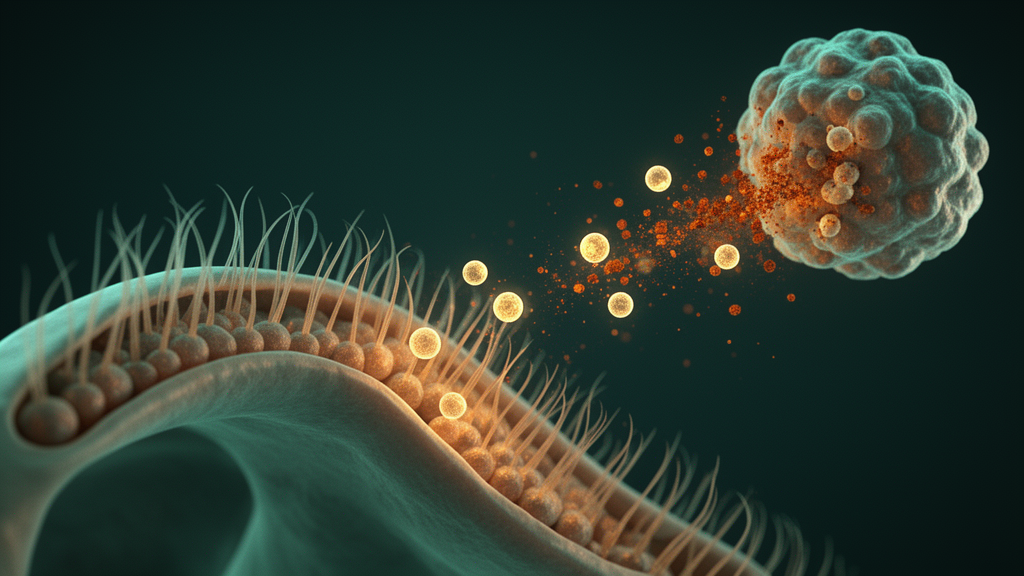
Vestibular schwannoma, the most common benign tumor of the cerebellopontine angle, leaves roughly 95% of patients with sensorineural hearing loss, yet the mechanisms linking the tumor to cochlear damage remain incompletely understood. A new study published in Cell Death Discovery reports that exosomes released by vestibular schwannomas can induce ferroptosis, an iron-dependent form of regulated cell death driven by lipid peroxidation, in cochlear hair cells.

The research team compared exosomes isolated from vestibular schwannoma patients with poor hearing against those from patients with good hearing, using proteomic and bioinformatic analyses to characterize differences between the two groups.

In laboratory experiments, the vesicles from vestibular schwannoma patients suppressed glutathione peroxidase 4, or GPX4, a key enzyme that normally protects cellular membranes from oxidative damage. Loss of GPX4 activity was accompanied by a disruption of iron homeostasis, with ferrous ions accumulating inside hair cells along with reactive oxygen species and lipid peroxidation products, the biochemical hallmarks of ferroptosis.

The comparison between patient groups proved particularly striking. Exosomes from patients with poor hearing induced significantly greater ferroptotic damage to cochlear hair cells than exosomes from patients whose hearing remained relatively preserved, suggesting that the cargo of these vesicles may differ according to the clinical severity of hearing loss.

To test whether blocking ferroptosis could protect hearing, the researchers used ferrostatin-1, a well-characterized inhibitor of the ferroptotic pathway. Treatment with ferrostatin-1 effectively alleviated hair cell injury in cell models and preserved auditory function in vivo, indicating that the damage observed was specifically mediated by ferroptosis rather than by other forms of cell death.

The findings point to a mechanistic chain in which tumor-derived signaling suppresses a central antioxidant enzyme, destabilizes iron regulation, and thereby tips vulnerable cochlear hair cells into iron-dependent death.

Beyond ferroptosis itself, the study suggests that the exosome-mediated communication between tumor and cochlea may itself be a target. Interfering with the vesicles or their cargo, the authors note, could offer an additional route to protecting hearing alongside direct inhibition of the ferroptotic pathway.

The work remains at the preclinical stage, combining cell culture experiments with animal models, and the abstract notes that the role of ferroptosis in vestibular schwannoma-associated hearing loss was previously poorly understood. The authors position their results as uncovering a novel mechanism and as an early step toward therapeutic strategies, with clinical translation still requiring further study. Even so, the identification of a specific, druggable cell death pathway connecting vestibular schwannoma to hair cell injury offers a concrete lead for hearing preservation research in this patient population.

Subject of Research: Exosome-induced ferroptosis in cochlear hair cells as a mechanism of hearing loss in vestibular schwannoma

Article Title: Exosome-induced ferroptosis mediates cochlear hair cell injury via GPX4 suppression and iron overload

Article References: Maimaitiming, D., Gao, Y., Wang, Z., Yang, T., Wu, H., Huo, Z., & Zhang, Z. (2026). Exosome-induced ferroptosis mediates cochlear hair cell injury via GPX4 suppression and iron overload. Cell Death Discovery. https://doi.org/10.1038/s41420-026-03419-x

Image Credits: AI Generated

DOI: 10.1038/s41420-026-03419-x

Keywords: vestibular schwannoma, exosomes, ferroptosis, cochlear hair cells, GPX4, iron overload, lipid peroxidation, sensorineural hearing loss, ferrostatin-1, Cell Death Discovery, Exosome-induced, mediates

Cite Scienmag News

Nathaniel Bowman. (October 28, 2026). Tumor-derived exosomes drive cochlear hair cell ferroptosis in vestibular schwannoma. Scienmag. https://scienmag.com/tumor-derived-exosomes-drive-cochlear-hair-cell-ferroptosis-in-vestibular-schwannoma/

Nathaniel Bowman. "Tumor-derived exosomes drive cochlear hair cell ferroptosis in vestibular schwannoma." Scienmag, 28 October 2026, https://scienmag.com/tumor-derived-exosomes-drive-cochlear-hair-cell-ferroptosis-in-vestibular-schwannoma/. Accessed 29 October 2026.

Nathaniel Bowman. "Tumor-derived exosomes drive cochlear hair cell ferroptosis in vestibular schwannoma." Scienmag. October 28, 2026. https://scienmag.com/tumor-derived-exosomes-drive-cochlear-hair-cell-ferroptosis-in-vestibular-schwannoma/

Tags: Cell Death Discoverycochlear hair cell ferroptosiscochlear hair cellsExosome-inducedexosomesferroptosisferroptosis biomarkers in hearing lossferrostatin-1glutathione peroxidase 4 suppressionGPX4hearing impairment in vestibular schwannomairon overloadiron-dependent cell death in auditory cellslipid peroxidationlipid peroxidation in cochlear cellsmediatesoxidative stress in cochlear damageproteomic analysis of schwannoma exosomesrole of exosomal cargo in auditory cell deathsensorineural hearing losstumor-induced hearing loss mechanismsvesicle-mediated cochlear toxicityvestibular schwannomavestibular schwannoma exosomes
Share26Tweet16
Previous Post

Machine learning models predict disability risk in older adults across three countries

Next Post

Computational study links PCB118 to estrogen receptor ESR1 in breast cancer

Related Posts

Recalibrating Polygenic Risk Scores to Local Data Sharpens Disease Risk Prediction
Medicine

Recalibrating Polygenic Risk Scores to Local Data Sharpens Disease Risk Prediction

October 29, 2026
MicroRNA miR-3663-3p emerges as diagnostic marker and driver of kidney disease vascular calcification
Medicine

MicroRNA miR-3663-3p emerges as diagnostic marker and driver of kidney disease vascular calcification

October 29, 2026
Plasma GDF15 Shows Diagnostic Potential in Biopsy-Indicated Prostate Cancer Cohort
Medicine

Plasma GDF15 Shows Diagnostic Potential in Biopsy-Indicated Prostate Cancer Cohort

October 29, 2026
Research report: Sickle cell disease in Germany – trends in epidemiology, healthcare utilization and disease burden from 2015 to 2024: a claims data analysis
Medicine

Research report: Sickle cell disease in Germany – trends in epidemiology, healthcare utilization and disease burden from 2015 to 2024: a claims data analysis

October 29, 2026
Lab-grown muscle bundles reveal weakness patterns in rare pediatric rheumatic diseases
Medicine

Lab-grown muscle bundles reveal weakness patterns in rare pediatric rheumatic diseases

October 28, 2026
GPs rarely examine pelvic floor in anorectal complaints, Dutch survey finds
Medicine

GPs rarely examine pelvic floor in anorectal complaints, Dutch survey finds

October 28, 2026
Next Post
Computational study links PCB118 to estrogen receptor ESR1 in breast cancer

Computational study links PCB118 to estrogen receptor ESR1 in breast cancer

  • Mothers who receive childcare support from maternal grandparents show more optimized

    Mothers who receive childcare support from maternal grandparents show more parental warmth, finds NTU Singapore study

    27656 shares
    Share 11059 Tweet 6912
  • University of Seville Breaks 120-Year-Old Mystery, Revises a Key Einstein Concept

    1061 shares
    Share 424 Tweet 265
  • Bee body mass, pathogens and local climate influence heat tolerance

    682 shares
    Share 273 Tweet 171
  • Researchers record first-ever images and data of a shark experiencing a boat strike

    546 shares
    Share 218 Tweet 137
  • Groundbreaking Clinical Trial Reveals Lubiprostone Enhances Kidney Function

    531 shares
    Share 212 Tweet 133
Science

Embark on a thrilling journey of discovery with Scienmag.com—your ultimate source for cutting-edge breakthroughs. Immerse yourself in a world where curiosity knows no limits and tomorrow’s possibilities become today’s reality!

RECENT NEWS

  • Recalibrating Polygenic Risk Scores to Local Data Sharpens Disease Risk Prediction
  • MicroRNA miR-3663-3p emerges as diagnostic marker and driver of kidney disease vascular calcification
  • Plasma GDF15 Shows Diagnostic Potential in Biopsy-Indicated Prostate Cancer Cohort
  • Research report: Sickle cell disease in Germany – trends in epidemiology, healthcare utilization and disease burden from 2015 to 2024: a claims data analysis

Categories

  • Agriculture
  • Anthropology
  • Archaeology
  • Athmospheric
  • Biology
  • Biotechnology
  • Blog
  • Bussines
  • Cancer
  • Chemistry
  • Climate
  • Earth Science
  • Editorial Policy
  • Marine
  • Mathematics
  • Medicine
  • Pediatry
  • Policy
  • Psychology & Psychiatry
  • Science Education
  • Science News
  • Social Science
  • Space
  • Technology and Engineering

Subscribe to Blog via Email

Enter your email address to subscribe to this blog and receive notifications of new posts by email.

Join 5,151 other subscribers

© 2025 Scienmag - Science Magazine

Welcome Back!

Login to your account below

Forgotten Password?

Retrieve your password

Please enter your username or email address to reset your password.

Log In
No Result
View All Result
  • HOME
  • SCIENCE NEWS
  • CONTACT US

© 2025 Scienmag - Science Magazine

Discover more from Science

Subscribe now to keep reading and get access to the full archive.

Continue reading