Thursday, October 29, 2026
Science
No Result
View All Result
  • Login
  • HOME
  • SCIENCE NEWS
  • CONTACT US
  • HOME
  • SCIENCE NEWS
  • CONTACT US
No Result
View All Result
Scienmag
No Result
View All Result
Home Science News Medicine

Machine learning models predict disability risk in older adults across three countries

October 28, 2026
in Medicine
Teresa Odom
By Teresa Odom Scienmag Editorial Profile - Machine Learning
Reading Time: 2 mins read
0
Machine learning models predict disability risk in older adults across three countries

Machine learning models predict disability risk in older adults across three countries

65
SHARES
587
VIEWS
Share on FacebookShare on Twitter
ADVERTISEMENT

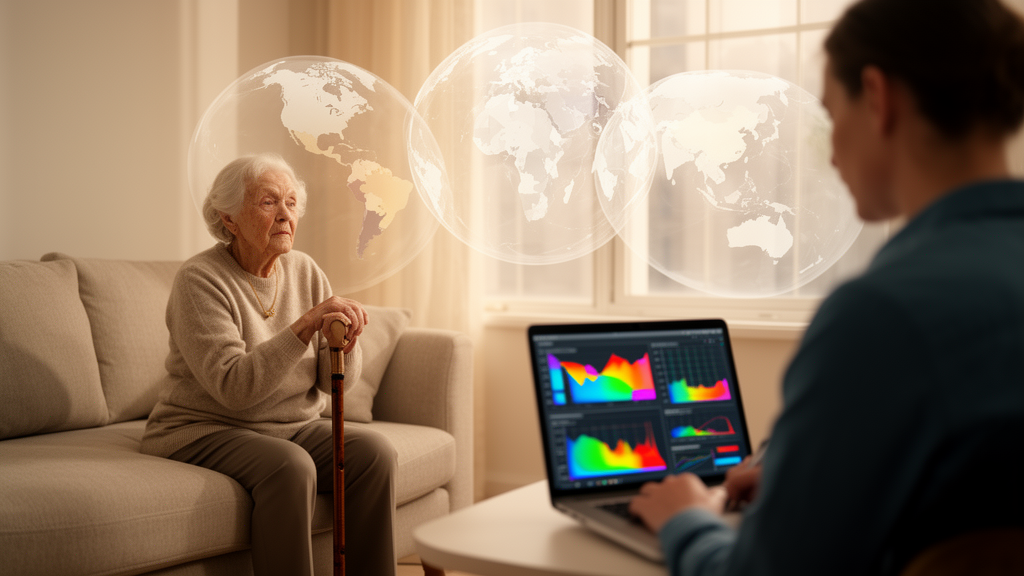
Researchers have developed and internationally validated machine learning models that predict whether older adults will develop disability in activities of daily living by the time of the next survey wave, using data from large aging studies in China, the United States and England. The open-access study, published in BMC Geriatrics, reports that a simple seven-predictor model built from readily obtainable, non-invasive information achieved moderate discrimination both over time within China and across the two other national cohorts.

The stated goal was to test whether objective measures add meaningful predictive value over non-invasive variables, a question the authors say previous single-cohort studies had left unresolved.

The primary CHARLS analysis included 8,267 unique participants and 2,070 incident disability outcomes. In internal validation, the Core Model achieved an area under the receiver operating characteristic curve (AUC) of 0.671 (95% CI 0.636 to 0.704). In the temporal evaluation on the later, participant-disjoint cohort, the AUC rose to 0.711 (0.693 to 0.729), with a Brier score of 0.166 and an observed-to-expected ratio of 1.016, indicating that predicted risks closely matched observed event rates over time.

The Objective-enriched Model reached an internal-validation AUC of 0.684 (0.649 to 0.716). Its paired AUC difference from the Core Model was 0.0131, with a confidence interval of -0.0046 to 0.0316 that crossed zero. The authors conclude that the selected objective measurements provided only modest additional predictive information, suggesting that a lean set of non-invasive predictors captures most of the available signal for this outcome.

Despite differences in cohort measurement systems, which meant several predictors were unavailable or could only be approximately mapped, the models retained moderate discrimination, with AUCs between 0.692 and 0.729 across the two external samples.

Calibration, however, did not transfer as cleanly. In the HRS and ELSA evaluations, predicted risks exceeded observed event rates, with observed-to-expected ratios ranging from 0.441 to 0.495. This means the models systematically overestimated disability risk in these populations, likely reflecting differences in how disability and its predictors were measured across the cohorts.

The authors emphasize that cross-population implementation should be preceded by cohort-specific predictor harmonization, recalibration, and prospective evaluation. They also note that earlier CHARLS-based models generally used a single development period, relied on random-split internal validation, or focused on restricted clinical subgroups, leaving temporal stability and cross-national transportability uncertain until now.

The findings are limited by the observational cohort design, the survey-based definition of disability, and the imperfect mapping of predictors across measurement systems, so the reported performance should be interpreted as a benchmark for further validation rather than a ready-to-deploy clinical tool.

Subject of Research: Machine learning prediction of incident disability in older adults using CHARLS, HRS and ELSA cohort data

Article Title: Development and international validation of machine learning models for predicting incident disability in older adults: a multi-cohort study using CHARLS, HRS, and ELSA

Article References: Liu, H., Chen, Y., Yang, X., & Wang, S. (2026). Development and international validation of machine learning models for predicting incident disability in older adults: a multi-cohort study using CHARLS, HRS, and ELSA. BMC Geriatrics. https://doi.org/10.1186/s12877-026-08595-0

Image Credits: AI Generated

DOI: 10.1186/s12877-026-08595-0

Keywords: machine learning, disability prediction, older adults, CHARLS, HRS, ELSA, XGBoost, ADL, IADL, model validation, BMC Geriatrics, aging research

Cite Scienmag News

Teresa Odom. (October 28, 2026). Machine learning models predict disability risk in older adults across three countries. Scienmag. https://scienmag.com/machine-learning-models-predict-disability-risk-in-older-adults-across-three-countries/

Teresa Odom. "Machine learning models predict disability risk in older adults across three countries." Scienmag, 28 October 2026, https://scienmag.com/machine-learning-models-predict-disability-risk-in-older-adults-across-three-countries/. Accessed 29 October 2026.

Teresa Odom. "Machine learning models predict disability risk in older adults across three countries." Scienmag. October 28, 2026. https://scienmag.com/machine-learning-models-predict-disability-risk-in-older-adults-across-three-countries/

Tags: ADLAging Researchaging studies in Chinaaging study datasets and model performanceand EnglandBMC GeriatricsCHARLScross-national validation of aging modelsDisability predictiondisability prediction using machine learningELSAhealth data analysis in older adultsHRSIADLlong-term disability risk predictionMachine learningMachine learning models for predicting disability risk in older adultsmodel validationnon-invasive health predictors for elderlyobjective health measures vs. non-invasive variablesolder adultsopen-access geriatric health researchrisk assessment in activities of daily livingUSvalidation of predictive models in aging populationsXGBoost
Share26Tweet16
Previous Post

Live-Streamed Grasslands: How Short Video Scenes Drive Premium Mutton Purchases

Next Post

Tumor-derived exosomes drive cochlear hair cell ferroptosis in vestibular schwannoma

Related Posts

REM Sleep Deprivation in Rats Tied to Manic- and OCD-Like Behaviors and Hippocampal Gene Changes
Psychology & Psychiatry

REM Sleep Deprivation in Rats Tied to Manic- and OCD-Like Behaviors and Hippocampal Gene Changes

October 29, 2026
Research report: Nursing as a systems profession in One Health: opportunities across the Quadripartite action tracks
Medicine

Research report: Nursing as a systems profession in One Health: opportunities across the Quadripartite action tracks

October 29, 2026
Nearly half of patients admitted for suspected sepsis do not meet sepsis criteria
Medicine

Nearly half of patients admitted for suspected sepsis do not meet sepsis criteria

October 29, 2026
New AI Model Learns a Generative Map of EEG Microstates While Preserving Their Spatial Shape
Medicine

New AI Model Learns a Generative Map of EEG Microstates While Preserving Their Spatial Shape

October 29, 2026
Novel Knitted Heart Patch Shows Early Tissue Ingrowth in Infant Case Report
Medicine

Novel Knitted Heart Patch Shows Early Tissue Ingrowth in Infant Case Report

October 29, 2026
What shapes women’s preference for a dual prevention pill in South Africa and Zimbabwe
Medicine

What shapes women’s preference for a dual prevention pill in South Africa and Zimbabwe

October 29, 2026
Next Post
Tumor-derived exosomes drive cochlear hair cell ferroptosis in vestibular schwannoma

Tumor-derived exosomes drive cochlear hair cell ferroptosis in vestibular schwannoma

  • Mothers who receive childcare support from maternal grandparents show more optimized

    Mothers who receive childcare support from maternal grandparents show more parental warmth, finds NTU Singapore study

    27656 shares
    Share 11059 Tweet 6912
  • University of Seville Breaks 120-Year-Old Mystery, Revises a Key Einstein Concept

    1061 shares
    Share 424 Tweet 265
  • Bee body mass, pathogens and local climate influence heat tolerance

    682 shares
    Share 273 Tweet 171
  • Researchers record first-ever images and data of a shark experiencing a boat strike

    546 shares
    Share 218 Tweet 137
  • Groundbreaking Clinical Trial Reveals Lubiprostone Enhances Kidney Function

    531 shares
    Share 212 Tweet 133
Science

Embark on a thrilling journey of discovery with Scienmag.com—your ultimate source for cutting-edge breakthroughs. Immerse yourself in a world where curiosity knows no limits and tomorrow’s possibilities become today’s reality!

RECENT NEWS

  • Silenced Gene PRSS33 Reactivates Antitumor Immunity in Myelodysplastic Syndromes
  • REM Sleep Deprivation in Rats Tied to Manic- and OCD-Like Behaviors and Hippocampal Gene Changes
  • Research report: Nursing as a systems profession in One Health: opportunities across the Quadripartite action tracks
  • Successive soybean plantings reshape soil microbiomes to suppress cyst nematode

Categories

  • Agriculture
  • Anthropology
  • Archaeology
  • Athmospheric
  • Biology
  • Biotechnology
  • Blog
  • Bussines
  • Cancer
  • Chemistry
  • Climate
  • Earth Science
  • Editorial Policy
  • Marine
  • Mathematics
  • Medicine
  • Pediatry
  • Policy
  • Psychology & Psychiatry
  • Science Education
  • Science News
  • Social Science
  • Space
  • Technology and Engineering

Subscribe to Blog via Email

Enter your email address to subscribe to this blog and receive notifications of new posts by email.

Join 5,151 other subscribers

© 2025 Scienmag - Science Magazine

Welcome Back!

Login to your account below

Forgotten Password?

Retrieve your password

Please enter your username or email address to reset your password.

Log In
No Result
View All Result
  • HOME
  • SCIENCE NEWS
  • CONTACT US

© 2025 Scienmag - Science Magazine

Discover more from Science

Subscribe now to keep reading and get access to the full archive.

Continue reading