


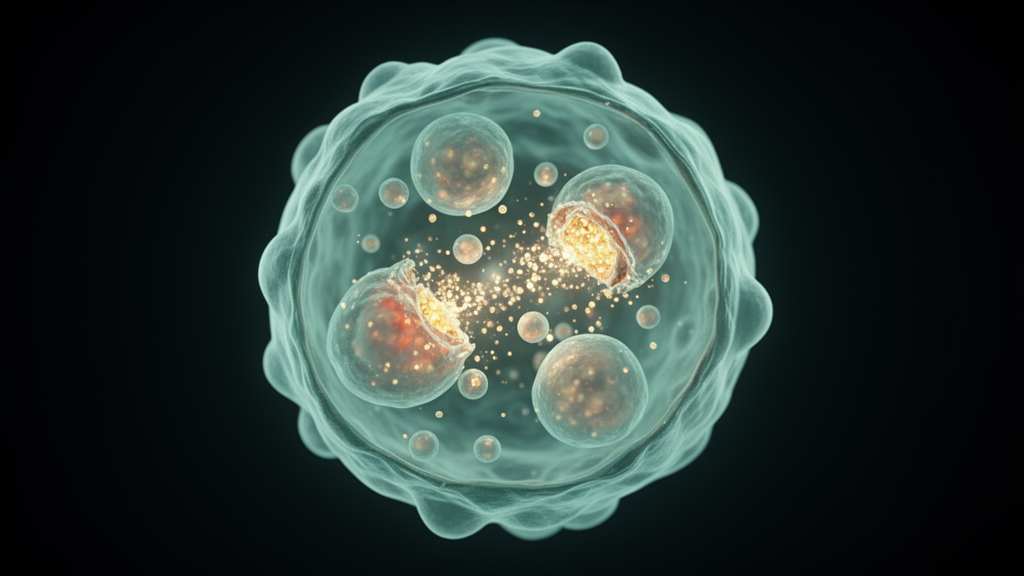
For decades, the study of regulated cell death has revolved around a familiar cast of characters: the mitochondrion, the nucleus, and the cellular membrane. Apoptosis, ferroptosis, necroptosis, and pyroptosis are now textbook pathways, each defined by characteristic molecular events such as caspase activation, lipid peroxidation, inflammatory signaling, or catastrophic DNA damage. A new review published in Cell Death & Discovery by Faisal Thayyullathil, Anees Rahman Cheratta, and Sehamuddin Galadari of New York University Abu Dhabi argues that this framework is incomplete. The authors propose a distinct, redox-dependent mode of cell death they call triaptosis, in which the decisive events unfold not in mitochondria or the nucleus but in endosomes, the membrane-bound vesicles that govern the trafficking and sorting of cellular cargo.
The central claim of the review is that reactive oxygen species, long recognized as master regulators of cell fate, can kill a cell by disabling a specific lipid kinase that maintains endosomal identity. That kinase is the class III phosphatidylinositol 3-kinase, better known in the field as PIK3C3 or VPS34. VPS34 is responsible for generating phosphatidylinositol 3-phosphate, or PI3P, a signaling lipid that decorates early endosomes and recruits the effector proteins needed for vesicular trafficking, endosomal maturation, and autophagy initiation. According to the authors, when oxidative stress reaches a critical level, ROS oxidize and inactivate VPS34. The resulting depletion of PI3P strips endosomes of their molecular identity, disrupts the trafficking networks that depend on it, and sets in motion a cascade that ends with the accumulation of enlarged, dysfunctional vacuoles and progressive cellular collapse.
What makes triaptosis mechanistically distinctive is its stubborn persistence in the face of interventions that block every canonical death pathway. The review emphasizes that triaptosis proceeds even when caspases are inhibited, when necroptotic signaling is suppressed, and when lipid peroxidation is prevented. In other words, a cell undergoing triaptosis does not die because its executioner caspases have been activated, because its membrane lipids have been oxidized in the manner characteristic of ferroptosis, or because inflammatory necroptotic machinery has fired. Instead, the defining lesion is the ROS-driven failure of endosomal homeostasis. This pharmacological independence is precisely what elevates triaptosis from a curiosity to a candidate for a genuinely separate cell death program, and it offers researchers a new set of experimental handles for distinguishing it from apoptosis, ferroptosis, necroptosis, and pyroptosis in cultured cells and tissues.
The spatial logic of the pathway is central to the authors’ argument. Redox signaling, they stress, is not a uniform flood of oxidizing molecules but a spatially organized and context-dependent system in which specific organelles experience specific oxidative insults. Established ROS-regulated death pathways have largely been interpreted through mitochondrial dysfunction, lipid peroxidation, inflammatory signaling, and DNA damage, leaving the endosomal system underexplored as a primary target of oxidative killing. Triaptosis fills that gap by proposing that the endosome itself can be the decisive target. In this view, ROS-mediated cytotoxicity may arise through targeted organelle failure alongside mitochondrial dysfunction, lipid peroxidation, and nuclear damage, expanding the conceptual map of how oxidants decide whether a cell survives, adapts, or dies.
A key question for any proposed death pathway is what determines whether a given cell succumbs. For triaptosis, the review identifies the answer in the cell’s redox buffering capacity, the biochemical machinery that keeps reactive oxygen species in check. Two components loom largest. The first is glutathione, the abundant intracellular antioxidant that directly neutralizes oxidants and maintains protein thiols in their reduced state. The second is the KEAP1-NRF2 pathway, the master transcriptional circuit that senses electrophilic and oxidative stress and, in response, upregulates a broad program of antioxidant and detoxifying genes. Together, glutathione levels and KEAP1-NRF2 activity set the threshold at which VPS34 becomes oxidized and PI3P begins to disappear. Cells with robust buffering can tolerate oxidative insults that would push a poorly buffered neighbor over the edge into endosomal collapse.
This threshold concept has immediate implications for how scientists might study and manipulate the pathway. Because triaptosis depends on VPS34 oxidation rather than on any single downstream executioner, the susceptibility of a cell is essentially a function of how close its redox state sits to the point of kinase failure. Experimental manipulations that deplete glutathione, inhibit NRF2 signaling, or otherwise erode antioxidant defenses would be expected to lower the threshold, allowing oxidative stresses that are otherwise survivable to trigger PI3P loss and vacuolar catastrophe. Conversely, reinforcing antioxidant capacity should raise the threshold and protect cells. This framework turns triaptosis into a quantifiable phenomenon: rather than asking simply whether ROS are present, researchers can ask whether a cell’s buffering capacity has been pushed below the level needed to keep VPS34 functional.
The therapeutic implications, particularly in oncology, form one of the most provocative threads of the review. Cancer cells frequently live in a state of elevated basal oxidative stress, a consequence of oncogenic signaling, metabolic reprogramming, and rapid proliferation. To survive, they compensate by shoring up their antioxidant systems, often relying heavily on glutathione metabolism and NRF2-driven transcription. The authors argue that this adaptation places many tumors in a near-threshold redox state, poised perilously close to the point at which VPS34 oxidation and PI3P depletion begin. In such cells, a modest additional oxidative push, or a targeted erosion of glutathione buffering, could selectively tip the balance toward endosomal collapse while sparing normal cells that operate with a wider redox margin. Triaptosis thus offers a conceptual route to exploiting a well-known vulnerability of cancer cells through an organelle-specific mechanism that has not previously been targeted.
The review also situates triaptosis within the broader network of ROS-regulated cell death, drawing careful distinctions between the new pathway and its established relatives. Apoptosis is executed by caspases and characterized by nuclear fragmentation and membrane blebbing; ferroptosis depends on iron-catalyzed lipid peroxidation of cellular membranes; necroptosis and pyroptosis are lytic, inflammatory programs driven by dedicated signaling complexes. Triaptosis shares none of these execution mechanisms and is instead defined by the loss of PI3P-dependent endosomal identity and the accumulation of dysfunctional vacuoles. The authors integrate the pathway into the ROS-RCD network as a parallel branch rather than a variant of any existing program, suggesting that the cellular response to oxidative stress may branch at an early point: if mitochondria, membranes, and DNA hold, the endosomal system may nonetheless fail, and that failure alone can be lethal.
As a review article, the work synthesizes and interprets rather than reports a single decisive experiment, and the authors are careful to frame triaptosis as an emerging framework whose boundaries remain to be mapped. Open questions include precisely how ROS oxidize VPS34 in living cells, which cysteine residues or cofactors are most vulnerable, how quickly PI3P must be depleted before endosomal identity is irreversibly lost, and whether the enlarged vacuoles that characterize the pathway are cause or consequence of the final collapse. It will also fall to future work to identify biomarkers that distinguish triaptosis in pathological tissue and to develop pharmacological tools that modulate the pathway selectively. The study was supported by a grant from New York University Abu Dhabi, and the authors declare no competing interests.
Even with those caveats, the appearance of triaptosis in the cell death literature marks a notable conceptual shift. It relocates a decisive node of oxidative cell death from the power plants and archives of the cell to its logistics network, and it reframes redox toxicity as a matter of targeted organelle failure rather than indiscriminate damage. If subsequent experimental work confirms and refines the mechanism, triaptosis could reshape how researchers think about oxidative stress in cancer therapy, neurodegeneration, and inflammatory disease, and it may inspire a search for other organelle-centered death programs hiding in plain sight. For a field that has spent decades cataloguing the ways cells die, the message is that the map is still expanding, and that some of the most important territory may lie in the smallest of cellular compartments.
Subject of Research: An endosome-centered mechanism of ROS-regulated cell death involving oxidative inactivation of VPS34 and depletion of PI3P
Article Title: Triaptosis: an emerging endosome-centered mechanism of ROS-regulated cell death
Article References: Thayyullathil, F., Cheratta, A. R., & Galadari, S. (2026). Triaptosis: an emerging endosome-centered mechanism of ROS-regulated cell death. Cell Death Discovery. https://doi.org/10.1038/s41420-026-03368-5
Image Credits: AI Generated
DOI: 10.1038/s41420-026-03368-5
Keywords: triaptosis, cell death, reactive oxygen species, endosomes, VPS34, PI3P, oxidative stress, glutathione, KEAP1-NRF2, ferroptosis, apoptosis, cancer therapy
Cite Scienmag News
Ophelia Keating. (October 9, 2026). Triaptosis: Scientists Unveil a New Form of Cell Death Centered on Endosomes. Scienmag. https://scienmag.com/triaptosis-scientists-unveil-a-new-form-of-cell-death-centered-on-endosomes/
Ophelia Keating. "Triaptosis: Scientists Unveil a New Form of Cell Death Centered on Endosomes." Scienmag, 9 October 2026, https://scienmag.com/triaptosis-scientists-unveil-a-new-form-of-cell-death-centered-on-endosomes/. Accessed 9 October 2026.
Ophelia Keating. "Triaptosis: Scientists Unveil a New Form of Cell Death Centered on Endosomes." Scienmag. October 9, 2026. https://scienmag.com/triaptosis-scientists-unveil-a-new-form-of-cell-death-centered-on-endosomes/


