


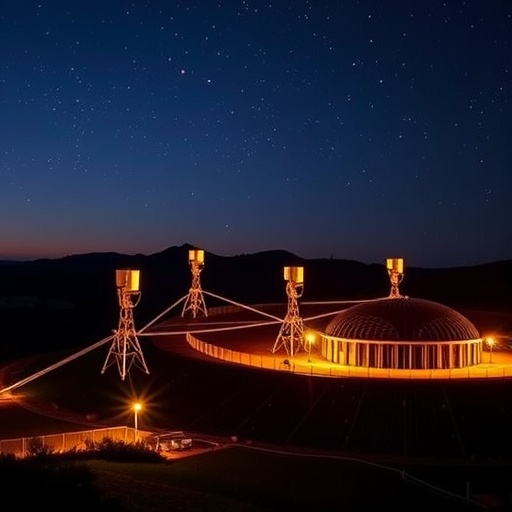
In a monumental stride toward securing Europe’s digital future, the TransEuroOGS project has officially commenced, marking a pivotal advancement in the EuroQCI (European Quantum Communication Infrastructure) initiative. This ambitious venture aims to forge an integrated network of eight interoperable optical ground stations (OGS) strategically positioned across four European Union member states: Germany, Greece, Ireland, and Luxembourg. With a robust budget nearing €18 million, jointly supported by the European Union and national governments, TransEuroOGS stands at the forefront of developing satellite-based quantum secure communication infrastructure, propelling Europe toward quantum technological sovereignty.
At its core, TransEuroOGS is designed to create a quantum-secure interface linking space-borne communication systems with terrestrial networks. This integration is accomplished through an intricate web of optical ground stations that are meticulously engineered to operate with high interoperability standards. These OGS sites serve as critical nodes, receiving quantum keys transmitted via satellites and linking this quantum information securely into local terrestrial fibre optic networks. This framework enables unbreachable encrypted communication, leveraging the fundamental principles of quantum mechanics to safeguard data against emerging cyber threats, particularly those posed by future quantum computers.
Delving into the technical essence, quantum key distribution (QKD) forms the backbone of this project. QKD utilizes quantum states—such as entangled photons or single photons encoded in polarization or phase—to generate cryptographic keys between distant parties with security guaranteed by quantum physics. Unlike classical key exchange methods, any eavesdropping attempt on a quantum channel inevitably disturbs the system, alerting legitimate users to potential security breaches. Establishing a transnational quantum communication link through these optical ground stations not only stretches the reach of QKD but also harmonizes operational protocols to ensure seamless integration and trustworthiness across multiple jurisdictions.
The geographic diversity of the eight OGS is one of TransEuroOGS’s remarkable strengths. Stretching from the northwestern reaches of Ireland and Luxembourg to the southeastern expanse of Greece, the network encompasses a range of environmental conditions and logistical challenges. Notably, the locations include both island and mainland sites, as well as rural and urban ecosystems, each presenting unique meteorological phenomena that influence optical signal propagation and station infrastructure. Addressing these variations is critical for the calibration and synchronization of quantum communication protocols, fostering resilience and reliability in real-world scenarios.
The logistical coordination and technical harmonization of these OGS units is a significant focus of the project. As these stations are at different stages of readiness—ranging from initial construction to pre-operational status—the project team is rigorously standardizing architectural frameworks, component specifications, and operational parameters. This standardization effort ensures that all stations are compatible with the stringent protocol requirements of upcoming European satellite missions such as EAGLE-1 and SAGA. These missions are pivotal testbeds for satellite-based quantum-secure communication, aiming to validate interoperability and the overall robustness of the network infrastructure.
A critical aspect of TransEuroOGS’s mission lies in its demonstration campaigns. These campaigns are designed to empirically showcase the feasibility and performance of cross-border QKD through real-time deployment and testing. By orchestrating coordinated transmissions and key exchanges among the OGS constellation, the project will validate the network’s capacity to provide continuous, secure, and high-fidelity quantum communication across challenging geographic and atmospheric conditions. Such demonstrations will pioneer pathways for integrating quantum-secure communication into both governmental and commercial applications, enhancing cybersecurity frameworks across Europe.
The consortium behind TransEuroOGS exemplifies a comprehensive collaboration. It unites leading academic institutions, innovative industry partners, and high-profile research organizations from the four participating member states. Key stakeholders include Fraunhofer IOF, which leads the project coordination efforts from Germany, alongside the German Aerospace Center’s Institute of Communications and Navigation and Friedrich-Alexander-Universität Erlangen-Nürnberg. Ireland’s national ecosystem is spearheaded by Walton Institute at South East Technological University (SETU) with the industrial partner Mbryonics adding expertise. Luxembourg brings to the table the Department of Media, Connectivity and Digital Policy (SMC), University of Luxembourg’s Sigcom Group, the Restena Foundation, and HITEC Luxembourg. Meanwhile, Greece’s network encompasses the National Infrastructures for Research and Technology (GRNET), Hellenic Ministry of Digital Governance, Hellenic Space Center, National Observatory of Athens, Aristotle University of Thessaloniki, and the Foundation for Research and Technology – Hellas.
The official kick-off in Berlin and Jena was a milestone gathering, uniting around 30 experts and representatives from 15 key institutions and agencies. This consortium meeting emphasized technical discourse and the exchange of resources critical for aligning fragmented capabilities into a coherent infrastructure. The inclusion of national space agencies and ministries underlines the project’s strategic importance and the collective commitment to positioning Europe at the vanguard of quantum communication technologies.
From a policy perspective, the German Federal Ministry of Research, Technology, and Space underscored the vital synergy between national and European efforts. Parliamentary State Secretary Matthias Hauer highlighted the critical role quantum communication plays in future-proof cybersecurity and expressed Germany’s dedicated involvement in advancing EuroQCI objectives through initiatives like TransEuroOGS. This aligns with Germany’s High-Tech Agenda, which prioritizes leadership in quantum technologies as essential to maintaining global competitiveness and technological sovereignty.
TransEuroOGS’s profound impact transcends mere network construction; it paves the way for a unified European standard in quantum communication technology interoperability. This standardization is instrumental in mitigating the technical fragmentation that often hinders cross-border collaborative technologies in Europe. By fostering consensus on design principles, safety protocols, and operational timings among diverse optical ground stations, the project fortifies Europe’s capability to deploy a secure, scalable quantum communication ecosystem.
Looking ahead, the project’s three-and-a-half-year timeline is poised to transform Europe’s quantum communication landscape. By systematically orchestrating technical validation, interoperability trials, and operational readiness, TransEuroOGS aims to establish a resilient quantum communication fabric. This will not only enhance secure communication channels for governmental functions but also catalyze the development of commercial and public sector applications, embedding quantum-secure communications into the fabric of European digital infrastructure.
Ultimately, TransEuroOGS serves as a beacon of scientific innovation and international cooperation. It concretely demonstrates how multinational synergy, cutting-edge research, and strategic investment can converge to tackle some of the most pressing cybersecurity challenges posed by the impending quantum computing era. In an age where data breaches and cyber-attacks are ever more sophisticated, projects like TransEuroOGS ensure that Europe remains at the cutting edge of protective technologies, safeguarding its digital sovereignty and securing the future of communication for generations to come.
News Publication Date: April 2024
Web References: TransEuroOGS project launch, EuroQCI initiative details (specific URLs not provided in source)
References: Not specified in the original content
Keywords
Quantum key distribution, optical ground stations, satellite quantum communication, EuroQCI, TransEuroOGS, quantum cybersecurity, quantum communication infrastructure, interoperable quantum networks, European Union quantum initiatives, EAGLE-1 mission, SAGA mission, quantum technological sovereignty
Cite Scienmag News
Bethany Barker. (May 19, 2026). TransEuroOGS Project to Connect Optical Ground Stations Across Europe. Scienmag. https://scienmag.com/transeuroogs-project-to-connect-optical-ground-stations-across-europe/
Bethany Barker. "TransEuroOGS Project to Connect Optical Ground Stations Across Europe." Scienmag, 19 May 2026, https://scienmag.com/transeuroogs-project-to-connect-optical-ground-stations-across-europe/. Accessed 3 September 2026.
Bethany Barker. "TransEuroOGS Project to Connect Optical Ground Stations Across Europe." Scienmag. May 19, 2026. https://scienmag.com/transeuroogs-project-to-connect-optical-ground-stations-across-europe/


