


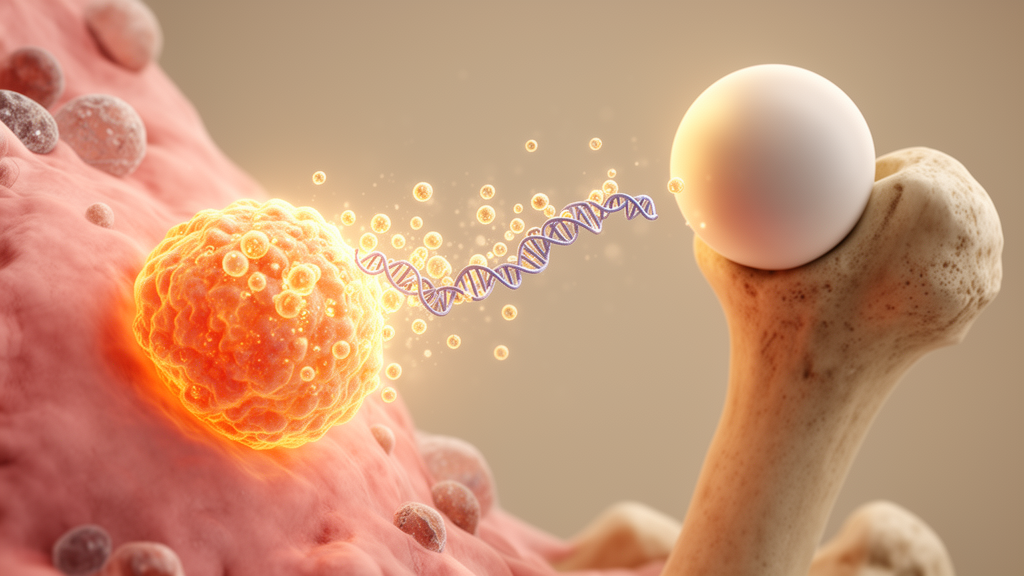
Chronic heavy drinking can quietly starve the femoral head of healthy bone until it collapses, a condition known as alcohol-induced osteonecrosis of the femoral head, or AIONFH. Now a team of researchers in China has traced a molecular chain of events that links alcohol, bone-resorbing cells, and a chemical tag on RNA, and has shown in rats that boosting a single microRNA carried between cells can partially reverse the damage. The study, published in Frontiers in Cell and Developmental Biology, points to the miR-378a-3p/FTO/m6A pathway as a potential therapeutic target for a disease that is usually detected only after permanent structural harm has occurred.
The researchers began with a simple observation about how the disease works. In a healthy femoral head, the spongy trabecular bone network is maintained by a balance between osteoblasts, which build bone, and osteoclasts, which resorb it. Long-term alcohol exposure breaks that balance in three ways at once: it blocks osteoblast growth and differentiation, it abnormally activates osteoclasts, and it kills mature osteocytes, the embedded cells that keep living bone functional.
Because early-stage AIONFH produces few symptoms, most patients are diagnosed at moderate or severe stages, when the femoral head has already collapsed and joint movement is permanently reduced. To probe how alcohol reshapes communication between these cell types, the team cultured rat bone marrow-derived macrophages and drove them to become osteoclasts, either with or without 50 millimolar ethanol, a concentration used to mimic the alcoholic microenvironment. After seven days, staining for tartrate-resistant acid phosphatase and F-actin showed that ethanol markedly increased the number of osteoclasts, enlarged the TRAP-positive cell bodies, and produced more nuclei per cell, confirming that alcohol pushes these bone-resorbing cells toward faster formation and fusion.
The critical cargo turned out to travel in exosomes, tiny membrane bubbles that cells release to send molecular messages to their neighbors. The researchers isolated exosomes from the osteoclast cultures by differential ultracentrifugation and verified their identity with transmission electron microscopy, nanoparticle tracking, and Western blots for the marker proteins TSG101 and CD63, while the endoplasmic reticulum protein Calnexin stayed negative, ruling out cellular contamination. The particles measured roughly 70 nanometers across.
High-throughput small-RNA sequencing of their contents revealed that one microRNA in particular, miR-378a-3p, was markedly depleted in exosomes from ethanol-exposed osteoclasts, a result the team confirmed by quantitative PCR. That depletion mattered because of what miR-378a-3p does downstream. A dual-luciferase reporter assay in HEK293T cells confirmed the prediction: adding miR-378a-3p mimics significantly reduced the luciferase activity of constructs carrying the wild-type FTO 3-prime-UTR, showing that the microRNA directly targets FTO and suppresses its expression.
The next question was what FTO does to bone-forming cells under alcoholic stress. In rat bone marrow mesenchymal stem cells exposed to ethanol, FTO expression rose, total m6A levels fell, osteogenic differentiation was inhibited, and apoptosis increased. When the team knocked FTO down with small interfering RNA, total m6A methylation rose and the alcohol-driven damage eased, as shown by stronger alkaline phosphatase and Alizarin red S staining and higher expression of the osteogenic markers ALP, OCN, and Collagen-1.
Overexpressing FTO produced the opposite effect. In other words, FTO acts as a negative regulator of bone formation in this context, and alcohol appears to lift the brake by stripping away the microRNA that normally restrains it. The rescue experiments tied the whole circuit together.
The researchers engineered osteoclasts to produce exosomes either enriched with miR-378a-3p or depleted of it, then applied these vesicles to ethanol-stressed mesenchymal stem cells. A dual-fluorescence tracking assay, labeling exosome membranes with DiO and their miRNA cargo with FAM, confirmed that the vesicles and their microRNA payload were absorbed by the recipient cells. Exosomes enriched in miR-378a-3p lowered FTO, raised m6A levels, promoted osteogenic differentiation, and reduced apoptosis as measured by TUNEL staining, with parallel changes in Caspase-3 and the Bax/Bcl-2 ratio.
Exosomes with the microRNA knocked down made things worse, and forcing FTO overexpression blunted the benefit of the enriched exosomes. The in vivo results followed the same pattern. Forty-eight Sprague-Dawley rats were fed an alcohol-infused liquid diet for twelve weeks to establish AIONFH, then randomly assigned to receive weekly tail-vein injections of phosphate-buffered saline, standard osteoclast exosomes, miR-378a-3p-enriched exosomes, or miR-378a-3p-depleted exosomes at 100 micrograms per dose for six weeks.
Micro-CT of the subchondral trabecular region showed that standard exosomes from alcohol-exposed osteoclasts worsened trabecular bone loss and collapse, reducing bone surface, bone volume, tissue volume, and bone volume fraction. The miR-378a-3p-enriched exosomes alleviated these changes, while the depleted exosomes exacerbated them. Histology with hematoxylin-eosin and Masson trichrome staining showed enhanced calcification of new bone in the weight-bearing region of the femoral head in the enriched-exosome group.
Apoptosis markers in the femoral head tracked the structural findings. TUNEL staining revealed more dying osteocytes in the standard-exosome group, fewer after miR-378a-3p enrichment, and even more after depletion. Immunohistochemistry showed that FTO, Caspase-3, and the Bax/Bcl-2 ratio moved in step with the number of apoptotic cells, while immunofluorescence for ALP and OCN showed the reverse trend, confirming that the treatment restored both bone formation and osteocyte survival through the same FTO-centered mechanism seen in the dish.
The authors are careful about the limits of the work. Ultracentrifugation cannot fully exclude contamination by non-exosomal particles and protein impurities; the tail-vein injections were not paired with imaging to confirm that exosomes actually reached the femoral head; the therapeutic assessment covered only a single six-week time point; the pathway was tested mainly through a rescue experiment with FTO overexpression, leaving other downstream targets unexplored; and m6A was measured only at the level of total RNA rather than on specific functional messenger RNAs. Most importantly, all experiments were performed in cells and rats, so clinical relevance in human patients remains to be demonstrated.
Even so, the study delivers a coherent disease model: chronic alcohol drains miR-378a-3p from osteoclast exosomes, FTO rises in bone-forming cells, m6A modification falls, osteogenesis falters, osteocytes die, and the femoral head collapses. Restoring a single microRNA interrupted that cascade in rats, offering a concrete molecular entry point for future therapies aimed at catching the disease before the bone gives way.
Subject of Research: The role of osteoclast-derived exosomal miR-378a-3p and FTO-mediated m6A modification in alcohol-induced osteonecrosis of the femoral head
Article Title: Osteoclast-derived exosomal miR-378a-3p targets FTO-mediated m6A modification to promote osteogenesis and inhibit osteocyte apoptosis in alcohol-induced osteonecrosis of the femoral head
Article References: Zhao, C., Liu, J., Chen, D., Guan, D., Guo, L., Wang, W., Xu, Q., Tao, H., Niu, C., Sun, B., Shao, J., & Zeng, P. (2026). Osteoclast-derived exosomal miR-378a-3p targets FTO-mediated m6A modification to promote osteogenesis and inhibit osteocyte apoptosis in alcohol-induced osteonecrosis of the femoral head. Frontiers in Cell and Developmental Biology, 14, Article 1975355. https://doi.org/10.3389/fcell.2026.1975355
Image Credits: AI Generated
DOI: 10.3389/fcell.2026.1975355
Keywords: osteonecrosis, femoral head, exosomes, miR-378a-3p, FTO, m6A modification, osteoclasts, osteogenesis, apoptosis, bone metabolism, alcohol, rat model
Cite Scienmag News
Drew Townsend. (October 26, 2026). Tiny RNA Cargo From Bone-Eating Cells Shields the Hip From Alcohol Damage. Scienmag. https://scienmag.com/tiny-rna-cargo-from-bone-eating-cells-shields-the-hip-from-alcohol-damage/
Drew Townsend. "Tiny RNA Cargo From Bone-Eating Cells Shields the Hip From Alcohol Damage." Scienmag, 26 October 2026, https://scienmag.com/tiny-rna-cargo-from-bone-eating-cells-shields-the-hip-from-alcohol-damage/. Accessed 26 October 2026.
Drew Townsend. "Tiny RNA Cargo From Bone-Eating Cells Shields the Hip From Alcohol Damage." Scienmag. October 26, 2026. https://scienmag.com/tiny-rna-cargo-from-bone-eating-cells-shields-the-hip-from-alcohol-damage/


