


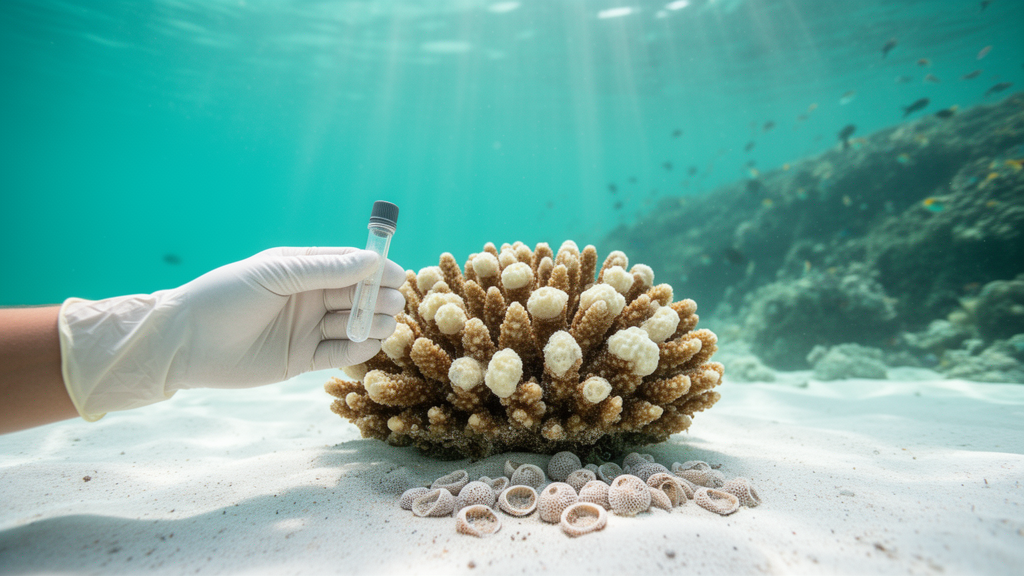
On coral reefs, some of the most reliable sentinels of environmental stress are not corals at all, but single-celled organisms barely a few millimeters across. Larger benthic foraminifera of the genus Amphistegina live on reef rubble, host microscopic algal symbionts that give them a distinctive golden-brown color, and, like corals, they bleach when heat and light push their symbiosis past its limits. A new study published in the journal Coral Reefs reports fresh results from the Maldives and, for the first time, from Australia’s Great Barrier Reef, showing that the Amphistegina bleaching index, or ABI, can detect photo-oxidative stress across seasons, years, and vastly different reef settings.
The ABI was originally developed for the Florida Keys as a standardized way to quantify visible bleaching in Amphistegina populations. It rests on two simple parameters: the density of living specimens per unit of rubble surface area, and the proportion of those individuals showing partial or complete loss of their algal symbionts. When plotted together on an ecological condition matrix, these values distinguish healthy reefs, which support dense populations with little bleaching, from reefs experiencing chronic or acute photo-inhibitory stress. Because Amphistegina bleaching can become visible within days of exposure to elevated temperature and irradiance, often before corals show any outward sign of trouble, the index has been proposed as an early warning system for reef managers.
The mechanism behind this sensitivity is well understood in broad terms. Prolonged heat stress combined with high light disrupts photosynthesis in the symbionts and promotes the production of reactive oxygen species inside the host, ultimately leading to the loss of the algae or their photosynthetic pigments. Early cytological work showed that visible bleaching in Amphistegina corresponds to chlorophyll loss and deterioration of its diatom symbionts. The same broad process drives coral bleaching, which is why the two groups of organisms respond in parallel, although symbiont loss can also be triggered by darkness, salinity changes, pollution, sedimentation, disease, and parasitism, complicating interpretation in some settings.
In the new study, a team led by Torin Cannings of the University of Geneva revisited four sites in Alifu Alifu Atoll in the central Maldives in May 2025, extending a record that began in 2015 and continued in 2018. The Maldivian sites, which include resort, community, and uninhabited islands, are remote from continental influence, making them well suited for tracking climate-related change. The 2015 survey had been conducted just before an El Nino-related bleaching event devastated corals across the region, while the 2018 survey documented conditions during recovery. The 2025 survey, by contrast, took place in the year following the widespread 2023 to 2024 global coral bleaching event.
The results were striking. The geometric mean of fully bleached specimens in 2025 was just 2 percent, compared with 7 percent in 2015 and 10 percent in 2018. Overall, only 15 percent of the 1,832 specimens examined showed any sign of bleaching, far below the 30 percent recorded in 2015 and 36 percent in 2018. No 2025 samples plotted in the ABI matrix regions associated with acute photo-oxidative stress, and the pronounced scatter in the 2015 data, previously interpreted as evidence of building stress ahead of the mass bleaching event, was absent. Mean abundances of Amphistegina remained broadly consistent across the decade, although slight reductions at some sites may reflect residual effects of the recent global bleaching event or local environmental differences.
The Australian component of the study brought the ABI to Lizard Island, also known as Jiigurru, on the northern Great Barrier Reef, a long-established focal site for coral bleaching research. Samples were collected from two sites, North Point and the more developed Watson Bay, during austral winter in August 2022 and again during austral summer in February 2024, when Degree Heating Weeks at the island exceeded 6 degrees Celsius-weeks amid the global bleaching event. The seasonal contrast proved dramatic. In winter 2022, bleaching affected 21 percent of specimens at North Point and 15 percent at Watson Bay. By summer 2024, those figures had climbed to 39 percent and 54 percent respectively, with fully bleached individuals reaching 12 percent of the assemblage at Watson Bay.
Population structure shifted in parallel. In winter 2022, small specimens under one millimeter made up less than 10 percent of the assemblages at both sites, but by summer 2024 they accounted for roughly half. The researchers attribute this partly to the seasonal peak in asexual reproduction during austral spring and early summer, a pattern documented in Amphistegina populations from Florida, where bursts of juvenile production coincide with elevated partial bleaching in adults. The ABI scores captured all of this: winter samples clustered in matrix regions indicating chronic mild or non-photo-oxidative stress, while summer samples shifted toward regions signaling recent acute stress, with minimal overlap between the two sampling intervals.
Notably, the ABI results aligned closely with independently derived satellite products. In both regions, survey periods characterized by heightened thermal stress or widespread coral bleaching corresponded to elevated bleaching levels and shifts in ABI scores, and these matched the alert status of NOAA’s Coral Reef Watch program. In the Maldives, the elevated stress recorded in 2015 preceded the extensive coral bleaching observed weeks later, reinforcing the idea that Amphistegina can serve as a biological early-warning indicator. The authors emphasize that the index is most powerful when combined with physical measurements such as temperature and water transparency, and with observations of corals and coralline algae, so that foraminiferal stress signals can be placed in a broader ecosystem context.
The practical appeal of the ABI lies in its simplicity and cost. Sampling requires a single dive per site, with three 50-meter transects laid at about 10 meters depth and coral rubble collected at fixed intervals. Back on the surface, rubble pieces are brushed to dislodge the foraminifera, which are given a couple of hours in dim light to migrate to the surface of petri dishes before being picked under a stereomicroscope, identified to species, sorted by size, and scored as normal, partially bleached, or bleached. Rubble surface area is measured from photographs to calculate population density. The whole workflow demands modest equipment and training, making it feasible for monitoring programs and even reef-dependent communities where frequent underwater surveys or aerial assessments would be prohibitively expensive.
The study does not claim that the ABI replaces large-scale bleaching assessments based on remote sensing or underwater surveys. Rather, the authors argue, it complements them by improving temporal resolution and providing biological ground truth in places where such surveys are difficult to sustain. Continued application at the sites already covered in Florida, the Maldives, and now Australia will be essential to extend long-term records and strengthen interannual and seasonal comparisons, and further testing across other reef regions will clarify how consistent the index remains under different environmental conditions. As marine heatwaves grow in frequency, duration, and severity, a cheap, repeatable, and biologically grounded tool that can flag rising bleaching risk before corals turn white may prove an invaluable addition to the reef-monitoring toolkit, one that turns the humblest inhabitants of the reef into messengers of its health.
Subject of Research: Using the Amphistegina bleaching index to monitor photo-oxidative stress and reef ecosystem health in the Maldives and on the Great Barrier Reef
Article Title: The Amphistegina bleaching index as a tool for evaluating reef-ecosystem health: new data from the Maldives & Australia provide updated insights
Article References: Cannings, T., Basso, D., Flöter, S., Hallock, P., Pisapia, C., Ross, B. J., Stainbank, S., Spezzaferri, S., & Samankassou, E. (2026). The Amphistegina bleaching index as a tool for evaluating reef-ecosystem health: new data from the Maldives & Australia provide updated insights. Coral Reefs. https://doi.org/10.1007/s00338-026-02973-1
Image Credits: AI Generated
DOI: 10.1007/s00338-026-02973-1
Keywords: Amphistegina, coral reefs, bleaching index, foraminifera, Maldives, Great Barrier Reef, Lizard Island, photo-oxidative stress, bioindicator, reef monitoring, symbiont loss, NOAA Coral Reef Watch
Cite Scienmag News
Violet Maxwell. (October 17, 2026). Tiny Reef Sentinels: Foraminifera Bleaching Index Tracks Coral Stress from the Maldives to the Great Barrier Reef. Scienmag. https://scienmag.com/tiny-reef-sentinels-foraminifera-bleaching-index-tracks-coral-stress-from-the-maldives-to-the-great-barrier-reef/
Violet Maxwell. "Tiny Reef Sentinels: Foraminifera Bleaching Index Tracks Coral Stress from the Maldives to the Great Barrier Reef." Scienmag, 17 October 2026, https://scienmag.com/tiny-reef-sentinels-foraminifera-bleaching-index-tracks-coral-stress-from-the-maldives-to-the-great-barrier-reef/. Accessed 17 October 2026.
Violet Maxwell. "Tiny Reef Sentinels: Foraminifera Bleaching Index Tracks Coral Stress from the Maldives to the Great Barrier Reef." Scienmag. October 17, 2026. https://scienmag.com/tiny-reef-sentinels-foraminifera-bleaching-index-tracks-coral-stress-from-the-maldives-to-the-great-barrier-reef/


