


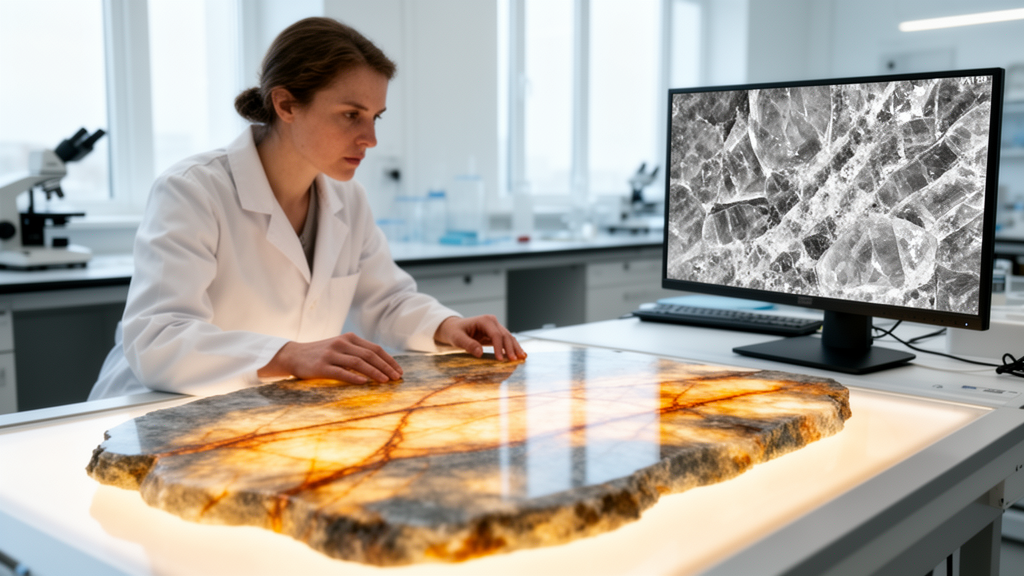
Every rock tells a story, but sometimes the story gets garbled in translation. Scientists at King Fahd University of Petroleum and Minerals and Saudi Aramco have developed a deep learning workflow that automatically cleans up micro-computed tomography (micro-CT) images of rock samples, removing noise and artifacts that have long plagued geologists trying to peer inside stones. The research, published in Earth Science Informatics, demonstrates how artificial intelligence can recover pristine images from degraded scans, potentially transforming how the petroleum industry characterizes the hidden pore networks that determine how oil, gas, and water flow through reservoir rocks.
Micro-CT imaging works like a medical CT scanner but at microscopic scale, firing X-rays through rock cores to build three-dimensional maps of pores, grains, and fractures. These digital rock models are the foundation of digital rock physics, a field that uses computed properties to predict how fluids move through stone without destructive testing. But the images are rarely clean. Salt-and-pepper noise scatters bright and dark pixels randomly across the picture. Ring artifacts draw concentric circles around the center of rotation, like ripples frozen in stone. Beam-hardening-like artifacts darken the edges and corners, distorting the true density of the rock. Each degradation type traditionally demands its own specialized filter, its own parameter tuning, and its own manual inspection, turning image cleanup into a slow, error-prone bottleneck.
The team, led by Xu Jiang, built a three-stage workflow: dataset preparation, model training, and prediction with performance evaluation. First, they generated a synthetic dataset of 35,060 paired images—one noisy, one clean—covering isolated and combined degradations of all three artifact types. By training on pairs where the ground truth is known, the models learn to reverse the damage without ever seeing a real scan during training. This synthetic approach sidesteps the fundamental problem that real degraded micro-CT images almost never come with clean reference versions for comparison.
Three deep learning architectures went head to head: U-Net, a convolutional network originally designed for biomedical image segmentation; an adapted FCN-ResNet50, which combines fully convolutional layers with a deep residual backbone; and a Hybrid Swin Transformer, which brings the attention mechanisms that revolutionized natural language processing to image restoration. U-Net processes images through an encoder-decoder structure with skip connections, preserving fine spatial detail while building abstract representations. The Swin Transformer uses shifted windows of self-attention to capture long-range dependencies, letting the model understand that a dark edge in one corner relates to the overall illumination pattern rather than being a real rock feature.
The results were evaluated on independent sandstone and carbonate slices with synthetically generated noise, using both visual comparison and quantitative metrics. Peak signal-to-noise ratio (PSNR) measures how closely the denoised image matches the clean reference in terms of pixel-level fidelity. Structural similarity index (SSIM) goes further, assessing whether perceptually important structures—edges, textures, contrast—survive the cleanup. Beyond image quality, the team measured pore-structure descriptors based on Minkowski functionals, mathematical tools from integral geometry that quantify the morphology of the pore space, including its volume, surface area, curvature, and connectivity. These descriptors matter because they feed directly into permeability and resistivity predictions downstream.
U-Net achieved the highest mean PSNR and SSIM across all evaluated synthetic conditions, while the Hybrid Swin Transformer produced closely comparable image-quality results. Both models generally recovered pore-structure descriptors close to those obtained from segmentations of the clean reference images. The adapted FCN-ResNet50 lagged behind, suggesting that the encoder-decoder architecture with skip connections is particularly well suited to this task. Traditional methods, which required artifact-specific selection and parameter tuning, could not match the deep learning models on combined degradations, where multiple noise types overlapped in the same image.
The true test came on real images. Three independent micro-CT slices containing identifiable beam-hardening-like or ring artifacts were evaluated qualitatively, because no clean references existed. U-Net and the Hybrid Swin Transformer visually attenuated the structured artifacts while preserving the contrast between pores and grains. This preservation is critical: an aggressive filter that smooths away artifacts can also smooth away real geological features, destroying the very information the scan was meant to capture. The deep learning models walked this tightrope successfully, removing what was fake while keeping what was real.
The implications ripple outward. Faster, more reliable image cleanup means more rock samples can be characterized in less time, accelerating reservoir evaluation and reducing the manual intervention that has long been required. The workflow handles isolated and combined degradations within a single trained model, eliminating the need to select and tune different filters for different artifact types. Because the models were trained entirely on synthetic data, they can be retrained on new degradation patterns without collecting new paired real images, making the approach adaptable to different scanner configurations and rock types.
The team has released both the source code on GitHub and the dataset on Zenodo, inviting researchers worldwide to build on the work. As deep learning continues to penetrate every corner of science, this study shows that the tools of computer vision—originally developed for medical imaging and natural language processing—can solve stubborn problems in geoscience, one noisy pixel at a time. The rocks are finally speaking clearly.
Subject of Research: Micro-CT image denoising of rock sample using deep learning
Article Title: Micro-CT image denoising of rock sample using deep learning
Article References: Jiang, X., Wang, Y., Jin, G., Deshenenkov, I., Kwak, H., & Alqahtani, N. J. (2026). Micro-CT image denoising of rock sample using deep learning. Earth Science Informatics, 19(12), Article 214. https://doi.org/10.1007/s12145-026-02266-9
Image Credits: AI Generated
DOI: 10.1007/s12145-026-02266-9
Keywords: deep learning, micro-CT, digital rock physics, image denoising, petroleum geoscience, U-Net, Swin Transformer, image, denoising, rock, sample, deep
Cite Scienmag News
Blake Davidson. (October 17, 2026). Deep Learning Cleans Up Rock Scans, One Noisy Pixel at a Time. Scienmag. https://scienmag.com/deep-learning-cleans-up-rock-scans-one-noisy-pixel-at-a-time/
Blake Davidson. "Deep Learning Cleans Up Rock Scans, One Noisy Pixel at a Time." Scienmag, 17 October 2026, https://scienmag.com/deep-learning-cleans-up-rock-scans-one-noisy-pixel-at-a-time/. Accessed 17 October 2026.
Blake Davidson. "Deep Learning Cleans Up Rock Scans, One Noisy Pixel at a Time." Scienmag. October 17, 2026. https://scienmag.com/deep-learning-cleans-up-rock-scans-one-noisy-pixel-at-a-time/


