


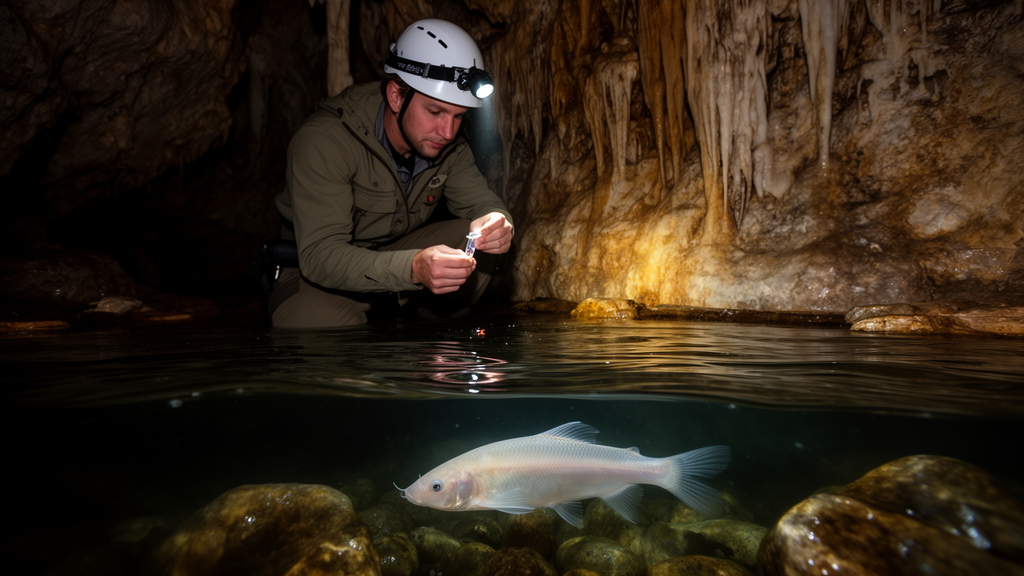
Deep beneath the arid landscapes of north-western Australia, two species of tiny, eyeless fish drift through groundwater aquifers that no human eye can easily reach. Now, scientists have developed a genetic detection tool that can find them from nothing more than a sample of water, offering a lifeline for conservation efforts targeting some of the country’s most elusive vertebrates.
The two cave gudgeons, Milyeringa justitia and Milyeringa veritas, are entirely restricted to subterranean waters and have been listed as endangered and vulnerable respectively under Australian Commonwealth law, with the IUCN Red List categorising them as critically endangered and endangered. Their habitats are physically inaccessible, their populations are extremely low in density, and their conservation status limits the ability to capture or handle individuals for study. Conventional survey methods such as visual observation, cave diving, cameras, netting, or baited trapping are logistically challenging and often ineffective in these conditions.
A research team publishing in the journal Metabarcoding and Metagenomics has now designed and validated a genus-specific environmental DNA assay, called MilyeringaCR, that detects DNA shed by these fish into the groundwater. Environmental DNA, or eDNA, is the genetic material organisms release into their surroundings through excretions, secretions, and tissues such as skin cells. Because it can be collected from water samples without disturbing the animals, eDNA has become a powerful alternative for monitoring rare aquatic fauna, including subterranean species.
To build the assay, the researchers first sequenced and assembled the mitochondrial genomes of both species from vouchered museum specimens held at the Western Australian Museum. Using high-throughput sequencing on an Illumina MiSeq platform, they achieved robust coverage for three of four tissue samples, producing essentially complete circular mitogenomes of approximately 16,588 base pairs containing the full complement of vertebrate mitochondrial genes: two rRNA genes, 22 tRNA genes, and 13 protein-coding genes, plus the putative control region. The closest mitochondrial match currently on GenBank was to Oxyeleotris marmorata, the marble gudgeon found in Asia, at 78.6% similarity, underscoring how genetically distinct these Australian cave fishes are.
The mitochondrial control region was selected as the target for the qPCR assay because of its high variability, which provides greater resolution for distinguishing closely related populations. Consensus sequences were aligned and conserved primer regions targeting a roughly 230-base-pair fragment were identified, with the final assay designed using Primer3 software. In-silico testing across the NCBI GenBank database confirmed that no non-target fish species would bind to the primers with four or fewer mismatches, providing strong theoretical specificity before any laboratory work began.
Laboratory validation revealed striking differences in sensitivity between the two species. For M. justitia, the assay demonstrated a modelled limit of detection of just 1.36 copies of DNA per reaction and a limit of quantification of 6 copies per reaction, with a standard curve showing high precision (R² = 0.998), a slope of -3.46, and a PCR efficiency of 94%. For M. veritas, the modelled limit of detection was higher at 12.8 copies per reaction with a limit of quantification of 524 copies per reaction, reflecting lower precision in the standard curve (R² = 0.862) and an efficiency of 88%. Empirical testing, however, showed that all ten replicates amplified successfully for M. veritas at 41 copies per reaction, indicating reliable detection well below the modelled quantification threshold.
The researchers also tested the assay against eDNA extracts from surface water on the Swan Coastal Plain of Western Australia, where numerous fish taxa were identified including cichlids, gobies, minnows, carps, toothcarps, goldfish, Eastern Gambusia, Pearl Cichlid, and Western Hardyhead. No PCR amplification occurred in any of these non-target samples, confirming the assay’s exclusivity. Inhibition testing using an eDNA extract with known PCR-inhibitory properties showed that the assay could still detect both species’ DNA in the presence of environmental inhibitors once the extract was diluted, with cycle threshold values remaining below 40 cycles.
In-situ validation was performed on groundwater samples collected from the Cape Range peninsula, where M. veritas is known to occur and was visually observed co-occurring with the Blind Cave Eel at the time of collection. Of the 18 reactions run on neat eDNA groundwater extracts, 15 (83%) showed successful amplification with melt peaks identical to the positive control. Sanger sequencing confirmed the amplicons were a 100% match to the reference mitogenome, providing definitive confirmation that the assay had amplified its intended target DNA in a real field setting.
The mitochondrial genome data also provided preliminary genetic insights. Sequencing of two M. justitia mitogenomes from Barrow Island revealed 12 single nucleotide polymorphisms, corresponding to 0.1% sequence variation, suggesting limited haplotype diversity within the population that could potentially indicate a bottleneck, founder effect, or restricted gene flow. In contrast, comparison with the mostly complete M. veritas mitogenome identified 2,538 SNPs, representing 11.3% sequence divergence between the species. The researchers caution that the small sample size means these findings should be interpreted cautiously, and broader spatial and temporal groundwater sampling may uncover additional mitochondrial diversity.
The conservation stakes are considerable. Barrow Island, where M. justitia is endemic, has been a Class A Nature Reserve since 1910 but is also the site of the large Gorgon gas processing project and, until recently, an active oil field dating back to the 1960s. The known habitat of M. justitia coincides with the island’s industrial zone, making habitat disturbance from industrial activities the primary threat. Both species face additional pressures from nutrient enrichment and pollution, lowering of the water table, and urban, tourism, and industrial development. A non-invasive genetic tool that can routinely detect these fish from water samples fundamentally improves the ability to monitor populations in habitats where traditional survey methods are impractical, establishing a foundation for scalable conservation monitoring across Australia’s ancient and diverse subterranean ecosystems.
Subject of Research: Cave gudgeon ( Milyeringa spp.) eDNA assay for rapid detection in the dark
Article Title: Cave gudgeon ( Milyeringa spp.) eDNA assay for rapid detection in the dark
Article References: White, N. E., van der Heyde, M., Guzik, M. T., Heydenrych, M. J., Moore, G. I., & Allentoft, M. E. (2026). Cave gudgeon (Milyeringa spp.) eDNA assay for rapid detection in the dark. Metabarcoding and Metagenomics, 10, Article e192801. https://doi.org/10.3897/mbmg.10.192801
Image Credits: AI Generated
Keywords: eDNA, cave gudgeon, Milyeringa, conservation, groundwater, qPCR, Australia, endangered species, Cave, gudgeon, assay, rapid
Cite Scienmag News
Margaret Porter. (October 17, 2026). Scientists develop eDNA test to find eyeless cave fish hiding in the dark. Scienmag. https://scienmag.com/scientists-develop-edna-test-to-find-eyeless-cave-fish-hiding-in-the-dark/
Margaret Porter. "Scientists develop eDNA test to find eyeless cave fish hiding in the dark." Scienmag, 17 October 2026, https://scienmag.com/scientists-develop-edna-test-to-find-eyeless-cave-fish-hiding-in-the-dark/. Accessed 17 October 2026.
Margaret Porter. "Scientists develop eDNA test to find eyeless cave fish hiding in the dark." Scienmag. October 17, 2026. https://scienmag.com/scientists-develop-edna-test-to-find-eyeless-cave-fish-hiding-in-the-dark/


