


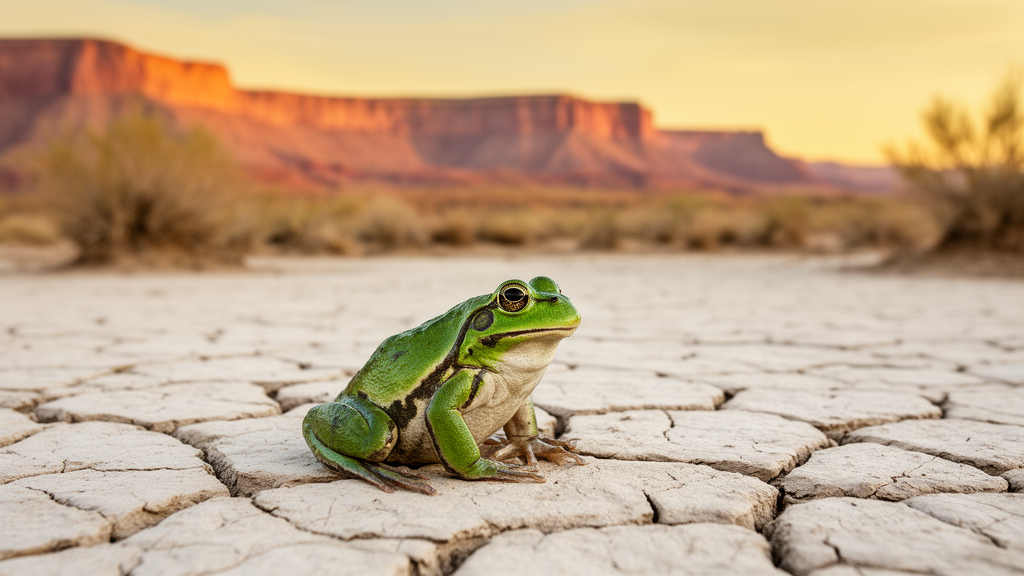
Deep in the Gran Chaco, a small, secretive frog has been keeping a secret of its own. Pleurodema guayapae, a leptodactylid amphibian that spends most of the year buried in the saline flats and semidesert soils of the Dry Chaco ecoregion, is known from two population clusters separated by roughly 820 kilometers of terrain where, despite decades of intensive field surveys, no confirmed record of the species has ever been obtained. Argentine populations are well documented across the provinces of Catamarca, Córdoba, La Rioja, San Juan, San Luis, and Santiago del Estero. Bolivian populations, first reported in 1998 from anthropogenic habitats in Santa Cruz department, sit nearly a thousand kilometers to the north. The question of whether these two clusters belong to the same species, or represent a hidden vicariant taxon, has lingered for twenty-seven years. A new study integrating mitochondrial phylogenetics with paleoclimatic niche modeling now provides a compelling answer: the Bolivian and Argentine frogs are conspecific, and their striking separation is a true disjunct distribution shaped by the climatic oscillations of the Late Pleistocene and Holocene.
Disjunct distributions, in which populations of a putative species are separated by large distances with no evident geographical or ecological barrier, represent one of the most intriguing yet poorly understood patterns in biogeography. Once sampling artifacts are ruled out, such patterns can arise from three processes: vicariance, local extinction, or long-distance dispersal. Each can restrict gene flow between clusters and, if the gap persists long enough, promote allopatric speciation. Molecular data have frequently revealed that disjunct populations previously considered conspecific actually represent distinct species, making the taxonomic identity of separated clusters a critical first question. Amphibians, being small, tightly tied to humid environments, and limited in dispersal, are especially informative models for studying these patterns, yet their distributions remain fragmentary in many tropical and subtropical regions.
The research team, publishing in Frontiers of Biogeography, sampled five Pleurodema guayapae specimens from the Bolivian populations held at the Museo de Historia Natural Noel Kempff Mercado in Santa Cruz de la Sierra. They extracted DNA from leg muscle tissue and PCR-amplified two mitochondrial gene fragments: 571 base pairs of the 16S rRNA gene in three individuals and 384 base pairs of the cytochrome-b gene in all five. These sequences were combined with all available GenBank data for P. guayapae and its sister species P. nebulosum, one specimen of each described Pleurodema species with sequences for both target genes, and an outgroup specimen of Physalaemus cuvieri. Phylogenetic trees were inferred using Bayesian inference in BEAST v1.10.4 under a Yule speciation process and a strict molecular clock, with three independent runs of 100 million generations each and best-fitting substitution models selected by PARTITIONFINDER.
The results were striking. Despite the enormous geographical distance separating the two population clusters, the phylogenetic analyses revealed minimal divergence between Bolivian and Argentine frogs, which do not form reciprocally monophyletic lineages in the cytochrome-b or concatenated datasets. The mean divergence between P. guayapae and P. nebulosum, once an introgressed Argentine individual was excluded, is 1.15 percent in 16S and 2.14 percent in cytochrome-b, confirming that the two species are genetically distinct from each other while the Bolivian and Argentine P. guayapae populations are not. These findings support the hypothesis that the Bolivian populations are conspecific with Argentine populations and present a true disjunct, or bicentric, distribution resulting from recent range fragmentation rather than an ancient split. The authors note, however, that nuclear gene data would be needed to test whether any population structure exists but is obscured by mitochondrial introgression.
Ruling out sampling bias was a critical step. Many Pleurodema species, including P. guayapae, spend much of the year buried, which hampers detectability outside explosive breeding events that occur during brief and unpredictable windows of optimal environmental conditions. Yet the intervening regions between the two clusters have been relatively well surveyed from a herpetological standpoint, with sampling intensity comparable to or greater than that of localities where the species has actually been recorded. Furthermore, calling activity has been reported from January to May and again in October, substantially extending the potential detection window. The species lays eggs in floating foam nests and has exotrophic tadpoles that develop in lentic water bodies, both of which are conspicuous. These factors strongly suggest the species is genuinely absent from the intervening region, and that the gap is real rather than an artifact of incomplete surveys.
With sampling bias discarded, two hypotheses remained: recent long-distance dispersal, or a complex history shaped by climate change and local extinctions. The dispersal hypothesis gains some support from the fact that all known Bolivian populations occur in anthropogenic habitats, suggesting that human-altered landscapes may have facilitated passive transport of individuals, possibly through movement of soil or agricultural materials. Most Bolivian localities lie along the railway connecting Bolivia and Argentina. However, the plausibility of a human introduction is limited, as trains do not continue southwards from the Bolivian border, and from that point there is still a gap of more than 550 kilometers in a straight line to the closest Argentine localities. Transporting material from rural areas over more than 800 kilometers with no direct connections and across international borders is logistically unlikely.
The most plausible explanation, according to the study’s paleoclimatic niche projections, is that past climate fluctuations triggered multiple episodes of range fragmentation, contraction, and expansion since the Last Glacial Maximum. The team compiled 91 georeferenced occurrence records from published literature, GBIF, and iNaturalist, ultimately using 46 records to build species distribution models with the Maximum Entropy algorithm. Five bioclimatic variables were selected after removing those with unusual spatial patterns and evaluating multicollinearity. To account for sampling bias, the researchers followed a target-group background approach, merging over 62,000 reptile and amphibian occurrence records from GBIF to create a two-dimensional kernel density raster reflecting sampling intensity across the study area. Model evaluation confirmed high reliability, with a mean test AUC of 0.980 and a mean test TSS of 0.837, both significantly higher than null models.
The paleoclimatic projections reveal a dynamic history. During the Last Glacial Maximum around 21,000 years ago, suitable habitat was nearly continuous, extending from Paraguay and Bolivia southward to Córdoba in Argentina. In the subsequent Heinrich Stadial, habitat suitability decreased sharply, and two isolated clusters of suitable habitat emerged: one near Parque Nacional Translasierra in Córdoba and a second, representing the most suitable conditions, near the current border between Argentina, Paraguay, and Bolivia. During the Bølling-Allerød period, suitability increased within these clusters, and a third cluster emerged near the present-day southeastern border between Bolivia and Brazil. By the Younger Dryas and Greenlandian periods, the transborder clusters consolidated into a continuous suitable area across Bolivia, Paraguay, and Brazil. However, from the Greenlandian onward, this formerly uniform cluster gradually fragmented, and by the Northgrippian around 4,200 years ago, a stepping-stone process of fragmentation combined with subsequent range contractions to cluster centers ultimately produced the current disjunct pattern.
Throughout all modeled periods, the most suitable habitat cluster occurred near the borders between Argentina, Paraguay, and Bolivia, suggesting this region may have acted as a source cluster for the species’ present distribution. The findings place P. guayapae among a growing set of chacoan organisms whose distributions were reshaped by Pleistocene climatic fluctuations, as the ecosystem moved northwards during cool periods and recovered during warm ones. Similar patterns have been documented in harvestmen, leguminous plants, palms, and mammals. Among amphibians, P. guayapae represents the most striking case, though Chacophrys pierottii and Lepidobatrachus llanensis show similar patterns warranting further investigation.
The Gran Chaco ecoregion, spanning more than one million square kilometers across Argentina, Bolivia, Brazil, and Paraguay, is suffering a catastrophic rate of deforestation driven by intensive agriculture, cattle ranching, and fires. While some amphibians like P. guayapae appear to tolerate a degree of human perturbation, the systematic destruction of this rich ecosystem might extirpate many poorly studied organisms before their distributional patterns and the past processes that shaped them can be understood. Twenty-seven years after the discovery of the Bolivian populations, the demonstration that they are conspecific with Argentine frogs despite the ca. 800-kilometer gap represents a striking example of a true disjunct distribution in amphibians, likely resulting from repeated range expansions and contractions driven by past climatic oscillations, and a reminder that some of biogeography’s most intriguing stories may be lost before they are fully told.
Subject of Research: Biogeographic origins of the disjunct distribution of the chacoan frog Pleurodema guayapae
Article Title: Biogeographic origins of the disjunct distribution of the chacoan Neotropical frog Pleurodema guayapae
Article References: Carné, A., Gonzales, L., & De la Riva, I. (2026). Biogeographic origins of the disjunct distribution of the chacoan Neotropical frog Pleurodema guayapae. Frontiers of Biogeography, 19, Article e208301. https://doi.org/10.21425/fob.19.208301
Image Credits: AI Generated
Keywords: Pleurodema guayapae, disjunct distribution, Gran Chaco, biogeography, paleoclimatic modeling, mitochondrial phylogenetics, Biogeographic, origins, disjunct, distribution, chacoan, Neotropical
Cite Scienmag News
Violet Maxwell. (October 17, 2026). Ancient Climate Swings Left a Chacoan Frog Stranded 800 Kilometers From Its Kin. Scienmag. https://scienmag.com/ancient-climate-swings-left-a-chacoan-frog-stranded-800-kilometers-from-its-kin/
Violet Maxwell. "Ancient Climate Swings Left a Chacoan Frog Stranded 800 Kilometers From Its Kin." Scienmag, 17 October 2026, https://scienmag.com/ancient-climate-swings-left-a-chacoan-frog-stranded-800-kilometers-from-its-kin/. Accessed 17 October 2026.
Violet Maxwell. "Ancient Climate Swings Left a Chacoan Frog Stranded 800 Kilometers From Its Kin." Scienmag. October 17, 2026. https://scienmag.com/ancient-climate-swings-left-a-chacoan-frog-stranded-800-kilometers-from-its-kin/


