


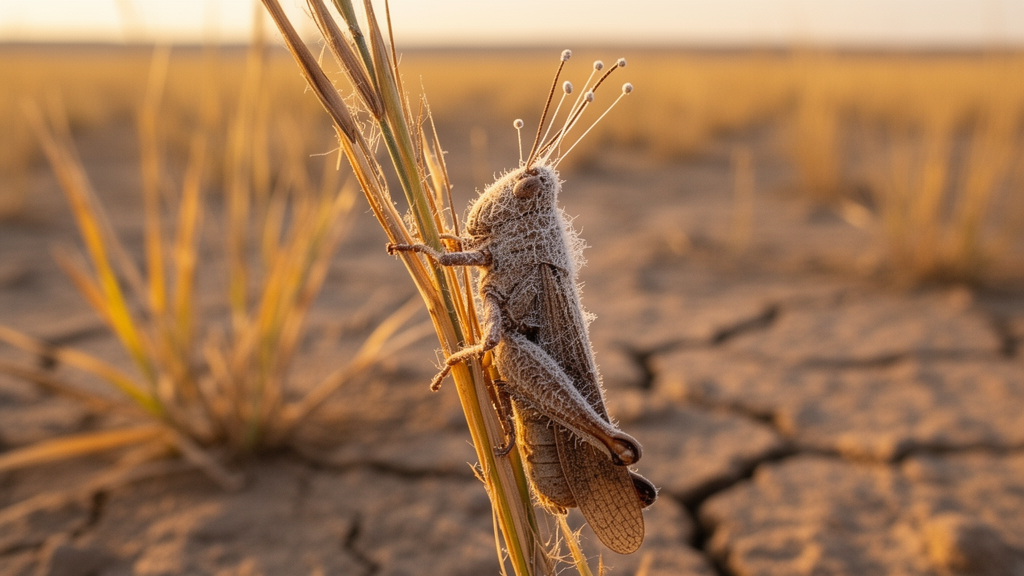
A fungus best known for fermenting soybeans and sake may be about to earn a very different reputation. In the arid grasslands of northwestern China, a locally isolated strain of Aspergillus oryzae has cut grasshopper populations by up to 84.9 percent within 15 days of aerial spraying, according to field trials conducted across Xinjiang between 2024 and 2025. The strain, designated XJ-1, was originally isolated from a naturally infected grasshopper in the region, and the new study is the first to demonstrate that it can kill multiple grasshopper species under the harsh, drought-prone conditions of natural rangeland rather than in the laboratory.
The stakes are considerable. Xinjiang Uygur Autonomous Region contains roughly 57 million hectares of grassland inhabited by more than 100 locust and grasshopper species, several of which periodically devastate rangelands and threaten rural livelihoods. Chemical insecticides remain the principal control method worldwide, but their environmental impacts have pushed researchers toward microbial biopesticides such as Beauveria bassiana, Metarhizium species, and the protozoan Paranosema locustae. Fungal pathogens, however, often underperform in the field because infected grasshoppers can raise their body temperature through behavioral thermoregulation—basking in the sun to create an internal fever that inhibits fungal development. Whether a fungal agent can overcome this defense under natural conditions is therefore a critical test of its practical value.
A. oryzae is an unlikely candidate for insect warfare. The species has been used for centuries in traditional food fermentations and is a mainstay of industrial enzyme production, and Aspergillus species have rarely been investigated for pest control. Yet XJ-1, identified through morphological and molecular analyses after its isolation from a Xinjiang grasshopper, had previously shown pathogenicity against several locust and grasshopper species in laboratory, field-cage, and cropland trials in Shandong Province, where it killed adults of the migratory locust Locusta migratoria and other pests at temperatures of 26 to 38 degrees Celsius. What remained unknown was its efficacy in natural grasslands—the environment where it originated and where control options are fewest.
The research team, working with conidial powder produced by the Biological Control Laboratory of the Institute of Plant Protection at the Shandong Academy of Agricultural Sciences, ran a three-tier evaluation: infection assays in field cages, large-scale field trials, and post-mortem confirmation of fungal colonization on wild cadavers. In the field-cage bioassay, conducted at the Yili Prefecture Desert Steppe Experimental Station in Huocheng County from 20 August to 8 September 2024, adult grasshoppers of two common species—Oedipoda miniata and Calliptamus barbarus—were individually dipped for less than one second in a suspension of 106 viable conidia per milliliter, then held outdoors in ventilated containers under ambient temperatures ranging from 8 to 32 degrees Celsius. Mortality was recorded daily for 20 days.
The results were unambiguous. Treated O. miniata began dying on the second or third day, and by day 20 cumulative mortality reached 73.3 ± 8.8 percent, compared with 26.7 ± 12.0 percent in the Tween-80-only controls. C. barbarus fared similarly, with treated mortality of 76.7 ± 6.7 percent against 30.0 ± 11.5 percent in controls. Student’s t-tests confirmed the differences were statistically significant, and conidial viability had been verified beforehand by trypan blue staining, with density checked by hemocytometer. The gradual rise in mortality over three weeks is characteristic of fungal infection, which must germinate on the cuticle, penetrate the body, and proliferate before killing the host—a slower mechanism than chemical neurotoxins but one that can spread through a population as sporulating cadavers infect new individuals.
The field trials were the real test. Three treatment plots were sprayed aerially with a DJI T40 agricultural drone using an aqueous suspension of 2 × 10⁸ conidia per milliliter at an application rate of 3 × 10¹² conidia per hectare. Plot 1, a 6.67-hectare site in Huocheng at 723.3 meters altitude, was treated in August 2024; Plot 2, a 33.35-hectare Huocheng site at 793.6 meters, was treated in July 2025; and Plot 3, a 33.35-hectare alpine site near Bole at 2,292.98 meters, was treated in July 2025. Each had an untreated control plot 100 to 200 meters away with a comparable grasshopper community and vegetation. Grasshopper densities were surveyed one day before treatment and on days 5 or 6, 10, and 15 afterward, using a one-square-meter quadrat placed every 30 steps along a diagonal transect, with 50 samples per plot per survey. Almost all grasshoppers in the plots were adults, and no significant rainfall occurred during any of the trials.
The population data tell a striking story of delayed but powerful suppression. In Plot 1, mean density fell from 1.82 to 0.26 individuals per square meter by day 15, while the control plot declined only from 1.76 to 0.80; the difference was significant at p < 0.001, though not at days 6 or 10. Reduction rates in Plot 1 reached 54.8 ± 5.2 percent at day 10 and 84.9 ± 4.3 percent at day 15, against 24.9 ± 8.7 and 52.2 ± 7.8 percent in the control. Plot 2 showed a similar trajectory, with reduction rates of 14.3 ± 0.8, 43.3 ± 4.2, and 59.7 ± 4.6 percent at days 5, 10, and 15, significantly exceeding the control values of –13.7 ± 9.8, 9.8 ± 1.1, and 2.6 ± 0.6 percent. In the alpine Plot 3, densities in the treated plot dropped from 4.00 to 0.28 individuals per square meter by day 15, with reduction rates of 79.6 ± 4.8 percent at day 5 and 93.2 ± 1.6 percent at day 15, compared with 46.6 ± 4.5 and 79.4 ± 4.0 percent in the control. The treated plot showed significantly lower densities than the control at days 5, 10, and 15.
Crucially, the fungus proved itself a broad-spectrum agent. Cadavers collected from treated plots, incubated at approximately 28 degrees Celsius on moist sterile filter paper for seven days, developed the characteristic yellow conidial growth of A. oryzae XJ-1 on the bodies of seven grasshopper species: O. miniata, C. barbarus, Sphingonotus coerulipes, Oedaleus decorus, Calliptamus italicus, Notostaurus albicornis, and Gomphocerus sibiricus. Mycelial growth appeared after four to five days of incubation, confirming that the fungus had successfully colonized each host under field conditions rather than merely being present in the environment.
Compared with previously evaluated microbial agents in Xinjiang, the performance figures are impressive. A Metarhizium strain achieved corrected reduction of 37.6 percent after 14 days, an oil formulation of M. flavoviride reached 60.9 percent after 16 days, and P. locustae delivered 36.1 to 56.2 percent after 28 days. XJ-1, by contrast, achieved roughly 80 percent population reduction within 15 days. The researchers suggest that the fungus’s local origin may partly explain its performance: because the isolate came from Xinjiang, it may be well adapted to regional stresses such as low annual precipitation—often under 300 millimeters—high ultraviolet radiation, and the operational temperature range of 6 to 37 degrees Celsius observed during the trials, which is broader than the 26 to 38 degrees recorded in Shandong. The mechanisms underlying its virulence remain unknown, though other entomopathogenic fungi rely on secondary metabolites such as the destruxins of Metarhizium and the beauvericin compounds of B. bassiana, and similar toxins may contribute to XJ-1’s activity.
The authors are candid about the study’s limitations. The relatively high reduction rates in some control plots may reflect grasshopper movements rather than mortality alone, since species such as C. italicus and G. sibiricus are strong dispersers capable of skewing local density estimates. Mortality in control cages may also have been inflated by capture stress, variation in adult age, and confinement. Because each trial included only one treated plot and one control plot, the experiments should be considered operational demonstrations rather than fully replicated field trials, and the study included no assessments of effects on non-target organisms—an important gap that must be addressed before large-scale deployment. Future work should determine whether infected grasshoppers exhibit the behavioral thermoregulation seen with Metarhizium acridum infections, include carrier-only controls to disentangle formulation effects, and characterize the infection pathway at the molecular level. Still, the core finding stands: a fungus isolated from the very grasshoppers it now kills, in the very landscape where chemical control is least desirable, has demonstrated field efficacy against seven species at once. For the arid grasslands of northwestern China, that is a promising start for an unconventional biopesticide drawn from one of humanity’s oldest microbial partners.
Subject of Research: Field evaluation of Aspergillus oryzae XJ-1 as a potential biological control agent against grasshoppers in arid grasslands of northwestern China
Article Title: Field evaluation of Aspergillus oryzae XJ-1 as a potential biological control agent against grasshoppers in arid grasslands of northwestern China
Article References: Du, J., You, Y., Yue, F., Xu, X., Nulakeman, Y., Shali, Y., & Lecoq, M. (2026). Field evaluation of Aspergillus oryzae XJ-1 as a potential biological control agent against grasshoppers in arid grasslands of northwestern China. Journal of Orthoptera Research, 35(2), 313-318. https://doi.org/10.3897/jor.35.207048
Image Credits: AI Generated
Keywords: entomopathogenic fungi, biological control, grasshoppers, locusts, Xinjiang, biopesticides, Aspergillus oryzae, grassland ecology, Field, evaluation, Aspergillus, oryzae
Cite Scienmag News
Roger Howard. (October 17, 2026). Fungus from Xinjiang grasshoppers slashes locust swarms in arid grasslands. Scienmag. https://scienmag.com/fungus-from-xinjiang-grasshoppers-slashes-locust-swarms-in-arid-grasslands/
Roger Howard. "Fungus from Xinjiang grasshoppers slashes locust swarms in arid grasslands." Scienmag, 17 October 2026, https://scienmag.com/fungus-from-xinjiang-grasshoppers-slashes-locust-swarms-in-arid-grasslands/. Accessed 17 October 2026.
Roger Howard. "Fungus from Xinjiang grasshoppers slashes locust swarms in arid grasslands." Scienmag. October 17, 2026. https://scienmag.com/fungus-from-xinjiang-grasshoppers-slashes-locust-swarms-in-arid-grasslands/


