


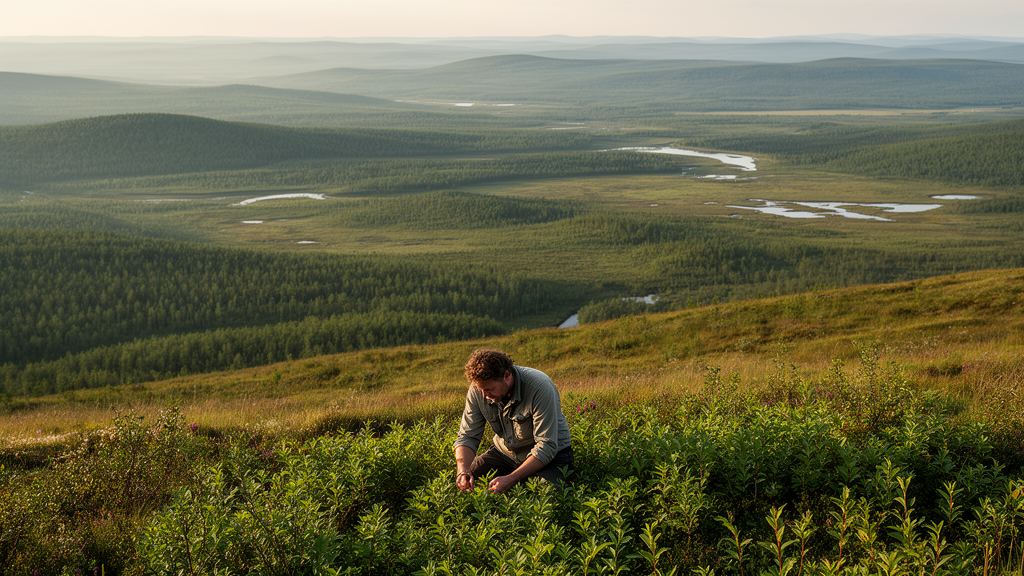
Scientists have proposed a new classification system for the terrestrial vegetation of the world, designed to work at every spatial scale from the entire globe down to individual patches of forest floor. The proposal, published in the journal Vegetation Classification and Survey, outlines the principles and structure of a framework that could eventually organize vegetation descriptions anywhere on Earth, from Arctic tundra to Amazonian rainforest. The authors present only the outline and principles at this stage, leaving further development to future national and regional surveys.
The problem the new system addresses is a long-standing one. Comprehensive global classification systems have existed since the nineteenth century, when researchers such as Schimper began defining vegetation types by physiognomy, the outward appearance of plant communities, on a climatic basis. The zonobiomes proposed by Walter in 1985 remain among the most widely followed, particularly in the German literature, and the ecozones of Pfadenhauer and Klötzli provide a similarly complete overview of the globe’s vegetation. These approaches divide the terrestrial surface into broad zonal units with large spatial extent, focusing on potential natural vegetation types and covering the entire land surface of the planet with largely synthetic units.
At the opposite end of the scale spectrum, local classification systems for plant communities have been developed independently. The most intensively used is the Braun-Blanquet approach, which describes habitats on the basis of species composition and reflects site conditions and successional status. This method can in principle be extended across all terrestrial areas of the world, but it requires good knowledge of the local flora. Because floristic richness and botanical expertise are distributed very unevenly across the planet, the Braun-Blanquet system has only been strongly developed in Europe and a few other regions, including Algeria, Argentina, Iran, Japan and Morocco. National systems such as the US National Vegetation Classification and the Vegetation Classification System of China have broad geographical scope but cover only their own territories and do not provide an approach of global value.
The idea of combining broad physiognomy-based units covering large areas with detailed local units was initially recommended by Beard in 1978, and several comprehensive approaches have pursued that goal since. The most important recent proposals are the IUCN typology published by Keith and colleagues in 2020 and the EcoVeg approach developed by Faber-Langendoen and colleagues. However, in these systems, structural elements often linked to different zonalities and disturbance conditions are classified at various levels, including higher ones. Types resulting from disturbances such as fire or grazing, or units due to edaphic conditions, can appear together with types essentially defined by climate. The authors of the new proposal aim to put order into this issue by organizing the defining criteria hierarchically, from the highest level to the lowest, so that each level responds to clear and unambiguous rules.
The proposed system consists of seven levels arranged in two blocks that overlap at level 3. The upper block, levels 1 to 3, is constructed deductively, in a top-down manner, using clearly sorted criteria. Level 1 is defined solely by climate at a global scale and comprises the Domains and Ecozones. Level 1a contains the Domains, defined only by their general thermal and xeric regime, while level 1b contains the Ecozones, which incorporate the seasonality of precipitation and extreme continentality into their bioclimatic definition. Level 2 adds physiognomy, producing the Biomes and Subbiomes, general units such as evergreen forests, coniferous forests, shrublands, grasslands and deserts that respond to climatic variability. So far the system recognizes 9 Biomes and 20 Subbiomes.
Level 3 is the genuinely new element: the Regional Subbiomes. Each Subbiome is represented in the different biogeographical territories of the world, and recognizing the distinct species pools in which each Subbiome is immersed makes it possible to divide it into its regional versions. The floristic differentiation is expressed using the biogeographical realms and regions proposed by Loidi and Vynokurov, and 84 Regional Subbiomes are recognized in this first approach. Continental maps show their approximate locations, though more detailed regional surveys will be needed to delimit their areas precisely. Each Regional Subbiome can, where available, be characterized by one or several Braun-Blanquet vegetation classes of level 4, but only zonal and intrazonal classes qualify, because azonal classes and those conditioned by disturbance tend to exceed the scope of a particular climatic zone.
The lower block, levels 4 to 7, is built inductively, from the bottom up, following the Braun-Blanquet classification as a model in the areas where it is available. These four levels correspond to the hierarchical units of that system: Class, Order, Alliance and Association. All of them are characterized by their species composition, which automatically reflects the environmental variables influencing each community, including substrate quality, temperature, biogeography and successional position. Important attributes of vegetation such as structure, and conditions related to disturbance such as fire, mowing or herbivory, are represented at these lower levels through the species composition and abundance data that the Braun-Blanquet system entails. The syntaxonomic hierarchy is structured so that floristically and ecologically related units of lower rank combine to form units of higher rank.
The criteria are applied in a cascade down the hierarchy. Zonality is the main criterion for the two upper levels and the only one at the first. Physiognomy is used at all levels except the first. Biogeography is applied in increasing detail from level 3 to level 7, using realms and regions at level 3 and provinces or sectors lower down. Site conditions, meaning topography, substrate quality and water availability, combined with zonality or azonality and biogeography, are expressed through floristic composition in levels 4 to 7. Disturbance, both natural and human-induced, is likewise applied in the four lower levels, where classes determined by severe anthropic influence, such as Polygono-Poetea annuae or Artemisietea vulgaris, and semi-natural classes such as Calluno-Ulicetea or Molinio-Arrhenatheretea are recognized.
Three European examples illustrate how the system works in practice. In a subalpine area of the Pyrenees, the zonal vegetation is a pine forest of the association Rhododendro ferruginei-Pinetum uncinatae, alongside azonal communities in limestone rock crevices and disturbed ruderal vegetation. In central Spain, the zonal vegetation is the holm oak association Asparago acutifolii-Quercetum rotundifoliae, with wetland rush communities representing azonal vegetation and fire-related scrub communities representing disturbance. In the lowland coastal area of northern Iberia, the mixed forest Polysticho setiferi-Fraxinetum excelsioris represents the zonal potential vegetation, with wetland and managed hay meadow associations completing the local set. Each example contains azonal and disturbed communities that together constitute the set of associations linked to the corresponding zonal type.
The authors argue that the system differs from the IUCN and EcoVeg approaches in several technical traits. The upper levels are not defined by azonality or disturbance and therefore do not reflect structure such as being forest, shrubland or grassland; they are defined by climate, physiognomy and geography. Climate is framed within the bioclimatic classification matching the higher-level units, using variables and indexes such as the positive temperature sum, the ombrothermic index and precipitation seasonality drawn from the CHELSA climate database. All levels are defined by vegetation conceived at different integration levels, since ecological conditions are considered inherent to the vegetational envelope, which provides structure and primary production to the ecosystem. The classification covers only terrestrial vegetation, excluding marine and freshwater ecosystems. The system is intended to help organize the growing volume of ecological and biodiversity data, to frame and contextualize local field surveys so that results from separate locations can be compared, and to provide objective scientific descriptions of the world’s territories for teaching purposes. In regions lacking detailed low-level classifications, surveys based on floristic composition or species dominance could supply the missing units as national and subnational vegetation surveys progress.
Subject of Research: A proposed multi-scalar classification system for the terrestrial vegetation of the world
Article Title: A multi-scalar classification system for the terrestrial vegetation of the world
Article References: Loidi, J. (2025). A multi-scalar classification system for the terrestrial vegetation of the world. Vegetation Classification and Survey, 6, 69-78. https://doi.org/10.3897/vcs.139673
Image Credits: AI Generated
DOI: 10.3897/VCS.139673
Keywords: vegetation classification, biomes, Braun-Blanquet, biogeography, ecosystems, plant communities, global ecology, multi-scalar, classification, system, terrestrial, vegetation
Cite Scienmag News
Gavin Prescott. (October 17, 2026). New Global Vegetation Classification System Spans From Continents to Local Plant Communities. Scienmag. https://scienmag.com/new-global-vegetation-classification-system-spans-from-continents-to-local-plant-communities/
Gavin Prescott. "New Global Vegetation Classification System Spans From Continents to Local Plant Communities." Scienmag, 17 October 2026, https://scienmag.com/new-global-vegetation-classification-system-spans-from-continents-to-local-plant-communities/. Accessed 17 October 2026.
Gavin Prescott. "New Global Vegetation Classification System Spans From Continents to Local Plant Communities." Scienmag. October 17, 2026. https://scienmag.com/new-global-vegetation-classification-system-spans-from-continents-to-local-plant-communities/


