


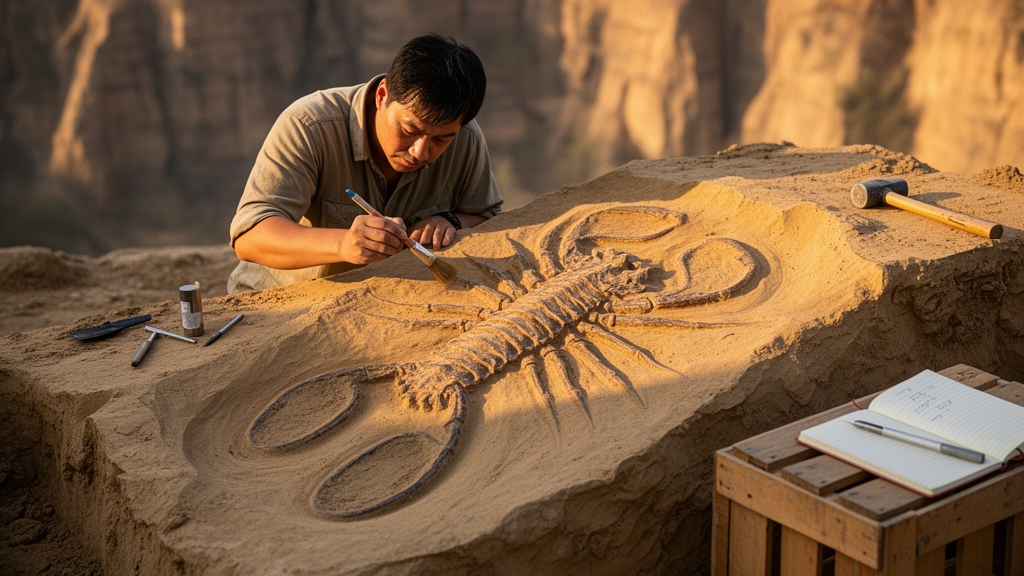
Eurypterids, the predatory aquatic chelicerates popularly known as sea scorpions, have long fascinated palaeontologists with a fossil record stretching from the Early Ordovician to the Late Permian extinction event. A new study published in the Swiss Journal of Palaeontology now adds a striking chapter to their story, one that begins with a slab of siltstone recovered from the Early Devonian Xitun Formation in Yunnan Province, south-western China. The slab preserves two individuals of Malongia mirabilis, a poorly known Chinese dolichopterid eurypterid first described only in 2022, and it reveals a suite of morphological features that were never documented in the original description of the species.
The significance of the new material lies in what it preserves. The original diagnosis of Malongia was based on an incomplete specimen preserved in ventral aspect from the Xiaxishancun Formation of Yunnan, which left the animal’s dorsal anatomy largely unknown. The two newly described individuals, however, preserve the carapace and dorsal exoskeletal structures, features that are incompletely preserved or absent in the original type material. One individual is preserved in dorsal view, showing an incomplete carapace, partial swimming appendages and an articulated prosoma with eight tergites, while the other is preserved in ventral view, revealing the carapace outline, six pairs of proximal podomeres with associated appendages and an articulated opisthosoma composed of two ventral plates.
The dorsal-view individual measures more than 55.5 millimetres in preserved length, with a maximum width exceeding 22.3 millimetres at the third tergite. Its carapace, incompletely preserved at more than 14.3 millimetres long and 15.7 millimetres wide, is fringed by a narrow marginal rim roughly 3 millimetres wide bearing coarse surface ornamentation. Crucially, the right lateral compound eye is intact: relatively large, up to 4.6 millimetres long and 2.3 millimetres wide, arcuate with rounded extremities, covered dorsally by a well-developed rounded palpebral lobe and occupying an anteromesial position on the carapace. A median ridge runs along the centriaxial region of the carapace, and each opisthosomal tergite carries a row of tubercles along its posterior margin. These details, invisible in the holotype, form the raw material for a systematic revision of the genus.
The ventral-view individual is equally informative. Its carapace outline, traced from the impressed carapace trace, is distinctly horseshoe-shaped, with a gently convex frontal margin and a narrow marginal rim approximately 2 millimetres wide. The prosomal appendages are preserved exclusively on the left side, but their coxae exhibit only slight torsion while retaining their relative spatial arrangement, allowing unambiguous identification of each appendage. Appendages I and II are known only from small subrectangular proximal podomeres, while appendages III, IV and V preserve pairs of coxae and several rectangular podomeres of nearly uniform width. Appendage VI, the swimming paddle, preserves a pair of subrhomboidal coxae and two podomeres, expanding gradually in width from proximal to distal end. The coxal gnathobase bears a row of triangular teeth, and although the principal tooth is absent, the preserved morphology indicates that it would have been larger than the other teeth.
Perhaps the most consequential ventral feature is the slender, type-A genital appendage, partially preserved on the median portion of the second ventral plates and extending to their posterior margin with a total length of 6.2 millimetres. The ventral plates themselves are splayed open, forming an aperture of two symmetrical, unconnected elements. This configuration initially invited comparison with the Megalograptus morphotype, but the authors caution that eurypterid carapaces are susceptible to cracking during moulting and that the ventral plates on both sides show evidence of folding, so assignment to the Megalograptus type may not be accurate. Following the taxonomic treatment of Lamsdell, the specimens are instead assigned to the Eurypterus-type ventral plates, a decision that carries real weight in phylogenetic character coding.
The horseshoe-shaped carapace of the new specimens differs from that of the holotype, but the discrepancy is interpreted as the result of taphonomic distortion affecting the original type material. The new individuals, preserved in flattened siltstone with some tectonic distortion, likely represent the natural carapace morphology of Malongia mirabilis. On this basis the authors present an emended diagnosis of the genus: a dolichopterid with a horseshoe-shaped prosomal carapace, genal facets continuously inclined towards the carapace centre, prosomal ventral plates of Eurypterus type, arcuate lateral eyes positioned anteromesially on the carapace, spiniferous Dolichopterus-type appendages I to IV, a non-spiniferous Dolichopterus-type appendage V, and a moderately expanded paddle of regular Dolichopterus type on appendage VI, together with a lyrate metastoma.
To assess where Malongia sits relative to other dolichopterids, the team re-coded morphological characters following the standardised trait definitions and scoring criteria established in a recent revision of the family, supplementing the existing character matrix with the newly recognised dorsal and ventral features. Phylogenetic inference was performed in TNT v.1.5 using 100,000 replicates of random addition sequence followed by tree bisection-reconnection branch swapping, with all characters treated as unordered and equally weighted. Strobilopterus laticeps served as the outgroup taxon for tree rooting and character polarisation across the Dolichopteridae, establishing ancestral character state distributions for comparative evolutionary analysis.
The recovered topology reshapes the picture of dolichopterid evolution. Paraeurypterus anatoliensis and Pentlandopterus minor form successive early-diverging lineages, branching sequentially before the origin of a clade containing all remaining sampled dolichopterid species. Within that core clade, the position of Malongia is affected by a polytomy: its relationships with Dolichopterus and with the clade comprising Ruedemannipterus and Clarkeipterus remain unresolved. Three equally plausible phylogenetic hypotheses are permitted by the data. Malongia could be the sister taxon to Dolichopterus, sister to the Ruedemannipterus and Clarkeipterus clade, or sister to both lineages combined. It is therefore not possible to confirm whether Malongia constitutes a distinct monophyletic subgroup, although the Dolichopterus assemblage and the Ruedemannipterus plus Clarkeipterus grouping each emerge as coherent subclades within the polytomy.
That uncertainty is itself scientifically meaningful. Previous work had recovered Malongia as the sister taxon to Dolichopterus, but the revised analyses, incorporating the newly described dorsal and ventral characters, instead support an alternative placement. The unresolved phylogenetic position, combined with the genus’s morphological apomorphies, is consistent with the hypothesis that the ancestral lineage of Malongia underwent geographically isolated evolution on the South China Block following its divergence from the common ancestor shared with the Dolichopterus lineage. The South China Block rifted away from Gondwana during the Late Silurian to Early Devonian, and such biogeographic isolation may have restricted gene flow between South Chinese dolichopterids and their closely related lineages distributed across Laurussia, facilitating the evolution of exclusive derived features and the origin of this independent evolutionary lineage.
The new material also strengthens the case for a long-lived palaeobiogeographic province on the South China Block during the Early Devonian. Both Malongia mirabilis and the eurypterid Pterygotus wanggaii, recovered from the Xitun and Xiaxishancun Formations, provide direct fossil evidence for a close faunal linkage between the two units in the Qujing area of eastern Yunnan. Identical ostracod assemblages, early vertebrate fish taxa and fragmentary primitive land plant remains are found in both successions, reflecting stable, homogeneous palaeoecological conditions without major faunal turnover across the formation boundary. The continuous depositional sequence and shared endemic eurypterid species indicate that the Xiaxishancun and Xitun Formations represent a single, long-lived province with unimpeded biotic exchange and sustained faunal continuity, a setting in which an isolated lineage like Malongia could evolve its own distinctive morphology while the rest of the dolichopterid family tree branched across Euramerica.
Subject of Research: Palaeontology
Article Title: New insights on the morphology and phylogeny of the Chinese dolichopterid eurypterid Malongia ( Eurypterida , Dolichopteridae )
Article References: Ma, Z., Zheng, Y., Wang, M., Lamsdell, J. C., Wang, J., Pang, L., Chen, L., Selden, P. A., Yuan, Y., Zeng, J., He, B., & Hu, X. (2026). New insights on the morphology and phylogeny of the Chinese dolichopterid eurypterid Malongia (Eurypterida, Dolichopteridae). Swiss Journal of Palaeontology, 145, 991-998. https://doi.org/10.3897/sjp.145.210382
Image Credits: AI Generated
Keywords: eurypterids, sea scorpions, Malongia, Dolichopteridae, Devonian, Yunnan, phylogeny, palaeontology, insights, morphology, Chinese, dolichopterid
Cite Scienmag News
Gavin Prescott. (October 17, 2026). Sea Scorpion Fossil From China Rewrites the Family Tree of Ancient Predators. Scienmag. https://scienmag.com/sea-scorpion-fossil-from-china-rewrites-the-family-tree-of-ancient-predators/
Gavin Prescott. "Sea Scorpion Fossil From China Rewrites the Family Tree of Ancient Predators." Scienmag, 17 October 2026, https://scienmag.com/sea-scorpion-fossil-from-china-rewrites-the-family-tree-of-ancient-predators/. Accessed 17 October 2026.
Gavin Prescott. "Sea Scorpion Fossil From China Rewrites the Family Tree of Ancient Predators." Scienmag. October 17, 2026. https://scienmag.com/sea-scorpion-fossil-from-china-rewrites-the-family-tree-of-ancient-predators/


