


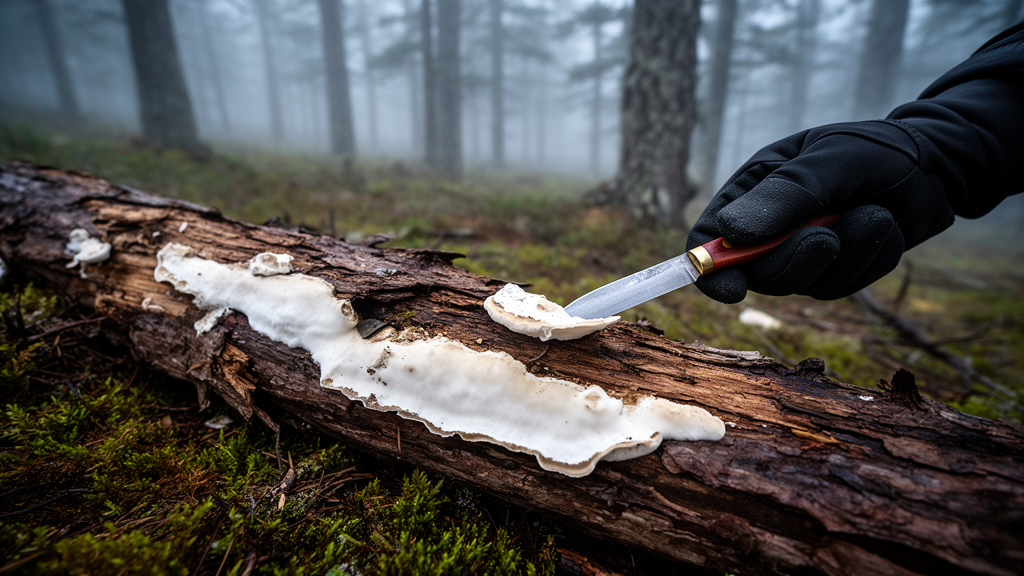
Deep in the forests of Qinghai Province, on the northeastern edge of the Qinghai–Tibet Plateau, two previously unknown species of wood-decaying fungi have been formally described, adding fresh branches to the evolutionary tree of a genus long overlooked by science. The new taxa, named Hyphoderma tenuicystidiatum and Hyphoderma tabuliformis, belong to the Basidiomycota, the same broad fungal division that includes mushrooms, puffballs and rusts. Their discovery, published in the journal MycoKeys, was based on a combination of painstaking microscopic anatomy and DNA-based phylogenetic analysis, the twin pillars of modern fungal taxonomy.
Wood-inhabiting fungi are far more than botanical curiosities. As primary decomposers of lignocellulose, the tough composite of cellulose, hemicellulose and lignin that makes up wood, they drive the release of carbon and the turnover of nutrients in forest ecosystems. Without them, fallen branches and trunks would accumulate indefinitely, and the material cycling, energy flow and soil health that sustain forests would grind to a halt. Some wood-inhabiting species also carry significant economic weight, whether as sources of medicinal compounds or as forest pathogens. Yet despite decades of collection in western China, the true diversity of this ecological group remains poorly charted, a gap the new study helps to close.
The genus Hyphoderma, placed in the family Hyphodermataceae within the order Polyporales, was established as long ago as 1833 by the German botanist Wallroth, who originally included eight species under a broad concept spanning both resupinate and club-shaped thelephoroid forms. The genus then languished in neglect until the mid-twentieth century, when the Dutch mycologist M.A. Donk undertook extensive revisions. Donk selected Hyphoderma setigerum as the type species in 1949 and, in a more thorough 1957 revision, recognized 25 species. Later taxonomists attempted sectional subdivisions, with Parmasto dividing the genus into three sections in 1968, while Eriksson and Ryvarden proposed twelve possible natural species groups in 1975 as a basis for future revision.
The twenty-first century brought molecular phylogenetics, and with it a profound reshaping of Hyphoderma’s traditional classification. Species bearing distinctive structures such as echinocysts were segregated into a reinstated older genus, Peniophorella, leaving Hyphoderma with a narrower circumscription. Even so, the genus remains substantial: 137 species are now accepted worldwide, of which 45 had been reported from China before the present study. The new work raises China’s tally to 47, a modest-sounding but meaningful increment for a group whose species are often thin, crust-like and easily mistaken for one another.
The trail to the two new species began during surveys of wood-rotting fungal diversity in China, when researchers collected four Hyphoderma-like samples from Qinghai. The specimens were deposited in the fungarium of the Institute of Microbiology at Beijing Forestry University. Under the stereomicroscope, the team recorded macromorphological features such as the color and thickness of the basidiomata, the fungal fruiting bodies, along with the hymenophoral surface and sterile margin. Microscopic examination followed, with tissues stained in Cotton Blue, Melzer’s reagent and dilute potassium hydroxide, and thirty basidiospores measured from each specimen to capture the variation in spore dimensions that often separates closely related species.
The first new species, Hyphoderma tenuicystidiatum, was collected on rotten wood of Picea crassifolia, the Qinghai spruce, in Shuangpengxi, Tongren County, at an altitude of 3,068 meters, with a second specimen found on a dead angiosperm tree in Mengdatianchi Nature Reserve. Its name refers to the thin cystidia, sterile microscopic cells that stud the spore-bearing surface. The species is distinguished by light vinaceous gray basidiomata when fresh and cream when dry, a smooth hymenophore, a monomitic hyphal system with clamp connections on the generative hyphae, cylindrical cystidia measuring 40 to 55 micrometers long, the presence of fusoid cystidioles, and subcylindrical to oblong ellipsoid basidiospores of 10.4 to 14.9 by 5.2 to 7.1 micrometers. Like many Polyporales members, it causes white rot, enzymatically stripping the brown lignin from wood and leaving the pale cellulose behind.
The second species, Hyphoderma tabuliformis, carries a name honoring its host, Pinus tabuliformis, the Chinese red pine, on whose fallen branches both the holotype and paratype were found in Beishan Forest Park, Huzhu County, at 2,900 meters. In contrast to its vinaceous relative, H. tabuliformis exhibits white to cream basidiomata with an arachnoid, cobweb-like hymenial surface, generative hyphae encrusted with crystals, clavate cystidia of 48 to 68 micrometers, and distinctly narrower subcylindrical basidiospores of 8.7 to 12.2 by 3.6 to 4.2 micrometers, usually with oil drops inside. The differing host associations are ecologically telling: H. tenuicystidiatum shows a relatively broad host range spanning both conifer and angiosperm wood, whereas H. tabuliformis appears more specialized, hinting at distinct lignin-degrading capacities or niche partitioning strategies within the genus.
To confirm that the four specimens represented two genuinely new species rather than variants of known taxa, the researchers extracted DNA from the dried specimens using a CTAB rapid extraction kit and amplified two nuclear ribosomal regions: the internal transcribed spacer, or ITS, widely used as a fungal barcode, and the nuclear large subunit, nLSU. The ITS region was amplified with the primers ITS5 and ITS4, and the nLSU with LR0R and LR7, following standardized polymerase chain reaction protocols with initial denaturation and 35 amplification cycles. The purified products were sequenced bidirectionally by Sanger sequencing, and the new sequences were deposited in GenBank.
The phylogenetic analysis drew on 134 sequences from 79 fungal samples representing 50 taxa, with Climacocystis borealis and Diplomitoporus crustulinus serving as outgroups. After alignment in MAFFT and manual optimization in BioEdit, the combined dataset spanned 2,040 aligned characters, of which 527, about 26 percent, were parsimony-informative. Maximum likelihood analysis in IQ-TREE with ultrafast bootstrap support from 5,000 replicates, and Bayesian inference in MrBayes running four Markov chains for 6 million generations, produced concordant topologies. Both new species formed well-supported lineages, each receiving 100 percent maximum likelihood bootstrap support and Bayesian posterior probabilities of 1.00. Hyphoderma tenuicystidiatum emerged as related to H. obtusiforme, though its ITS region differs by 4.4 percent, while H. tabuliformis sits near H. medioburiense with an ITS divergence of 5.8 percent.
Because the phylogenetic sampling included only a subset of accepted Hyphoderma species, the authors took the precaution of comparing the new taxa with morphologically similar species, especially those lacking molecular data, examining cystidia type, shape and size, basidia dimensions, and basidiospore morphology. The comparisons held up: H. microporoides, H. fissuratum and H. transiens all differ from H. tenuicystidiatum in spore size or cystidial form, while H. alboarachnum and H. prosopidis are separable from H. tabuliformis by spore and basidial dimensions. The study’s authors note that much of Qinghai and neighboring under-surveyed regions, from the margins of the Qinghai–Tibet Plateau to the boreal coniferous forests of northeastern China, may harbor further undiscovered Hyphoderma species, and they call for broader geographic sampling together with multilocus sequencing, since most species still lack RPB1, RPB2 and TEF1 sequences in public databases. For a genus once neglected for over a century, the fungal crusts of Asia’s high forests are proving to be anything but barren ground.
Subject of Research: Taxonomic description of two new wood-inhabiting Hyphoderma species from Qinghai, northwestern China, based on morphological and molecular phylogenetic evidence.
Article Title: Morphological and molecular identification of two new wood-inhabiting species of Hyphoderma ( Basidiomycota ) from Qinghai, northwestern China
Article References: Li, X., Cui, Y., Xing, R., Dai, Y., Yuan, Y., & Wu, Y. (2026). Morphological and molecular identification of two new wood-inhabiting species of Hyphoderma (Basidiomycota) from Qinghai, northwestern China. MycoKeys, 141, 315-336. https://doi.org/10.3897/mycokeys.141.210190
Image Credits: AI Generated
DOI: 10.3897/mycokeys.141.210190
Keywords: Hyphoderma, wood-inhabiting fungi, Qinghai, new species, Basidiomycota, phylogenetics, Morphological, molecular, identification, wood-inhabiting, species, northwestern
Cite Scienmag News
Roger Howard. (October 17, 2026). Two New Wood-Decay Fungi Unearthed in Qinghai Expand the Global Map of Hyphoderma. Scienmag. https://scienmag.com/two-new-wood-decay-fungi-unearthed-in-qinghai-expand-the-global-map-of-hyphoderma/
Roger Howard. "Two New Wood-Decay Fungi Unearthed in Qinghai Expand the Global Map of Hyphoderma." Scienmag, 17 October 2026, https://scienmag.com/two-new-wood-decay-fungi-unearthed-in-qinghai-expand-the-global-map-of-hyphoderma/. Accessed 17 October 2026.
Roger Howard. "Two New Wood-Decay Fungi Unearthed in Qinghai Expand the Global Map of Hyphoderma." Scienmag. October 17, 2026. https://scienmag.com/two-new-wood-decay-fungi-unearthed-in-qinghai-expand-the-global-map-of-hyphoderma/


