


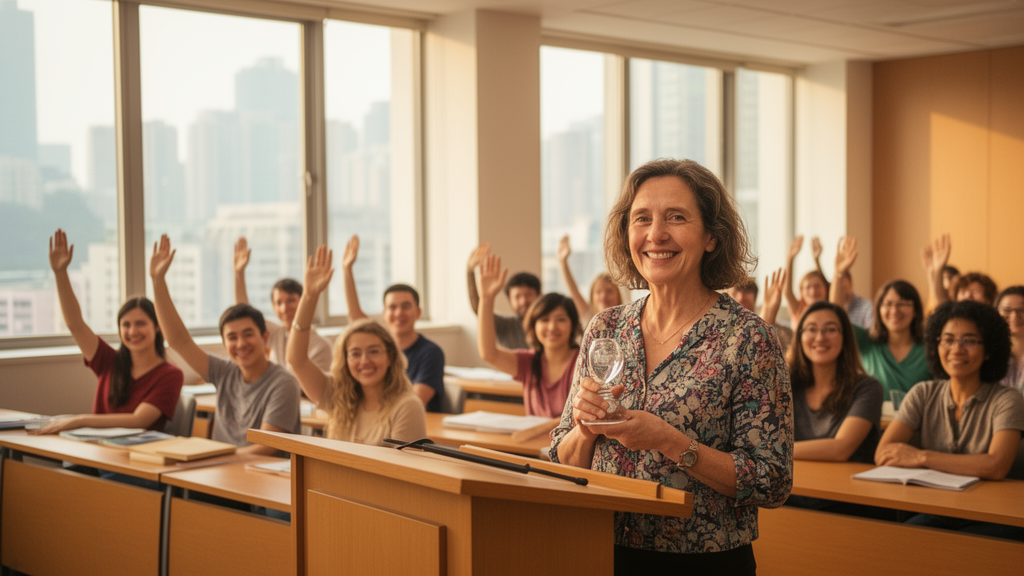
A biological anthropologist at The University of Hong Kong has been recognised with one of the most prestigious teaching honours in the city’s higher education system. Dr Michael Rivera, a Lecturer in the Faculty of Social Science, has received the 2026 University Grants Committee Teaching Award in the Early Career Faculty Members category, an accolade that distinguishes educators who demonstrate outstanding teaching performance, sustained achievement, leadership, and scholarly contributions to teaching and learning across UGC-funded institutions. The award places Rivera among a small group of early-career academics whose classroom practice has been judged to shape not only their own students but the culture of university teaching more broadly.
The honour carries particular weight because of what Rivera teaches and how he teaches it. He is, according to the university, the first lecturer in Hong Kong to offer university courses dedicated specifically to biological anthropology and human diversity, and he has built his teaching around a humanistic, community-centred model that treats public engagement as an essential obligation of higher education rather than an optional extra. In a discipline that often lives in laboratories and museum collections, Rivera has worked to bring the study of human variation and evolution into conversation with the city around him, arguing that publicly engaged teaching is a vital imperative for the future of Hong Kong’s universities.
At the heart of his teaching portfolio is a large Common Core course, ‘All You’ve Ever Wanted to Know About Humans’, known by its course code CCST9081, which introduces students from across the university to human variation and evolution. The course is deliberately hands-on. Rather than relying solely on lectures, Rivera uses active, inquiry-based laboratory sessions in which students handle skeletal material and learn the methods that bioarchaeologists and forensic scientists use to read the human body as a record of lived experience. Bones and teeth, in this framework, are not static specimens but documents: they carry traces of diet, disease, activity and environment that can be recovered through careful, methodical analysis.
The pedagogical logic behind those laboratories is as important as the content. Rivera has designed them to help students confront common misconceptions about human development, to foster ethical thinking about how scientific knowledge is produced and used, and to cultivate a sense of civic duty grounded in that knowledge. Students are asked to consider how anthropological science contributes to significant societal issues, a framing that pushes the discipline beyond its academic boundaries and into questions of public policy, social justice and community wellbeing. In a university system often organised around narrow specialisation, the approach asks students to see science as something embedded in society rather than separate from it.
Perhaps the most distinctive element of Rivera’s teaching is his university-level course on race and racism, which is described as the first of its kind in Hong Kong and the only one of its scope in all of Asia. The course integrates elements of critical race theory with story-sharing and anti-racist praxis, and it deliberately spans both the local and the global, the historical and the contemporary, and the scientific and the sociopolitical understandings of race. That breadth matters because race sits at an awkward intersection of disciplines: biological anthropology has a painful historical entanglement with racial classification, while modern genetics has decisively shown that human variation does not map onto folk racial categories. Teaching the topic well requires students to hold both the science and the social history in view at the same time.
Through the course, students develop what Rivera describes as critical consciousness and transformative insights, capacities that allow them to engage thoughtfully with questions of race in Hong Kong and beyond. In a globalised city where questions of identity, migration and belonging are live and often contested, the course gives students analytical tools that extend well past the classroom. Alongside it, Rivera is promoting a project called ENGAGE with colleagues at HKU, which provides students with feedback and encouragement designed to build their confidence in communicating with public audiences. The project reflects a consistent theme in his work: that the ability to speak clearly and honestly about science in public is a skill that must be taught and practised, not assumed.
Underlying all of this is a philosophy of care. Drawing on care theorists and recent higher education scholarship, Rivera has embedded an ethics of care into his courses, emphasising values of respect, trust, responsiveness, empathy and community-building in university teaching. In his own words, he treats teaching as a relational practice rather than content delivery or training for work readiness. Assignments and course activities are designed to foreground emotional health, holistic development and inclusive values, so that students feel seen and supported. That framing runs counter to prevailing pressures in higher education, where metrics of throughput and employability often dominate, and it suggests why the award committee found his work worthy of recognition: it models a different account of what a university education is for.
Rivera’s scholarly background helps explain the range of his teaching. He is a biological anthropologist, writer, public speaker and interdisciplinary researcher who obtained his PhD from the University of Cambridge in 2019. His research focuses on how humans have evolved and adapted, both biologically and culturally, over the last six million years. His doctoral work involved reconstructing the diets, health profiles, physical activities and body shapes of ancient humans, and through the analysis of ancient bones and teeth he has been most interested in how active and healthy the lifestyles and diets of ancient peoples were, particularly those living in coastal environments in East and Southeast Asia and in the Baltic region of northeastern Europe. That research agenda, which connects skeletal evidence to questions of daily life and environment, translates naturally into the inquiry-based laboratory teaching for which he has been recognised.
His interests extend well beyond the skeleton. Rivera’s wider work encompasses heritage and museums, cultural identity, food studies, ethnographic documentary-making and visual anthropology, decolonial theory and praxis, the history of racism and contemporary racial justice issues, social media and digital technologies, public engagement and science communication, and archaeology and anthropology more broadly. This breadth is not incidental to his teaching; it is the reason his courses can move so fluidly between the biological and the social, the ancient and the contemporary, and the academic and the public. It also reflects a broader shift within anthropology itself, as the discipline reckons with its colonial legacies and seeks more collaborative, community-embedded ways of producing knowledge.
The 2026 UGC Teaching Award is, on one level, an individual honour for an early-career lecturer. On another level, it is a signal about the direction of teaching in Hong Kong’s publicly funded universities. The award explicitly rewards leadership and scholarly contribution to teaching and learning within and across institutions, and Rivera’s profile fits that brief: he has created courses that did not previously exist in the city, developed laboratory and discussion-based methods that make dense scientific material accessible to students from every faculty, and built projects that train students to communicate science to the wider public. As universities everywhere grapple with how to teach about human diversity, race and science in ways that are rigorous, ethical and humane, the work now recognised by the UGC offers one concrete, tested example of what that can look like in practice.
Subject of Research: Recognition of a biological anthropologist's teaching of human diversity and race at a Hong Kong university
Article Title: HKU academic receives UGC Teaching Award 2026
Article References: HKU academic receives UGC Teaching Award 2026. (n.d.). Original publication
Image Credits: AI Generated
DOI: Not provided
Keywords: UGC Teaching Award, University of Hong Kong, biological anthropology, human diversity, race and racism, critical race theory, bioarchaeology, forensic science, care ethics, science communication, higher education, public engagement
Cite Scienmag News
Courtney Benton. (October 17, 2026). Hong Kong Anthropologist Wins Top University Teaching Prize for Human-Centred Science. Scienmag. https://scienmag.com/hong-kong-anthropologist-wins-top-university-teaching-prize-for-human-centred-science/
Courtney Benton. "Hong Kong Anthropologist Wins Top University Teaching Prize for Human-Centred Science." Scienmag, 17 October 2026, https://scienmag.com/hong-kong-anthropologist-wins-top-university-teaching-prize-for-human-centred-science/. Accessed 17 October 2026.
Courtney Benton. "Hong Kong Anthropologist Wins Top University Teaching Prize for Human-Centred Science." Scienmag. October 17, 2026. https://scienmag.com/hong-kong-anthropologist-wins-top-university-teaching-prize-for-human-centred-science/


