


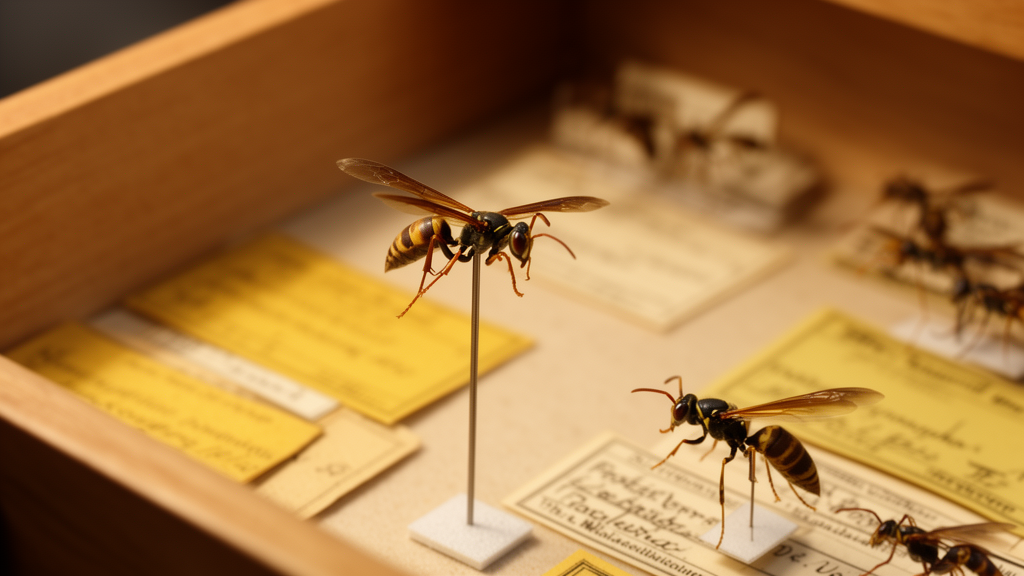
In the vaults of the Natural History Museum in London, pinned insects collected more than two centuries ago have just rewritten part of Australia’s wasp record. A new taxonomic study published in the Journal of Hymenoptera Research reports that three species of the eumenine potter wasp genus Paralastor, described in the early twentieth century by the prolific Hawaiian specialist Robert Cyril Layton Perkins, are in fact not new species at all. They are junior synonyms of names that de Saussure and even Fabricius had already coined decades earlier, some of them dating back to 1775, when the genus’s oldest name was described from material in the Banks collection labeled only Nova Hollandia.
The study is the work of a taxonomist who visited London specifically to examine the type specimens, the single pinned individuals that anchor each species name in law of nomenclature. Most of Perkins’s Paralastor types are housed there, along with types described by other authors, and close comparison under the microscope turned up new synonymies and clarified several points that had remained uncertain for more than a hundred years. The result is a cleaner, more honest map of Australian wasp diversity, and a reminder that in taxonomy, the physical specimen is the ultimate arbiter.
Paralastor belongs to the subfamily Eumeninae, the potter wasps, a group of solitary vespids famous for constructing mud cells in which their larvae develop. The genus is endemic to Australia and characterized by slender bodies, elongated metasomal segments and distinctive pale markings on the thorax and abdomen. Species limits within Paralastor have long been difficult because many of the diagnostic features are color patterns that vary enormously within populations, a problem that Perkins himself acknowledged when he described his species in 1914.
The first and oldest synonymy concerns Paralastor albifrons, described by Fabricius in 1775 from a specimen in the Banks collection. De Saussure redescribed the type in 1856 but questioned the locality, suspecting the wasp actually came from an oceanic archipelago rather than mainland Australia. Perkins, working without access to the type, described P. habilis from North Queensland in 1914 and relied on Meade-Waldo’s examination of the albifrons type, noting that he did not feel sure habilis might not be a variety or race of the Fabrician species. Bequaert in 1928 saw the type and confirmed it belonged to Paralastor, but noted it differed from any of the species Perkins had studied.
The new examination settles the question. The albifrons type keys directly to habilis in Perkins’s own key, and differs from it only in minor color details: the pronotal marks are dull yellow rather than orange, and the band on the second metasomal tergum is more widely emarginate, features the author judges to be ordinary color variation. The type of P. habilis itself is now missing from the Natural History Museum and may be lost, but the evidence is sufficient to establish the synonymy Paralastor albifrons Fabricius equals P. habilis Perkins, new synonymy. A related species, P. subhabilis, was also compared; it is a female with more abundant pale markings and slightly finer punctation on the tegulae, while the albifrons type is a male, so the author conservatively leaves subhabilis standing as a separate species pending further study.
The second synonymy resolves a pair of names separated only by head color. Paralastor brunneus was described by de Saussure in 1856 from La Nouvelle-Hollande, and no other records exist. Perkins described P. multicolor from Port Darwin in 1914 and distinguished the two in his key solely by color differences of the head, though in the text he noted that the edges of the lateral deflexed parts of the clypeus were not so sharply defined in multicolor. Direct comparison of the two types shows no appreciable difference in the clypeus, and examination of a large series of specimens from the Northern Territory reveals extensive color variation that encompasses both taxa. The synonymy Paralastor brunneus de Saussure equals P. multicolor Perkins, new synonymy, is therefore confirmed.
The third synonymy involves Paralastor maculiventris, described from L’Australie in 1856, and P. elegans, which Perkins described from North Queensland in 1914. Perkins himself suspected the two might be identical, writing that he thought it probable maculiventris was the same as his elegans, and he mentioned color differences and a metanotum that was hardly perceptibly tuberculate in elegans. Comparison of the types, together with numerous Northern Territory specimens, confirms that they are indeed the same species, establishing Paralastor maculiventris de Saussure equals P. elegans Perkins, new synonymy.
Two further species were examined without resulting in synonymy but with important clarifications. Paralastor nautarum, described by de Saussure in 1856 from L’Australie, was never seen by Perkins, who included it in his key with the cautious note that it was probably tabulated rightly. The type has now been examined and does key correctly, although its markings are rufous rather than golden as previously described, and the wings are mostly hyaline, being only infumate along the costal margin. Paralastor smithii, also described in 1856 from L’Australie, could not be placed by Perkins at all. The type keys to P. placens in Perkins’s key but is distinct in having a narrower clypeus; notably, the rufous markings occur in the type of placens as well, not golden as Perkins had stated, correcting a long-standing error in the literature.
The significance of this work extends beyond the genus Paralastor. Australia’s potter wasp fauna was largely cataloged in the nineteenth and early twentieth centuries on the basis of scattered specimens and vague locality labels such as L’Australie or La Nouvelle-Hollande, names that covered the entire continent or its eastern seaboard without precision. Modern collectors working in the Northern Territory have shown that many of the color characters used to define species vary continuously within populations, meaning that names based on a single color variant may describe nothing more than one end of a spectrum. Type specimens, the physical anchors of every name, are the only reliable way to test whether two such names refer to one biological species or two.
The study also highlights the fragility of the taxonomic record. The type of P. habilis is missing from the Natural History Museum and possibly lost, a sobering reminder that even the most important specimens in a collection are not immune to the passage of time. Every synonymy established here rests on the survival of types described by Fabricius, de Saussure and Perkins, some collected before the French Revolution. As molecular phylogenetics and DNA barcoding transform the way species are discovered, studies like this one demonstrate that classical morphology, careful comparison of pinned types, remains indispensable for reconciling the historical literature with modern understanding of Australia’s wasp diversity.
Subject of Research: Taxonomy and systematics of the Australian potter wasp genus Paralastor
Article Title: Taxonomic notes on the genus Paralastor ( Hymenoptera , Vespidae )
Article References: Carpenter, J. M. (2025). Taxonomic notes on the genus Paralastor (Hymenoptera, Vespidae). Journal of Hymenoptera Research, 98, 1127-1129. https://doi.org/10.3897/jhr.98.155267
Image Credits: AI Generated
Keywords: Paralastor, Eumeninae, potter wasps, Vespidae, taxonomy, new synonymy, type specimens, Natural History Museum London, Australia, Journal of Hymenoptera Research, Taxonomic, notes
Cite Scienmag News
Gavin Prescott. (October 17, 2026). Century-Old Wasp Mystery Solved as Museum Types Reveal Three New Synonymies in Australian Genus Paralastor. Scienmag. https://scienmag.com/century-old-wasp-mystery-solved-as-museum-types-reveal-three-new-synonymies-in-australian-genus-paralastor/
Gavin Prescott. "Century-Old Wasp Mystery Solved as Museum Types Reveal Three New Synonymies in Australian Genus Paralastor." Scienmag, 17 October 2026, https://scienmag.com/century-old-wasp-mystery-solved-as-museum-types-reveal-three-new-synonymies-in-australian-genus-paralastor/. Accessed 17 October 2026.
Gavin Prescott. "Century-Old Wasp Mystery Solved as Museum Types Reveal Three New Synonymies in Australian Genus Paralastor." Scienmag. October 17, 2026. https://scienmag.com/century-old-wasp-mystery-solved-as-museum-types-reveal-three-new-synonymies-in-australian-genus-paralastor/


