


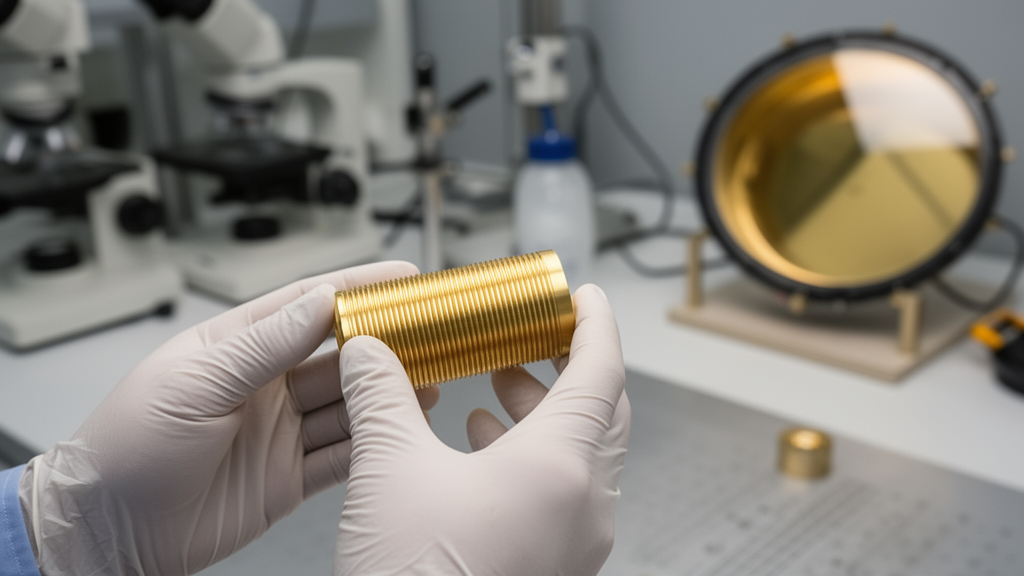
A team of Italian researchers has built and tested the first published asymmetric waveguide orthomode transducer operating in the D-band, the 130 to 170 gigahertz range, using nothing more exotic than chemically etched brass plates stacked and clamped together. The device, described in the journal Experimental Astronomy, is a small but strategically important step toward the enormous detector arrays that future Cosmic Microwave Background polarization experiments will demand. The prototype cost less than one thousand euros to fabricate, a fraction of what conventional precision machining would require, and the entire production process is fast enough to be scaled to arrays containing hundreds of elements.
The motivation lies in one of the most ambitious goals of modern cosmology: detecting the faint primordial B-mode polarization of the Cosmic Microwave Background, the relic radiation released roughly 380,000 years after the Big Bang. About ten percent of the CMB’s intensity is linearly polarized, and this signal can be decomposed into E-modes and B-modes. E-modes, which arise from both density fluctuations and gravitational waves in the primordial plasma, have been mapped with high precision. B-modes, however, are generated by tensor fluctuations alone, meaning gravitational waves from the epoch of inflation. On small angular scales the dominant B-mode signal comes instead from gravitational lensing, which has already been measured, but the cosmological component produced during inflation remains undetected because it is extraordinarily faint.
Catching that primordial whisper requires instruments with ultra-high sensitivity and equally rigorous control of systematic errors. Future experiments will need focal planes packed with thousands of receivers, and every component in the detection chain must avoid injecting spurious polarization. This is where the orthomode transducer, or OMT, becomes critical. An OMT is a passive device that separates incoming radiation into two orthogonal linearly polarized components, feeding each to a separate detector. Any imperfection in this polarization splitting can mimic or mask the very signal cosmologists are hunting for, making OMTs among the most crucial and demanding components in the entire receiver.
Existing OMT technologies each carry trade-offs. Planar OMTs, built from metal probes on silicon membranes, are used in modern experiments above 90 gigahertz combined with on-chip filters, but they typically achieve reflected power only below minus 15 decibels and cross-polarization below minus 20 decibels. Waveguide OMTs perform considerably better: symmetric designs reach reflected power below minus 20 decibels and cross-polarization below minus 40 decibels with bandwidths of 30 to 40 percent, but their mechanical complexity makes them expensive. Asymmetric waveguide OMTs, the type built by the Milan-based team, offer comparable electromagnetic performance with simpler mechanics, at the cost of a narrower bandwidth below 20 percent. Conventional fabrication methods for these devices, including milling, electroforming, and wire erosion, achieve tolerances around 30 micrometers but are either costly or slow, which is fatal for mass production.
The team’s solution combines the platelet technique, introduced by Haas in 1993, with chemical etching. In the platelet approach, the three-dimensional waveguide structure is sliced into thin metal plates, each drilled with the appropriate cavity cross-section, and the plates are then stacked, aligned, and clamped to form the complete device. Chemical etching takes this concept further by eroding the design into metal sheets using an acid bath: a photosensitive master is stamped onto the sheet, exposed to ultraviolet radiation to imprint the pattern, and the unmasked material is dissolved away. Because many plates can be etched simultaneously, the method is inherently parallel and inexpensive. It has already proven successful in producing corrugated feedhorn arrays with state-of-the-art performance up to 150 gigahertz, but applying it to the more complex internal geometry of an OMT had never been demonstrated at these frequencies.
The prototype consists of 62 thin brass plates, each 0.15 millimeters thick, sandwiched between a 5-millimeter aluminum top plate and aluminum bottom plates that provide structural stiffness and host the output waveguides. The design features a circular input waveguide, 1.7 millimeters in diameter, followed by a T-junction polarization divider that splits the signal into a main arm and a side arm, the latter using a 90-degree bend so that both rectangular output ports lie in the same plane. The team coupled the device to the central antenna of a pre-existing 37-element corrugated feedhorn array on one side and to kinetic inductance detectors on the other. Mechanical clamping with brass screws and steel dowel pins eliminated the need for glue, allowing disassembly and replacement of individual plates. Brass was chosen over more conductive aluminum because of its compatibility with the etching process, and simulations suggested the transmission penalty would be modest.
Before any electromagnetic testing, the researchers subjected every plate to meticulous metrological measurements using a Werth ScopeCheck 200 machine, comparing each cavity dimension against its nominal value. The measurements confirmed a systematic tendency of chemical etching toward over-erosion: most profiles came out slightly larger than designed, particularly in a group of six plates after the polarization division, apparently because the acid had already over-eroded the smaller OMT profiles by the time it finished cutting through the larger pin holes. The team also performed a point-cloud acquisition of each etched profile at roughly 50 points per millimeter, reconstructing a full three-dimensional computer model of the manufactured device, flaws and all, which they imported into the CST Microwave Studio electromagnetic simulator.
Simulations based on this measured profile predicted reflected power below minus 10 decibels, cross-polarization better than minus 30 decibels, and transmission around minus 0.5 decibels across the 140 to 170 gigahertz band. The actual measurements, performed at the University of Milano-Bicocca with a vector network analyzer and OML millimeter-wave frequency extenders, told a more nuanced story. Reflected power matched the simulations well, staying below minus 10 decibels over the 140 to 160 gigahertz range and dipping below minus 20 decibels at band center. Transmission, however, came in at around minus 1.5 to minus 2 decibels, more than a decibel worse than predicted, and measured cross-polarization reached only about minus 20 decibels rather than the expected minus 30.
The team traced the transmission loss to surface roughness along the etched walls, which metrological data put at roughly 3 micrometers root mean square. At millimeter wavelengths, when the electromagnetic skin depth becomes comparable to the size of surface imperfections, the roughness drives parasitic currents that increase resistive losses. When the researchers re-ran their simulations including a roughness model with the measured 3-micrometer value, the results reproduced the measured transmission almost exactly, confirming that other loss mechanisms such as contact resistance or plate oxidation were negligible. Strikingly, simulations of an identical device made entirely of aluminum showed the same degradation, proving that the loss stems from the etching process itself rather than the choice of metal. The excess cross-polarization, meanwhile, could be explained by a rotation of the polarization angle of roughly 1.5 to 3 degrees somewhere in the measurement chain, and even if the measured value reflected the true device performance, it would still match the cross-polarization of planar OMTs currently flying in CMB experiments.
The verdict is a carefully balanced one. Chemical etching, the authors conclude, is a fast, low-cost, and scalable route to waveguide OMTs with state-of-the-art reflected power and cross-polarization, provided designers rescale the profiles to compensate for systematic over-erosion. But the mechanical precision limits of acid erosion degrade transmission above 100 gigahertz, which may be too costly for CMB polarization experiments where every decibel counts, though the performance could suit other astrophysical and telecommunication applications. The technique remains attractive for lower-frequency OMTs, where roughness matters less, and the team is now investigating laser micro-machining as an alternative that could preserve the speed and low cost of etching while delivering a smoother finish for high-frequency devices. As CMB observatories grow toward the thousand-detector scale, the ability to mass-produce precision microwave components cheaply may prove just as decisive as the detectors themselves.
Subject of Research: Chemically etched platelet fabrication of a D-band waveguide orthomode transducer for Cosmic Microwave Background polarization measurements
Article Title: A chemically etched D-band waveguide orthomode transducer for CMB measurements
Article References: Manzan, E., Mennella, A., Cavaliere, F., Franceschet, C., Mandelli, S., Montonati, F., Zannoni, M., de Bernardis, P., Bersanelli, M., Boria, E., Brancadori, N., Coppolecchia, A., Gervasi, M., Lamagna, L., Limonta, A., Masi, S., Paiella, A., Passerini, A., Pezzotta, F., … Volpe, A. (2026). A chemically etched D-band waveguide orthomode transducer for CMB measurements. Experimental Astronomy, 62(3), Article 23. https://doi.org/10.1007/s10686-026-10082-8
Image Credits: AI Generated
DOI: 10.1007/s10686-026-10082-8
Keywords: orthomode transducer, cosmic microwave background, chemical etching, platelet technique, D-band, waveguide, B-mode polarization, millimeter-wave instrumentation, brass, surface roughness, kinetic inductance detectors, Experimental Astronomy
Cite Scienmag News
Grant Pearson. (October 17, 2026). Acid-Etched Brass Waveguide Could Slash Costs of Next-Generation CMB Telescopes. Scienmag. https://scienmag.com/acid-etched-brass-waveguide-could-slash-costs-of-next-generation-cmb-telescopes/
Grant Pearson. "Acid-Etched Brass Waveguide Could Slash Costs of Next-Generation CMB Telescopes." Scienmag, 17 October 2026, https://scienmag.com/acid-etched-brass-waveguide-could-slash-costs-of-next-generation-cmb-telescopes/. Accessed 17 October 2026.
Grant Pearson. "Acid-Etched Brass Waveguide Could Slash Costs of Next-Generation CMB Telescopes." Scienmag. October 17, 2026. https://scienmag.com/acid-etched-brass-waveguide-could-slash-costs-of-next-generation-cmb-telescopes/


