


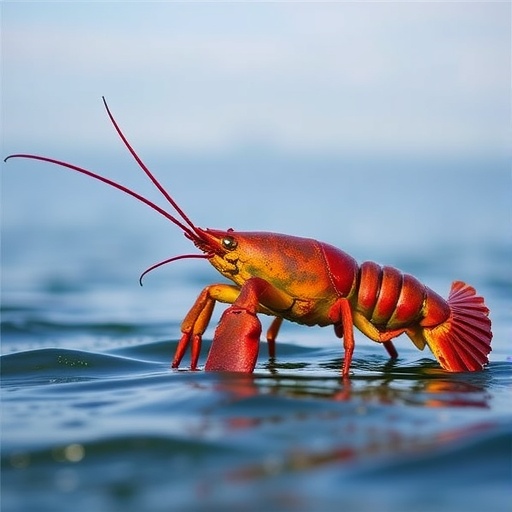
Maine’s lobster industry may be shaped by an animal so small it can disappear between the grains of a kitchen sieve. During the first weeks of life, newly hatched lobsters drift near the ocean surface as plankton, exposed to currents, predators and starvation. A new study led by researchers connected with the University of Maine suggests that the survival of these larval lobsters may depend disproportionately on access to one calorie-rich prey species: Calanus finmarchicus, a tiny copepod whose distribution is shifting northward as the Gulf of Maine warms. The finding offers a closer look at a poorly understood biological bottleneck that could influence how many lobsters eventually reach the fishery six to eight years later.
Adult lobsters dominate the public image of Maine’s seafood economy, but the future of each year’s harvest begins with animals only a few millimeters long. After hatching from eggs attached to the ocean floor, lobster larvae swim upward and enter the planktonic community, where they drift with currents through several developmental stages. They must capture sufficient food to fuel rapid growth, build tissues and survive the transition toward life on the seafloor. Stage-one larvae are especially vulnerable because they have limited reserves and are more likely than older larvae to die when prey is scarce or nutritionally inadequate. The new research focuses on this early period, when feeding success can determine whether a lobster ever becomes a juvenile.
The researchers found that larval and post-larval lobsters consumed Calanus finmarchicus more frequently than would be expected from its abundance in the surrounding zooplankton community. Approximately 30% of the lobster larvae examined contained DNA from the copepod in their digestive tracts, even though C. finmarchicus represented only a few percent of the available zooplankton. That mismatch indicates selective feeding rather than random encounters alone. Lobster larvae may be attracted to the copepod because of its size, movement, nutritional value or combination of traits. The result supports a theory proposed by marine scientists over the past decade: the availability of specific prey, not simply the total amount of plankton, may help regulate lobster recruitment.
“We see evidence that larvae are eating Calanus finmarchicus at a greater rate than you would expect if they were just feeding randomly,” said Alex Ascher, the study’s lead research scientist and a former University of Maine doctoral researcher. “However, we also know that the geographic range of Calanus is receding northward into cooler waters, making it less readily available.” The Gulf of Maine lies near the southern edge of the copepod’s range, leaving its populations particularly sensitive to temperature changes. As ocean conditions warm, the species has become less abundant in parts of the region where young lobsters develop. A northward shift could therefore separate larval lobsters from a prey item that has become central to their early diet.
The importance of C. finmarchicus goes beyond its abundance. The copepod stores energy-rich fatty acids that can be transferred to predators, including compounds associated with growth, nervous-system development and cellular function. For a lobster larva undergoing rapid transformation, consuming prey with a high-quality biochemical profile may provide benefits that cannot be measured by calories alone. If C. finmarchicus becomes scarce, larvae may switch to other zooplankton, but those alternatives could contain less energy or a different balance of essential nutrients. The result would not necessarily be immediate starvation; larvae might continue feeding while growing more slowly, developing poorly or becoming less capable of surviving later hazards.
To determine what the larvae had eaten, the team combined conventional microscopy with molecular analysis. In the first approach, researchers examined stomach contents and identified recognizable prey remains, such as hard-bodied fragments. This method is established and provides direct visual evidence, but it has an important limitation: soft-bodied organisms can be damaged during digestion and become impossible to identify. Environmental DNA, or eDNA, helped overcome that problem. The scientists used a newly developed DNA probe designed to detect genetic material from C. finmarchicus in the digestive tracts of lobster larvae. Because DNA can persist after the prey’s physical structures have disappeared, the molecular method expanded the range of food items that could be detected.
Using both techniques allowed the researchers to compare visual observations with genetic evidence and strengthen their conclusions. Microscopy supplied a physical record of identifiable prey, while eDNA functioned as a molecular fingerprint. The combination also helped “ground truth” the visual identifications, according to Ascher, making it possible to distinguish between what researchers could see and what the larvae had consumed but could no longer be recognized under a microscope. Molecular diet analysis is increasingly being used in marine ecology because many planktonic organisms are fragile, transparent or difficult to separate from closely related species. In this case, it offered a way to connect a larva’s feeding behavior with a changing ocean food web.
The findings arrive as scientists have observed declines in both C. finmarchicus availability at the southern end of its North Atlantic range and the number of young lobsters surviving into later life stages. Maine’s lobster harvest has fallen by about 40% from its 2016 peak, according to the state’s Department of Marine Resources. The study does not demonstrate that reduced Calanus availability directly caused the decline in adult landings, and the researchers emphasize that lobster populations are influenced by many factors, including ocean temperature, disease, fishing pressure, reproduction, predation and habitat conditions. However, a food shortage during the larval stage could help explain why changes in the environment may not become visible in the fishery until years later. A lobster landed today began life in a very different ocean season long before it reached legal size.
The ecological implications extend beyond Maine’s lobster traps. Calanus finmarchicus is a major link between microscopic primary producers and larger marine animals, transferring energy from planktonic communities to fish, invertebrates and other predators. It is also part of the food web that supports the endangered North Atlantic right whale, whose feeding grounds depend heavily on dense aggregations of energy-rich zooplankton. A shift in the distribution or nutritional quality of Calanus could therefore affect multiple species at once, although the consequences will vary among predators. The lobster study illustrates how climate-driven changes in a small planktonic animal can propagate through an ecosystem and eventually reach an economically important fishery.
The research was conducted through a collaboration involving the University of Maine, Bigelow Laboratory of Ocean Sciences and the University of Southern Maine. Ascher worked with retired University of Maine marine sciences professor Richard Wahle, Bigelow Laboratory senior research scientists Peter Countway and David Fields, and Rachel Lasley-Rasher of the University of Southern Maine. The project began as part of Ascher’s doctoral thesis, completed in 2023 through the Maine eDNA research initiative, which brought together research and education institutions across the state with support from the National Science Foundation’s Established Program to Stimulate Competitive Research. Published in the open-access journal Elementa: Science of the Anthropocene, the study provides a technical foundation for future monitoring. By tracking both larval diets and the changing distribution of their prey, scientists may eventually improve predictions of lobster recruitment—and determine whether the Gulf of Maine’s smallest creatures are warning of its next major fisheries shift.
News Publication Date: 20-Aug-2026
Web References: https://doi.org/10.1525/elementa.2025.00121
References: Elementa: Science of the Anthropocene, DOI: 10.1525/elementa.2025.00121
Cite Scienmag News
Violet Maxwell. (August 25, 2026). Tiny ocean plankton may predict Maine lobster fishery’s future. Scienmag. https://scienmag.com/tiny-ocean-plankton-may-predict-maine-lobster-fisherys-future/
Violet Maxwell. "Tiny ocean plankton may predict Maine lobster fishery’s future." Scienmag, 25 August 2026, https://scienmag.com/tiny-ocean-plankton-may-predict-maine-lobster-fisherys-future/. Accessed 3 September 2026.
Violet Maxwell. "Tiny ocean plankton may predict Maine lobster fishery’s future." Scienmag. August 25, 2026. https://scienmag.com/tiny-ocean-plankton-may-predict-maine-lobster-fisherys-future/


