


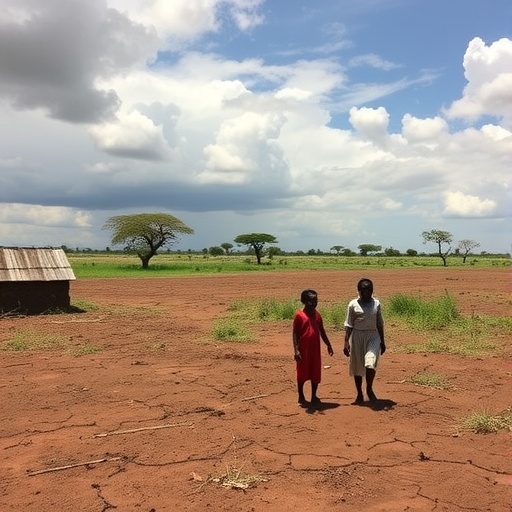
UNIVERSITY PARK, Pa. — In northern Kenya, one of the world’s most severe recent droughts did more than kill livestock and empty wells. It began reshaping an entire way of life. Among the Daasanach, a pastoralist community whose culture and economy have long centered on cattle, goats and other animals, families increasingly turned to Lake Turkana for a source of food and income they had traditionally viewed as a last resort: fish. A new longitudinal study led by Penn State researchers shows how extreme drought can transform diets, health, mobility, gender roles and cultural attitudes—and how some of those effects can continue long after the rains return.
The findings, published in Global Environmental Change, come from research that followed 515 adults and 384 children between 2019 and 2024. This timing allowed scientists to observe the community before, during and after the Greater Horn of Africa drought, which began in late 2020 and lasted until early 2023. The researchers were studying water and food security in a hot, arid region already vulnerable to climate shocks when the drought intensified. Because data had been collected before conditions deteriorated, the team could track changes as they unfolded rather than reconstructing them from memory afterward.
The drought disrupted the ecological foundation of Daasanach life. Pastoralism depends on the availability of grass and water, which determine whether animals can survive and produce milk, meat and offspring. As repeated failed rains reduced grazing resources, herds dwindled and households lost access to the animal products that traditionally supplied much of their nutrition. Livestock losses also altered patterns of movement. With fewer animals to herd, families traveled less across the landscape and increasingly stayed near towns, where schools, food aid, markets and other services were easier to reach. A climate event that began as a shortage of rainfall therefore became a cascade of nutritional, economic and social changes.
Measurements collected during the study revealed clear physical consequences. Adults and children lost weight, while children experienced reduced growth in height. These findings are important because childhood growth is a sensitive indicator of sustained nutritional stress: inadequate energy, protein and micronutrients can limit both weight gain and linear growth, particularly during periods when the body is developing rapidly. Although reported food and water insecurity improved after the rains returned, many nutritional effects remained visible through 2024. The researchers said children’s growth did not fully recover during the period they observed, suggesting that a drought can leave a biological legacy even when environmental conditions begin to improve.
Milk emerged as a particularly important protective factor. Children who consumed more milk during the drought had better nutritional outcomes than those with lower intake. For pastoralist communities, milk can provide energy, high-quality protein, fat and several essential micronutrients, making access to surviving lactating animals especially valuable during food shortages. But the same drought that reduced milk availability also made it harder for families to maintain the herds needed to produce it. This helps explain why the loss of livestock affected more than household income: it weakened a major nutritional buffer for children at the precise moment when food systems were under the greatest pressure.
As herds disappeared, fishing expanded. Lake Turkana offered an alternative source of animal protein and a potential way to earn money for grain and other foods. The change was culturally significant because fishing had historically carried a strong stigma among the Daasanach. Livestock and meat occupy a central place in social identity and economic life, while fishing was associated with people who lacked animals and were viewed as poor. Extreme environmental pressure altered that calculation. As more households began fishing, an activity once treated as a marker of hardship became a practical adaptation shared by a growing portion of the community. The shift illustrates how climate shocks can change not only what people do, but also how they judge one another.
The burden was not distributed evenly. Women experienced greater hardship than men, reflecting both social responsibilities and unequal access to resources. Women are primarily responsible for collecting water and preparing food, tasks that become more demanding as wells dry and water sources recede. They also often eat after other family members, meaning that household shortages can translate into reduced food intake for women. During the drought, women reported higher levels of food and water insecurity and experienced greater losses in body fat, with the largest differences appearing when conditions were most severe. These patterns show why drought assessments based only on rainfall, vegetation or livestock numbers can miss critical inequalities within households.
The study also documents a less visible dimension of drought: changes in settlement and mobility. Pastoralist mobility is often treated as a traditional lifestyle, but movement depends on resources. When animals are lost, families have fewer reasons and fewer means to travel with herds. At the same time, towns can become increasingly attractive because they provide access to relief programs, education, markets and health services. The result is not simply a temporary migration but a possible reorganization of where people live and how they make a living. Such changes can create new opportunities, but they may also increase dependence on external assistance and intensify pressure on urban resources.
The researchers argue that drought monitoring should incorporate human experience alongside environmental measurements. Rainfall records can establish that a meteorological drought has occurred, while livestock counts can indicate losses in pastoral economies. Neither measure reveals how frequently people go without drinking water, go to bed thirsty, skip bathing or reduce meals. Those experiences are direct indicators of water insecurity and can help identify health risks before they appear in clinical data. Combining household reports with nutritional measurements, satellite observations, rainfall records and livestock information could allow governments and humanitarian organizations to target assistance more precisely. Because the study is observational, it cannot prove that drought alone caused every measured change, but its repeated observations strongly connect environmental deterioration with shifts in health, livelihoods and behavior.
The Daasanach experience offers a warning for other communities whose survival depends heavily on climate-sensitive resources. As warming increases evaporation and contributes to more intense or prolonged drought in vulnerable regions, environmental shocks may increasingly push people toward new foods, new occupations and new settlements. Some adaptations, such as fishing, can improve access to food and income, while others may carry nutritional, economic or social costs. The Penn State team is continuing to study the community, including how changing drinking-water salinity may affect health. By following people before, during and after extreme events, researchers can capture not just the damage caused by drought, but the complex ways communities adapt—and the consequences that remain after the crisis appears to be over.
News Publication Date: 15-Jul-2026
Web References: https://doi.org/10.1016/j.gloenvcha.2026.103212
References: Rosinger, A. et al., “Historic drought in northern Kenya shifts diet and mobility away from traditional pastoralism as resource security and nutrition falter,” Global Environmental Change. DOI: 10.1016/j.gloenvcha.2026.103212
Cite Scienmag News
Russell Cooper. (August 25, 2026). Historic Kenyan drought transformed livelihoods, health, and everyday life. Scienmag. https://scienmag.com/historic-kenyan-drought-transformed-livelihoods-health-and-everyday-life/
Russell Cooper. "Historic Kenyan drought transformed livelihoods, health, and everyday life." Scienmag, 25 August 2026, https://scienmag.com/historic-kenyan-drought-transformed-livelihoods-health-and-everyday-life/. Accessed 4 September 2026.
Russell Cooper. "Historic Kenyan drought transformed livelihoods, health, and everyday life." Scienmag. August 25, 2026. https://scienmag.com/historic-kenyan-drought-transformed-livelihoods-health-and-everyday-life/


