


None
The interception of a single shipment at Philadelphia International Airport offers an unusually detailed window into how wildlife forensics operates at the intersection of law enforcement, conservation biology, and cultural anthropology. When inspectors with the US Fish and Wildlife Service opened boxes manifested under the vague label “MASKUREL,” they encountered an assortment that at first seemed routine: drums, hides, shells, and what appeared to be the skins of pangolins and the head of a lion. What made this case remarkable was not the presence of protected species alone, but the discovery that some of the most conspicuous items were fabrications, assembled from entirely different animals and materials than they purported to be. Untangling that mixture required a layered forensic approach, and the results illuminate both the ingenuity of traffickers and the analytical tools available to those who pursue them.
Pangolins occupy a singular and grim position in conservation discourse. Often described as the most heavily trafficked mammals on Earth, the eight recognized species, four in Asia and four in Africa, are protected under the Convention on International Trade in Endangered Species, with all populations listed on Appendix I, the strictest category of control. Trade in Appendix I species requires both import and export permits, and commercial trade is generally prohibited. Despite these protections, demand persists, driven overwhelmingly by scales used in traditional medicine systems across Asia and Africa and among diaspora communities worldwide. The scales are composed of keratin, the same protein found in human fingernails, yet they are ground into powders, brewed into teas, or prescribed whole in the belief that they can treat ailments ranging from skin conditions to circulatory problems. Beyond scales, nearly every part of a pangolin carries some purported use: bones, claws, eyes, fat, blood, and whole skins appear in medicinal, spiritual, and cultural practices, while the meat is prized as a delicacy in some regions.
Whole skins, however, occupy a less common niche in the trafficking record. Most seizures involve scales, sometimes by the ton, stripped from thousands of animals and packed into shipping containers. An intact skin suggests a different supply chain and a different end user. Rather than industrial-scale processing for pharmaceutical markets, a whole skin points toward individual practitioners, ritual specialists, or collectors who need the recognizable form of the animal itself. This distinction matters for enforcement agencies with finite resources: a container of scales represents volume and profit, while a single skin in a passenger shipment may represent a personal, culturally embedded practice that enforcement alone cannot extinguish.
The forensic examination began with the fundamentals. Morphological analysis, the oldest tool in the wildlife forensics toolkit, relies on the trained eye comparing evidence against reference specimens and published descriptions. The first suspected pangolin skin displayed features consistent with the family: overlapping scales with longitudinal ridges, a diamond pattern on the underside, and the characteristic taper of scales along the tail. The three-cusped scales proved diagnostic. Among African pangolins, the White-bellied Tree Pangolin, Phataginus tricuspis, bears scales with this distinctive trident shape, a feature reflected in its species name. The presence of short, pale hairs along the belly further supported identification, since tree-dwelling pangolins retain some fur on their undersides while their ground-dwelling cousins are more fully armored. The specimen’s condition, flattened, odoriferous, and hosting dead dermestid beetle larvae, told a story of crude preparation and prolonged storage, consistent with a skin harvested, treated minimally, and shipped without professional taxidermic care.
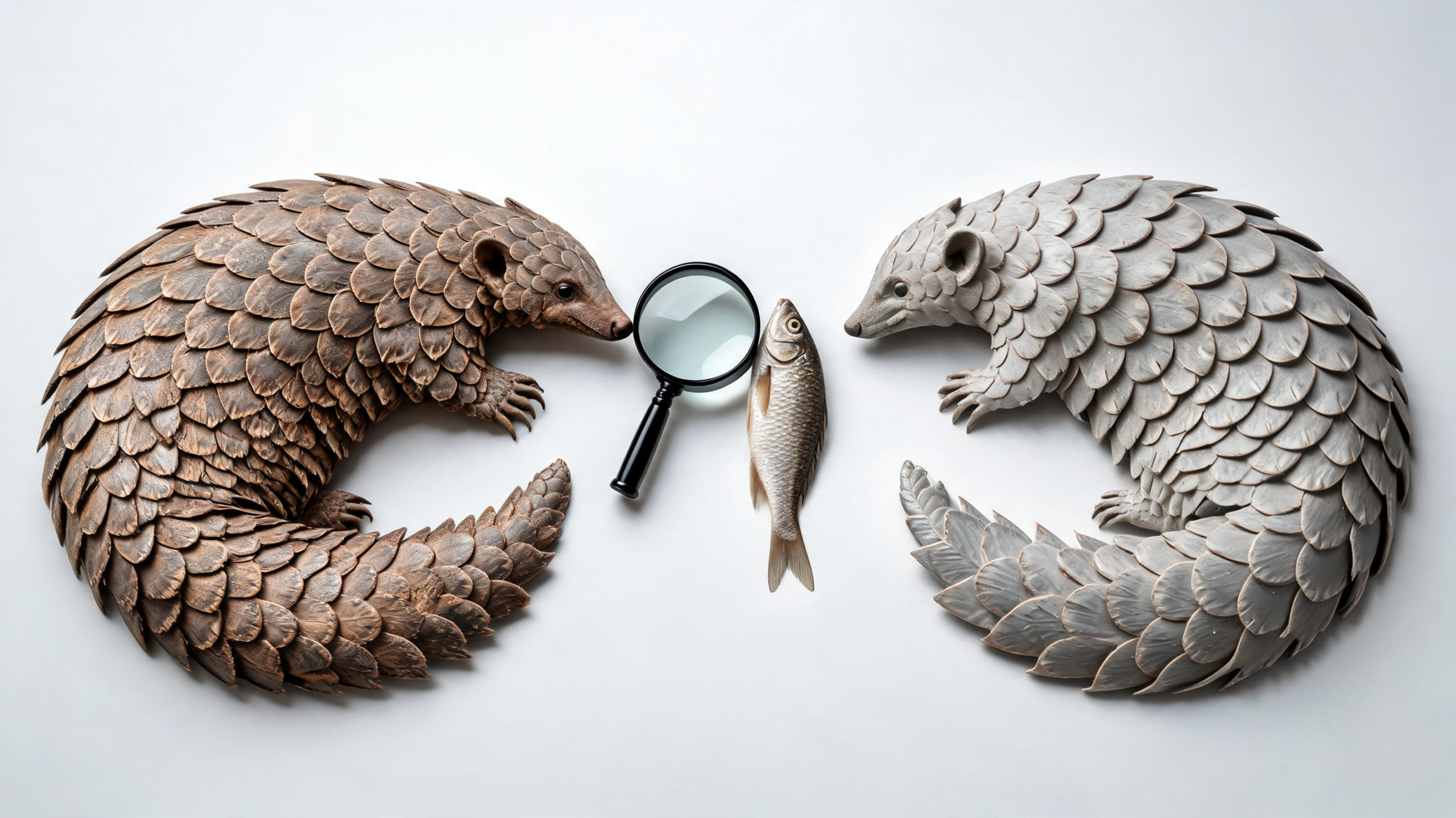
The second suspected pangolin skin told a different story upon close inspection. Its scales were unnaturally uniform in size and roughly rectangular, lacking the organic variation of true pangolin armor. A reddish-brown varnish had been applied after assembly, pooling in ways that revealed the item had been painted as a finished object rather than colored during the animal’s life. The backing was fabric. Whatever this object was meant to represent, it was manufactured, not harvested. Subsequent chemical analysis using x-ray fluorescence spectrometry, a technique that bombards a sample with x-rays and reads the characteristic secondary emissions to identify elemental composition, and genetic sequencing revealed the truth: the scales came from Atlantic Tarpon, Megalops atlanticus, a large silvery fish of coastal Atlantic waters. Tarpon scales are large, firm, and plate-like, making them plausible raw material for imitation pangolin armor once cut, shaped, and dyed.
The counterfeit lion head was, if anything, more brazen. Constructed over a carved block of hard foam, it featured plastic eyes, plastic teeth with an anatomically impossible count of five incisors where a true carnivoran has six, painted whisker follicles, and fur seams glued together with patches of hair concealing the joins. Styrofoam peeked through chipped paint on the cheek teeth. Genetic testing identified the fur as domestic goat. Yet the object was clearly made to deceive at a glance, and in a marketplace or ritual context where a lion head carries symbolic weight, a convincing silhouette and mane-like fur might suffice. Lions are protected under CITES, with Indian populations on Appendix I and all others on Appendix II, so a genuine lion head would require export documentation at minimum. A goat in costume requires nothing, which is precisely the economic logic of counterfeiting.
Counterfeiting in wildlife trade is not new, but it is understudied. Fakes can serve multiple functions: they allow sellers to meet demand when genuine products are scarce or expensive, they reduce risk for traffickers who can pass off cheap substitutes, and in some cases buyers may be complicit, purchasing a plausible token rather than a costly authentic item. The presence of both a genuine pangolin skin and a counterfeit one in the same shipment raises intriguing questions. Was the buyer deceived about one or both? Was the shipment a test of what sells? Or do different market segments exist, with authentic items commanding premium prices while fakes serve budget-conscious customers? The forensic record alone cannot answer these questions, but documenting the phenomenon alerts enforcement agencies and researchers that fraud, not just trafficking, characterizes parts of this trade.
The geographic reasoning in this case demonstrates how even modest investigative resources can narrow a shipment’s likely origin. The White-bellied Tree Pangolin ranges across West and Central Africa’s forest zones. Western Harnessed Bushbucks, identified from the hides in the shipment, occupy a more restricted range within coastal West Africa. Atlantic Tarpon spawn and juveniles inhabit coastal waters off West Africa, and domestic goats are, of course, ubiquitous. The intersection of all these species’ ranges points toward the coastal West African region, and the air waybill originating in Sierra Leone corroborated that inference. Sierra Leone appears on lists of both source and transit countries for illegal wildlife trade, and its position along the Upper Guinean forest region places it squarely within the overlap zone the species distributions suggest. This convergence of independent lines of evidence, morphology, chemistry, genetics, and shipping documentation, exemplifies the corroboration that gives forensic conclusions their weight.
The intended use of these items likely lies in traditional West African medicinal or religious practices. Cowrie shells, long significant in West African spiritual and economic history, and drums made from ungulate hides fit this context, as do bushbuck skins and pangolin parts, which appear in various regional traditions. If the shipment indeed served West African traditional practices within the United States, it may signal a demand stream distinct from the well-documented Asian medicinal trade that dominates pangolin trafficking statistics. Demand-reduction strategies must be tailored to the communities that generate demand, and a strategy designed for Asian medicine markets may resonate poorly, or offensively, with West African religious practitioners. Understanding the cultural context is therefore not an academic luxury but a practical prerequisite for interventions that are both effective and respectful.
The destruction of the drums and bushbuck hides under Centers for Disease Control and Prevention guidelines highlights another dimension of wildlife importation that receives less public attention: zoonotic risk. Untreated hides from hoofed stock can harbor Bacillus anthracis, the bacterium responsible for anthrax, which persists in animal products and poses genuine hazard to handlers, inspectors, and end users. Anthrax is endemic in parts of sub-Saharan Africa, and hides that have not undergone proper tanning or sterilization can carry viable spores across continents. The precautionary destruction of these items, photographed and documented first, reflects standard biosecurity protocol and underscores that wildlife trafficking endangers public health as well as biodiversity.
Methodologically, this case study champions a pragmatic philosophy. Forensic laboratories typically operate under tight budgets, and species identification alone often suffices to support prosecution. Investing in geographic provenancing, reference collections, and validated genetic markers for origin assignment is expensive. Yet the authors demonstrate that by considering every item in a shipment, including the legal, common, and counterfeit ones, investigators can extract intelligence about origin, purpose, and emerging trends without additional cost. A goat head dressed as a lion, a tarpon disguised as a pangolin, and a genuine tree pangolin skin together sketch a portrait of a trade route and a market that no single item could provide.
For conservationists, the broader lesson is that the wildlife trade is a moving target. As enforcement tightens around the most conspicuous flows, such as bulk pangolin scales, demand may fragment into smaller shipments, substitute species, and fabricated products. Detection requires not only better technology but broader thinking: forensic scientists who can recognize a fake, ecologists who can map where species overlap, and social scientists who can interpret why a package crossed an ocean. This single fishy pangolin, as the study’s title wryly acknowledges, carries within its counterfeit scales a reminder that protecting the world’s most trafficked mammal demands vigilance against both the trade in the real and the trade in the false.
Subject of Research: Forensic insights from a fishy pangolin on the trade in real and fake whole pangolin skins
Article Title: Forensic insights from a fishy pangolin on the trade in real and fake whole pangolin skins
Article References: Tinsman, J., Hamlin, B. C., Goldman, J.-M., Chaffra, A. S., Straughan, D. J., & Espinoza, E. (2026). Forensic insights from a fishy pangolin on the trade in real and fake whole pangolin skins. Discover Conservation, 3(1), Article 34. https://doi.org/10.1007/s44353-026-00100-3
Image Credits: AI Generated
DOI: 10.1007/s44353-026-00100-3
Keywords: Forensic, insights, fishy, pangolin, trade, real, fake, whole, skins, scientific research
Cite Scienmag News
Margaret Porter. (September 3, 2026). Forensic insights from a fishy pangolin on the trade in real and fake whole pangolin skins. Scienmag. https://scienmag.com/forensic-insights-from-a-fishy-pangolin-on-the-trade-in-real-and-fake-whole-pangolin-skins/
Margaret Porter. "Forensic insights from a fishy pangolin on the trade in real and fake whole pangolin skins." Scienmag, 3 September 2026, https://scienmag.com/forensic-insights-from-a-fishy-pangolin-on-the-trade-in-real-and-fake-whole-pangolin-skins/. Accessed 4 October 2026.
Margaret Porter. "Forensic insights from a fishy pangolin on the trade in real and fake whole pangolin skins." Scienmag. September 3, 2026. https://scienmag.com/forensic-insights-from-a-fishy-pangolin-on-the-trade-in-real-and-fake-whole-pangolin-skins/


