Indonesian bay leaf, Syzygium polyanthum, has long been a fixture of Southeast Asian kitchens and traditional medicine, prized for its aromatic flavor and its store of bioactive phytochemicals. Its leaves contain phenolic compounds, flavonoids, terpenoids, aromatic aldehydes, and fatty acid derivatives, constituents associated with antimicrobial and antioxidant properties that make the plant a promising source of value-added extracts for food, pharmaceutical, cosmetic, and biotechnological applications. Yet recovering these compounds efficiently has always been a challenge. Plant tissues are built from complex cellular structures that restrict solvent penetration and solute diffusion, and conventional methods such as maceration, Soxhlet extraction, and hydrodistillation demand long processing times, large solvent volumes, and prolonged heating that can degrade thermolabile constituents. A new study published in Results in Engineering by Darnengsih Darnengsih, Hikmatun Ni’mah, and Mahfud Mahfud of Institut Teknologi Sepuluh Nopember tackles this problem head-on, revealing that the solvent chosen for microwave-assisted extraction does far more than dissolve the target compounds. It fundamentally rewrites the physics of the entire process.
The research team used microwave-assisted extraction, or MAE, an intensified technique in which microwave irradiation generates volumetric heating through dipole rotation and ionic conduction. In a solvent-plant matrix system, this heating mechanism raises internal pressure, promotes cell-wall disruption, and enhances the diffusion of intracellular compounds into the solvent phase. But the performance of MAE depends strongly on process variables such as microwave power, extraction time, feed-to-solvent ratio, and, critically, solvent type. Solvent selection controls both solute-solvent affinity and microwave energy dissipation, and effective microwave heating cannot be inferred from polarity or dielectric constant alone. It also depends on the dielectric loss factor and loss tangent, together with matrix moisture, solvent-matrix interactions, and operating conditions. To probe these effects, the researchers selected three contrasting media: ethanol as a polar solvent, acetone as semi-polar, and n-hexane as non-polar, allowing them to compare solvent effects on yield, kinetic regime, chemical selectivity, and energy exposure within a common experimental framework.
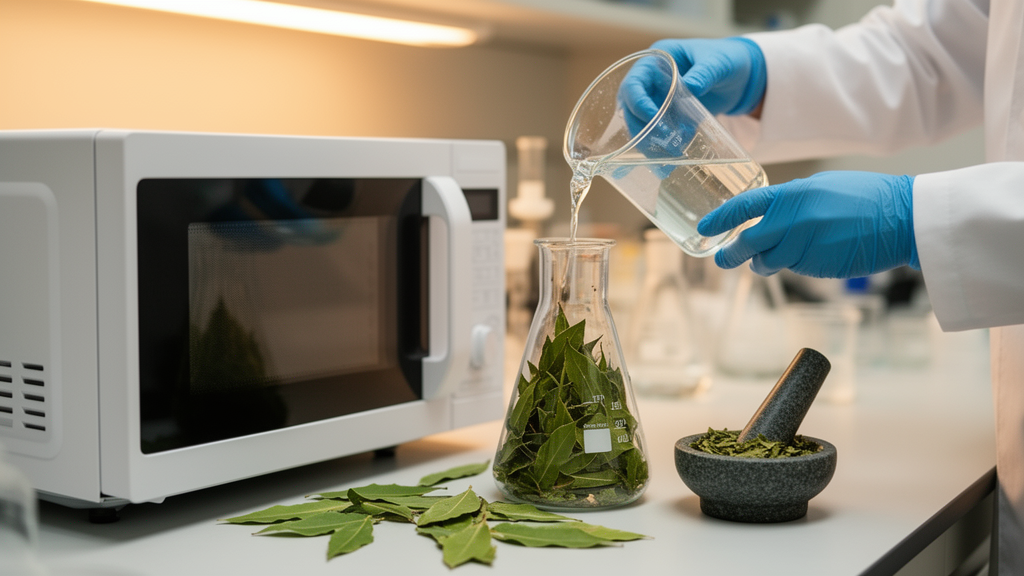
Fresh S. polyanthum leaves collected from East Java, Indonesia, were washed, drained, and cut into pieces of approximately one to two centimeters to increase contact area between the plant matrix and solvent without thermal pretreatment. Using fresh leaves was a deliberate choice to preserve the intrinsic moisture of the plant matrix, which contributes to microwave heating. Intracellular moisture can absorb microwave energy, generate localized pressure, and facilitate tissue disruption, thereby promoting solvent penetration and solute release. Extraction was performed using a laboratory-scale microwave system operating at 2.45 gigahertz with adjustable output power up to 800 watts, connected to a vertical reflux assembly with a one-liter round-bottom flask. The experiments were arranged using a three-factor, three-level Box-Behnken design evaluating microwave power from 150 to 450 watts, feed-to-solvent ratio from 0.10 to 0.20 grams per milliliter, and extraction time from 20 to 180 minutes, with seventeen runs including five center-point replicates. All runs were performed in triplicate, and yield was calculated as the mass of dried extract relative to the mass of plant material.
The results exposed striking solvent-dependent response patterns. Ethanol extraction showed a gradual increase in yield across the investigated power range, from 1.24 percent at 150 watts to 1.41 percent at 300 watts and 1.60 percent at 450 watts, suggesting that ethanol maintained effective microwave coupling as power increased, promoting internal heating, tissue disruption, and the release of oxygenated phytochemicals. In contrast, n-hexane exhibited a non-linear response: yield increased from 1.89 percent at 150 watts to 2.27 percent at 300 watts but then decreased to 1.30 percent at 450 watts. This optimum-like behavior indicates that n-hexane extraction was more sensitive to excessive microwave power. Because n-hexane has weak direct microwave absorption, heat generation is likely dominated by moisture present within the fresh plant matrix. At moderate power, this moisture-mediated heating enhances the diffusion of lipophilic compounds into the solvent phase, but at higher power, localized overheating may promote volatilization or degradation of thermally sensitive constituents. Acetone produced lower and relatively stable yields over the power range, reflecting an intermediate regime in which microwave heating partially enhanced mass transfer but extraction remained constrained by solvent-matrix interactions.
To interpret these differences mechanistically, the team fitted six kinetic models to the experimental yield-time data: pseudo-first-order, pseudo-second-order, power-law, hyperbolic, Elovich, and Weibull equations. The objective was not merely to identify the statistically best-fitting model but to relate model behavior to the physical processes governing extraction. For ethanol, the hyperbolic and Weibull models provided the highest goodness-of-fit with a coefficient of determination of 0.9959, and the Weibull shape parameter of 1.413, greater than one, suggests an accelerating early phase followed by saturation, typical for systems with strong initial desorption and subsequent equilibrium approach. Ethanol’s relatively high dielectric constant and dielectric loss factor allow efficient microwave energy absorption, enhancing internal pressure build-up, cell-wall rupture, and rapid desorption of surface-accessible phytochemicals. As extraction progresses, solutes located in deeper cellular compartments diffuse through partially disrupted tissues, resulting in increasing internal mass-transfer resistance. Ethanol extraction is therefore governed by a balanced washing-diffusion mechanism with clear saturation behavior.
Acetone and n-hexane told a different story. Acetone-based MAE showed a continuously decelerating profile with no sharply defined plateau within the investigated time range, and the power-law model provided the best fit with a coefficient of determination of 0.9961 and a low exponent of 0.3153. An exponent markedly below unity indicates strong non-linear diffusion control and progressively increasing internal mass-transfer resistance. Acetone absorbs microwave energy less efficiently than ethanol but more effectively than non-polar solvents, leading to moderate and spatially heterogeneous heating. Under such conditions, extraction proceeds through progressive matrix swelling and gradual structural reorganization rather than abrupt rupture, resulting in evolving diffusion pathways and time-dependent transport resistance. The n-hexane system exhibited the slowest kinetic progression, with the power-law exponent dropping to 0.2186, the lowest among all solvents, and a Weibull shape parameter of 0.4698, confirming strong diffusion control with sustained deceleration. The very low dielectric constant and negligible dielectric loss factor of n-hexane limit direct microwave absorption, so microwave energy is primarily absorbed by intrinsic water molecules within the plant matrix rather than by the solvent itself, producing moisture-driven localized heating and gradual internal pressure development.
The systematic decrease of the power-law exponent from ethanol through acetone to n-hexane quantitatively indicates increasing internal diffusion resistance as solvent polarity and dielectric coupling decrease. Solvent polarity, together with dielectric behavior, is not only a determinant of chemical selectivity but also a governing factor of kinetic regime and mass-transfer dynamics. The researchers then optimized the process using response surface methodology. Extraction time was the most influential variable for all three solvents, with the ethanol system demonstrating the most robust statistical performance, achieving a coefficient of determination of 0.9779 with excellent agreement between adjusted and predicted values. At the optimized conditions, ethanol required 349.55 watts and 177.7 minutes for a predicted yield of 1.477 percent, acetone required 312.81 watts and 180 minutes for 0.979 percent, and n-hexane required only 282.64 watts and 176 minutes for the highest predicted yield of 2.277 percent. All solvents approached a plateau at approximately 160 to 180 minutes.
The energy analysis produced perhaps the most counterintuitive finding of the study. The team calculated nominal microwave energy exposure from optimized power and time, and a yield-normalized nominal energy index expressed in kilowatt-hours per percentage-point yield. At the optimized conditions, nominal exposure was 1.035 kilowatt-hours for ethanol, 0.938 for acetone, and 0.829 for n-hexane. When normalized by optimized yield, the index was 0.701, 0.959, and 0.364 kilowatt-hours per percentage-point yield for ethanol, acetone, and n-hexane respectively. The lowest nominal power-time exposure occurred for n-hexane, not ethanol, demonstrating why dielectric coupling should not be used as a stand-alone surrogate for overall process energy performance. A solvent can exhibit strong microwave coupling without necessarily showing the lowest optimized nominal energy exposure. The authors are careful to note that these quantities are comparative nominal indicators, not substitutes for wall-plug energy, absorbed microwave energy, or true specific energy consumption per kilogram of extract, since actual electrical energy consumption, cavity efficiency, reflected power, heat losses, condenser cooling demand, and solvent-recovery duty were not directly measured.
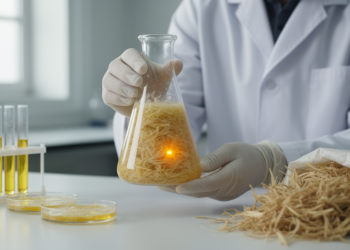
Chemical characterization by gas chromatography-mass spectrometry and Fourier transform infrared spectroscopy confirmed that solvent polarity governs chemical selectivity at both molecular and functional-group levels. Ethanol extracts were enriched in oxygenated monoterpenes such as citronellal at 19.15 percent and 1,8-cineole at 14.89 percent, alongside sabinene-like bicyclic monoterpenes, and the crude ethanol fraction displayed the most chemically diverse lipid-bioactive profile including oleic acid, glycerol monooleate, ethyl oleate, palmitic acid, and tocopherol derivatives. Acetone extracts demonstrated enrichment in phenylpropanoid derivatives, particularly methyl cinnamate at 28.95 percent. The n-hexane oil fraction was dominated by lipophilic terpenoid and hydrocarbon-rich components including d-limonene and dl-limonene, while the crude n-hexane fraction contained the highest lipid concentration with hydroxy oleoyl-palmitoyl glycerol at 22.16 percent. FTIR analysis showed a progressive simplification of spectral complexity from ethanol to acetone to n-hexane, with ethanol exhibiting the most intense and broad O-H stretching band in the 3600 to 3200 per centimeter region, indicating a high abundance of hydroxyl-containing phenolic compounds, while the n-hexane extract showed only a weak O-H band and minimal oxygenated functionality.
Antibacterial testing against Escherichia coli and Staphylococcus aureus using the agar disc diffusion method revealed a clear hierarchy: ethanol, then acetone, then n-hexane. Under optimal extraction conditions, the ethanol extract produced inhibition zones of 20 millimeters against S. aureus and 9.5 millimeters against E. coli, while the n-hexane extract showed minimal activity with one-millimeter zones against both bacteria. Across all solvent systems, inhibition zones were significantly larger against the Gram-positive S. aureus than the Gram-negative E. coli, a difference explained by bacterial cell-wall architecture. Gram-positive bacteria possess a thick peptidoglycan layer but lack the outer lipopolysaccharide membrane found in Gram-negative bacteria, which acts as a permeability barrier restricting diffusion of hydrophobic and moderately polar phytochemicals. The stronger antibacterial activity of the ethanol extract is consistent with its richer profile of oxygenated monoterpenes, phenylpropanoids, amphiphilic lipids, and hydroxyl-containing functional groups, which may contribute to antibacterial action through membrane perturbation, increased permeability, leakage of intracellular ions and macromolecules, and protein denaturation. Oxygenated terpenoids such as cineole and citronellal enhance antimicrobial activity through lipophilic membrane interaction combined with oxidative stress induction, and the coexistence of phenolics and amphiphilic monoacylglycerols may produce synergistic membrane-destabilization effects, particularly against Gram-positive bacteria.
The integrated findings establish a coherent solvent-composition-bioactivity framework for microwave-assisted extraction of S. polyanthum. Ethanol, as a polar and lower-toxicity solvent with high renewable sourcing potential through bioethanol routes, produces the most chemically diverse and functionally relevant extract among the tested systems, with the clearest rapid washing-diffusion kinetic behavior. Yet the study also demonstrates that kinetic approach to equilibrium and low yield-normalized nominal energy exposure are distinct performance attributes that should be evaluated together rather than treated as equivalent measures. For scale-up, the authors emphasize that microwave penetration depth and electromagnetic-field uniformity can change with vessel diameter, solvent loading, composition, and temperature, potentially creating hot and cold zones, so industrial translation would require evaluation of mixing or recirculation, residence-time distribution, vapor and pressure control, condenser capacity, solvent recovery and recycling, and explosion-protected equipment for flammable solvents. Future work should combine temperature-resolved energy measurements using microwave-compatible fiber-optic probes, validated scale-up studies, broader green-solvent screening including aqueous ethanol, ethyl acetate, and deep-eutectic systems, and formal life-cycle and techno-economic assessment to determine industrial feasibility. For now, the message is clear: in microwave-assisted extraction, the solvent is not just a medium but an active participant that dictates heating mechanism, transport regime, chemical selectivity, biological function, and energy demand, and choosing it wisely may matter more than any dial on the microwave.
Subject of Research: Chemical Engineering
Article Title: Solvent-dependent microwave-assisted extraction of Syzygium polyanthum leaves: process optimization, kinetic modeling, and energy performance
Article References: Darnengsih, D., Ni’mah, H., & Mahfud, M. (2026). Solvent-dependent microwave-assisted extraction of Syzygium polyanthum leaves: process optimization, kinetic modeling, and energy performance. Results in Engineering, 32, Article 113563. https://doi.org/10.1016/j.rineng.2026.113563
Image Credits: AI Generated
DOI: 10.1016/j.rineng.2026.113563
Keywords: microwave-assisted extraction, Syzygium polyanthum, Indonesian bay leaf, solvent selection, kinetic modeling, Weibull model, Box-Behnken design, antibacterial activity, green extraction, bioactive compounds, Solvent-dependent, microwave-assisted
Cite Scienmag News
Denise Maddox. (October 17, 2026). The Solvent Secret Behind Microwave Extraction of Indonesian Bay Leaf. Scienmag. https://scienmag.com/the-solvent-secret-behind-microwave-extraction-of-indonesian-bay-leaf/
Denise Maddox. "The Solvent Secret Behind Microwave Extraction of Indonesian Bay Leaf." Scienmag, 17 October 2026, https://scienmag.com/the-solvent-secret-behind-microwave-extraction-of-indonesian-bay-leaf/. Accessed 17 October 2026.
Denise Maddox. "The Solvent Secret Behind Microwave Extraction of Indonesian Bay Leaf." Scienmag. October 17, 2026. https://scienmag.com/the-solvent-secret-behind-microwave-extraction-of-indonesian-bay-leaf/