


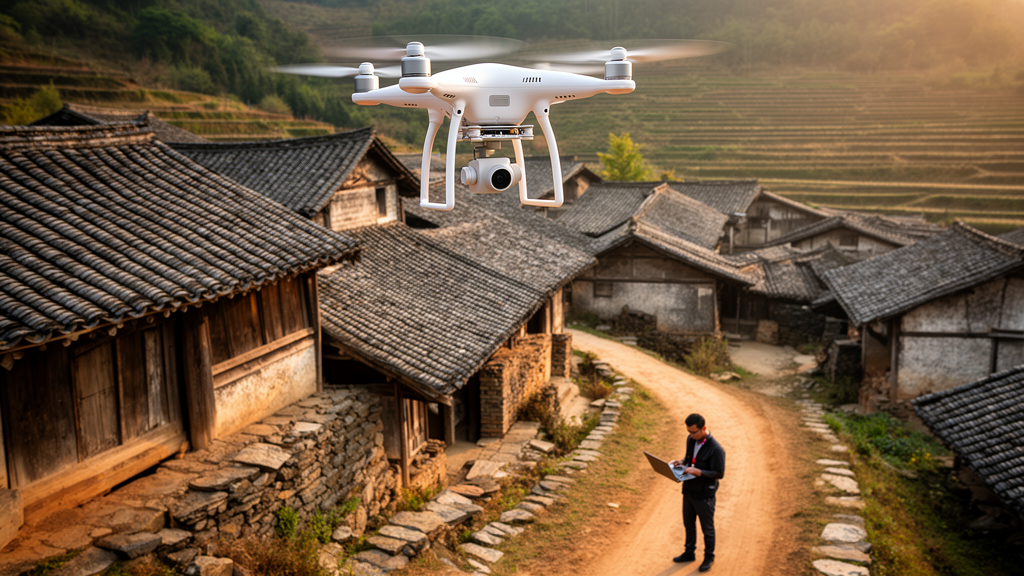
Deep in the rural landscapes of Guangdong Province, hundreds of centuries-old villages are quietly disappearing. Not all at once, but roof tile by roof tile, wall crack by wall crack, as maintenance crews fail to reach remote settlements before decay becomes irreversible. The scale of the loss is staggering: statistics cited by a new study indicate that roughly two million villages vanished in China between 1985 and 2025, and rural heritage sites across the world face similar pressures. Now a research team from City University of Macau and partner institutions in Guangdong has built a workflow that pairs drone photography with artificial intelligence to document these settlements in fine detail and flag roof damage automatically, before the buildings are gone for good.
The study, published in npj Heritage Science, takes five traditional villages in Guangdong Province as its case studies. These settlements share the characteristics that make manual inspection so difficult: complex spatial layouts, dense clusters of traditional buildings, narrow lanes that resist ground-based survey, and locations remote enough that they rarely attract the public attention or funding streams that urban monuments receive. When inspection is slow, repairs are delayed, and delayed repairs accelerate decay in a feedback loop that has already erased so much of China’s rural built heritage.
The team’s answer begins in the air. Using unmanned aerial vehicles equipped with visible-light cameras, they acquired a total of 12,762 images over the five villages. These were not casual snapshots but systematically collected photographs designed for photogrammetry, the technique of reconstructing three-dimensional geometry from overlapping two-dimensional images. Processed together, the images yield high-precision spatial digital archives: detailed orthophoto maps and three-dimensional models that record the state of every visible roof, wall, and courtyard at the moment of capture. Such archives serve a dual purpose. They are preservation documents in their own right, preserving a measurable record of structures that may not survive, and they are the raw material for automated condition assessment.
On top of that digital foundation sits the deep learning component. The researchers trained an object detection model based on the YOLOv8 architecture, a family of convolutional neural networks designed to identify and localize objects in images in a single pass. To teach the model what roof damage looks like in traditional Guangdong villages, the team assembled a training dataset of 41,213 annotated instances, each one a labeled example of damage or a feature of interest drawn from the drone imagery. Annotation at that scale is laborious work, but it is what allows a neural network to distinguish, say, a missing tile or a collapsed roof section from the ordinary textures of aged clay and weathered timber.
The performance figures reported in the paper are notable. The YOLOv8-based model achieved an overall mean average precision at an intersection-over-union threshold of 0.5, abbreviated mAP50, of 0.832. In practical terms, mean average precision combines how accurately the model detects damaged regions with how precisely it draws the bounding boxes around them; a value above 0.8 indicates that the system correctly identifies the large majority of damage instances while keeping false alarms at a manageable level. For heritage managers deciding where to send repair crews, that balance matters enormously, because every false positive wastes a site visit and every false negative is a building left to decay.
Speed is the other half of the story. The researchers validated their trained model on ultra-high-resolution digital orthophoto maps, known as DOMs, and on aerial video footage captured over the villages. Across these validation runs, the model averaged an inference time of 5.77 milliseconds per frame. That figure means the system can process aerial video essentially in real time, scanning continuous footage from a drone flight and flagging damage as it appears, rather than requiring hours of offline computation. Combined with the orthophoto analysis, it allows an entire village to be surveyed from the air in a fraction of the time a ground-based inspection would demand.
The technical logic of the workflow is straightforward to describe but demanding to execute. Photogrammetry converts the 12,762 overlapping drone images into georeferenced orthophotos and three-dimensional models, ensuring that every detected damage instance can be tied to a real-world location on a specific building. The deep learning model then sweeps across these products, drawing bounding boxes around damage and classifying it. Because the orthophotos are georeferenced, the output is not just a list of detections but a map of where repairs are needed, which is precisely the information a maintenance program requires to prioritize its limited budget.
Why roofs? In traditional village architecture, the roof is both the most vulnerable element and the most informative one. Tile slippage, ridge failure, and structural sagging are visible from above in ways that foundation problems are not, and roof damage is often the first sign that a building has passed from routine aging into active decline. A system that can detect roof damage across an entire settlement gives conservators an early-warning capability that manual inspection, constrained by narrow lanes, dense building clusters, and limited personnel, has never been able to provide at village scale.
The implications reach well beyond Guangdong. The authors frame their work as a response to a global problem: rural cultural heritage sites worldwide are losing maintenance attention as populations shift to cities, and the buildings most at risk are often those in the most remote locations. A workflow that requires only a consumer-grade drone, a photogrammetry pipeline, and a trained detection model could be adapted to other regions and other architectural traditions, provided that local training data is annotated to teach the model the specific damage patterns of each building type. The open-access publication of the study, under a Creative Commons Attribution 4.0 license, lowers the barrier for other teams to build on the approach.
There is also a quieter, more poignant dimension to the work. Every orthophoto and three-dimensional model in the digital archive is a record of a settlement as it stood on the day of the flight. For villages that ultimately cannot be saved, those archives become the definitive documentation of what was lost, available to researchers, descendants, and future reconstruction efforts. For villages that can be saved, the same data directs repairs to the buildings that need them most. Either way, the combination of 12,762 drone images, 41,213 annotated training instances, a detection model running at 5.77 milliseconds per frame, and a mean average precision of 0.832 represents a genuine shift in how the world’s most endangered rural heritage can be watched over, one flight and one frame at a time.
Subject of Research: UAV photogrammetry and deep learning for digital preservation and automated roof damage detection in Guangdong traditional villages
Article Title: Digital preservation and automated roof damage detection for traditional village heritage in Guangdong using UAV photogrammetry and deep learning
Article References: Zhu, Z., Hsieh, C.-M., Liu, X., Li, X., Zhong, Z., & Chen, Z. (2026). Digital preservation and automated roof damage detection for traditional village heritage in Guangdong using UAV photogrammetry and deep learning. npj Heritage Science. https://doi.org/10.1038/s40494-026-03055-9
Image Credits: AI Generated
DOI: 10.1038/s40494-026-03055-9
Keywords: UAV photogrammetry, deep learning, YOLOv8, roof damage detection, traditional villages, cultural heritage, Guangdong, digital preservation, orthophoto maps, heritage conservation, object detection, rural settlements
Cite Scienmag News
Courtney Benton. (October 17, 2026). Drones and Deep Learning Race to Save China’s Vanishing Traditional Villages. Scienmag. https://scienmag.com/drones-and-deep-learning-race-to-save-chinas-vanishing-traditional-villages/
Courtney Benton. "Drones and Deep Learning Race to Save China’s Vanishing Traditional Villages." Scienmag, 17 October 2026, https://scienmag.com/drones-and-deep-learning-race-to-save-chinas-vanishing-traditional-villages/. Accessed 17 October 2026.
Courtney Benton. "Drones and Deep Learning Race to Save China’s Vanishing Traditional Villages." Scienmag. October 17, 2026. https://scienmag.com/drones-and-deep-learning-race-to-save-chinas-vanishing-traditional-villages/


