


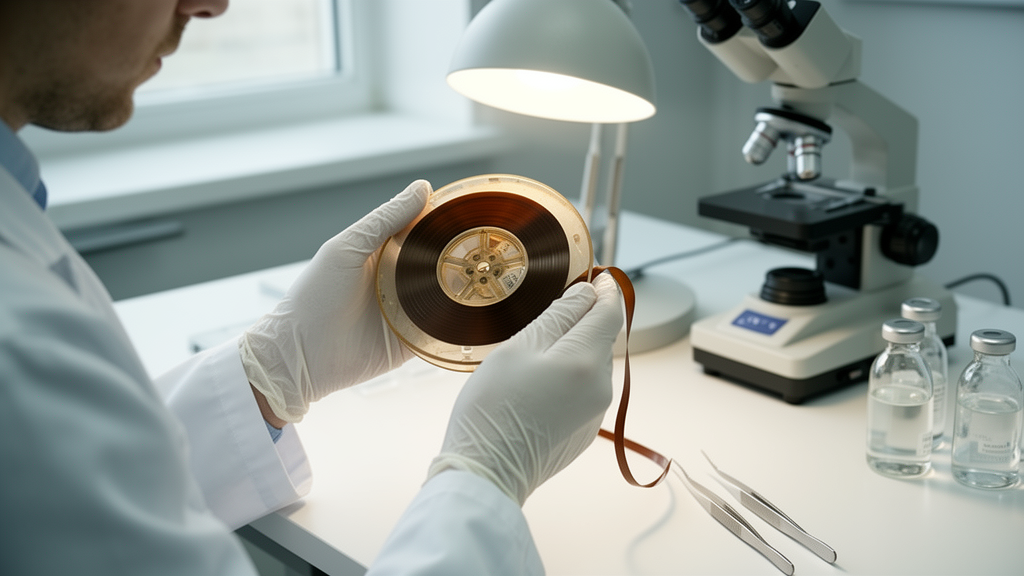
For decades, archivists have watched helplessly as the magnetic tapes holding irreplaceable recordings of twentieth-century music, broadcast history, and oral testimony slowly fall apart. The symptoms are familiar to any restoration engineer: tapes that squeal during playback, shed sticky residue onto playback heads, or delaminate in chunks when unwound from the reel. What has been far less clear is whether these different failure modes reflect fundamentally different chemical processes, or whether they are merely different faces of a single underlying decay. A new study published in npj Heritage Science now provides a compelling answer, showing that several macroscopically distinct tape syndromes share a common chemical origin: the hydrolysis of the polyester-polyurethane binder that holds the magnetic pigment in place.
The research, led by Jack Harrison and Sebastian Gliga at the Swiss Light Source of the Paul Scherrer Institute, together with collaborators from the tape restoration community, applied a multimodal analytical approach to four analogue audio tapes. The team combined attenuated total reflection Fourier-transform infrared spectroscopy (ATR-FTIR), optical microscopy, and scanning electron microscopy (SEM) to correlate chemical signatures with microscopic surface morphology. Their central finding is striking: tapes previously diagnosed with different forms of soft binder syndrome (SBS), including the well-known sticky-shed syndrome (SSS), all exhibit the same infrared fingerprints associated with binder hydrolysis, and these fingerprints respond to heat treatment in the same way.
Magnetic audio tape is a layered structure. The top magnetic layer, roughly 10 to 15 micrometres thick, consists of micron-sized magnetic pigment, most commonly gamma ferric oxide, embedded in a polymer binder typically made of polyester-polyurethane. Beneath it lies a plastic base layer, usually polyethylene terephthalate, around 35 micrometres thick, and many tapes carry a thin back coating of carbon black in a similar binder, roughly 1 to 2 micrometres thick, which aids tape packing by reducing entrained air and static charge. The binder is the glue of the whole system, and its chemical integrity determines whether the magnetic layer stays attached and behaves mechanically during playback.
Hydrolysis attacks the flexible polyester soft segments of the binder, cleaving ester linkages and producing low-molecular-weight chains that migrate to the tape surface. These short-chain ester products form the dark puddles visible in electron micrographs of degraded tapes, and they alter the tribological properties of the coating, producing the stickiness and shedding that define SSS. The team’s ATR-FTIR measurements, which probe approximately the top 2 micrometres of the tape, show a characteristic redistribution of carbonyl peaks: the 1728 per centimetre peak from the soft-segment ester bond grows relative to the 1702 per centimetre peak from the hard-segment polyurethane bond. Crucially, the researchers explain an apparent contradiction with earlier studies of pure PE-PU hydrolysis, where the peak behaviour is inverted. The change in tape spectra reflects not the degradation of the ester bond itself but a change in the relative concentration of short and hard segments at the surface, as cleaved soft segments accumulate there.
The team tested this framework on a 1977 quarter-inch Ampex 406 tape, a severe case of SSS with large chunks of magnetic coating delaminating during unwinding. Heat treatment at 55 degrees Celsius for one, five, and fifteen hours produced a rapid reduction of the characteristic hydrolysis fingerprints, and SEM images showed the dark surface puddles almost completely vanishing after just one hour. Remarkably, the chemical change begins within seconds once the tape reaches around 45 degrees Celsius, with minimal further change beyond a few minutes. This raises an obvious question: if the chemistry responds so quickly, why do archivists routinely bake full reels for eight hours to days? The answer lies in the tape pack itself. Previous work on full one-inch reels found that thermal diffusion occurs on a timescale of a few hours, whereas hygroscopic equilibrium requires several days, meaning moisture diffusion into the pack is roughly fifty times slower than the nominal rate of polymer recombination. The hygroscopic carbon black back coat also retains moisture and can initiate redegradation when the tape is rewound, which explains why baked reels often become unplayable again within weeks, while the team’s baked short segments showed no signs of redegradation after eighteen months of storage.
Spatially resolved ATR-FTIR measurements across the width of the Ampex 406 tape revealed another important finding: the degree of hydrolysis varies significantly across the tape, with the largest variations at the edges, where most delamination is observed near the hub. This spatial inhomogeneity, likely driven by pressure distribution and trapped air pockets in the wound reel, carries a practical warning. Single-point measurements could easily misdiagnose a tape, and the authors emphasise that systematic, position-resolved measurements are essential for reliable assessment. Similar results on a 1994 two-inch Ampex 456 tape, which had remained sealed since manufacture and shows milder adhesion and delamination, confirmed the same hydrolysis signatures and the same rapid response to heat treatment in isolated segments, again pointing to tape packing as the limiting factor for full reels.
The most instructive case, however, was a Pyral CJ87 tape from around 1979, which deposits large amounts of black residue on playback heads and guides, preventing digitisation beyond a few seconds. These tapes are not sticky and do not recover playability through baking alone, so they were not considered typical SSS. Yet the team found the same hydrolysis fingerprints, responding to heat treatment in the same manner, indicating that binder hydrolysis is a key component of the degradation here too. The Pyral tape also showed an additional infrared peak, absent from the other tapes, that matches the spectrum of the tape’s back coat, confirming that transferred back-coat material sits on the magnetic surface. The back coat itself shows hydrolysis signatures that reduce upon baking, promoting adhesion between adjacent layers and driving the transfer of carbon black onto the magnetic surface during playback. While the short-chain ester byproducts respond to heat, the transferred carbon black remains on the surface even after extended heating; it took roughly seventy-two hours for even isolated segments to look relatively clean, and the residue is only partially melted into the binder rather than removed.
This finding resolves why heat treatment alone fails for Pyral tapes: the remediation workflow must be supplemented with cleaning to remove back-coat residue. It also demonstrates the limits of any single analytical technique. ATR-FTIR of a heat-treated Pyral segment would suggest the tape should be playable, because the chemical signatures of hydrolysis have been reduced, but the physical contamination on the surface, invisible to spectroscopy, still blocks playback. Microscopy plays the crucial complementary role, revealing structural features that directly influence tape behaviour during handling. The authors argue that this multimodal approach can be performed on segments as small as one centimetre, allowing a section of a problematic tape to be tested before intervention to determine whether heat treatment alone would suffice or whether additional steps such as cleaning are required.
Based on these results, the team proposes a revised classification framework for soft binder syndrome, subdividing it by underlying degradation mechanism rather than playback behaviour alone. One sub-category comprises hydrolysis-driven SBS, in which the short-chain ester byproducts of PE-PU binder hydrolysis are detectable and are a major contributing factor. This covers conventional SSS tapes that respond to baking, such as the Ampex 406 and 456, as well as the Pyral CJ87, which requires an additional cleaning step. In this framework, the different symptoms are understood as observable manifestations of hydrolysis-driven degradation rather than distinct mechanisms, with differences in macroscopic behaviour reflecting variations in tape formulation, layer adhesion, and inhomogeneous degradation. A second sub-category comprises non-hydrolytic SBS, tapes that exhibit binder-related playback issues without detectable hydrolysis and that do not chemically respond to baking. SONY PR-150 tapes, for example, squeal during playback but show no infrared signatures of SSS and their spectra do not change upon heating, consistent with a plasticised, low glass-transition-temperature binder state. Adhesion syndrome in some tapes also falls into this category, requiring specialised cleaning rather than heat.
The implications for audiovisual heritage are substantial. As tape players and spare heads become increasingly rare and tapes continue to decay and grow more fragile, measurement-based diagnostics allow targeted treatment that reduces damage to both tapes and equipment. The multimodal approach could be extended with techniques such as vibrating sample magnetometry and X-ray fluorescence to probe further aspects of degradation, and the authors note it has already been applied to support the treatment workflow for Pyral tapes and to understand the effects of sub-zero storage on film magnetic soundtracks. What emerges is a shift away from trial-and-error remediation toward objective, mechanism-informed classification. The recordings at stake, from jazz festival masters to broadcast archives, are not merely plastic and oxide but complex chemical systems whose decay can now be read, understood, and countered with precision.
Subject of Research: Chemical degradation mechanisms of archival magnetic audio tapes
Article Title: Multimodal analysis reveals hydrolysis as a shared mechanism in magnetic tape degradation
Article References: Harrison, J., James, J., Borca, C. N., Blatter, D., Hess, R. L., Hadzis, D., Pribble, K., Ménétrier, F., Dufaux, A., & Gliga, S. (2026). Multimodal analysis reveals hydrolysis as a shared mechanism in magnetic tape degradation. npj Heritage Science, 14(1), Article 519. https://doi.org/10.1038/s40494-026-02940-7
Image Credits: AI Generated
DOI: 10.1038/s40494-026-02940-7
Keywords: magnetic tape, binder hydrolysis, sticky-shed syndrome, ATR-FTIR spectroscopy, scanning electron microscopy, audiovisual heritage, polyester-polyurethane, tape preservation, Multimodal, analysis, reveals, hydrolysis
Cite Scienmag News
Bethany Barker. (October 16, 2026). Scientists Discover the Hidden Chemistry Behind Decaying Magnetic Tapes. Scienmag. https://scienmag.com/scientists-discover-the-hidden-chemistry-behind-decaying-magnetic-tapes/
Bethany Barker. "Scientists Discover the Hidden Chemistry Behind Decaying Magnetic Tapes." Scienmag, 16 October 2026, https://scienmag.com/scientists-discover-the-hidden-chemistry-behind-decaying-magnetic-tapes/. Accessed 16 October 2026.
Bethany Barker. "Scientists Discover the Hidden Chemistry Behind Decaying Magnetic Tapes." Scienmag. October 16, 2026. https://scienmag.com/scientists-discover-the-hidden-chemistry-behind-decaying-magnetic-tapes/


