


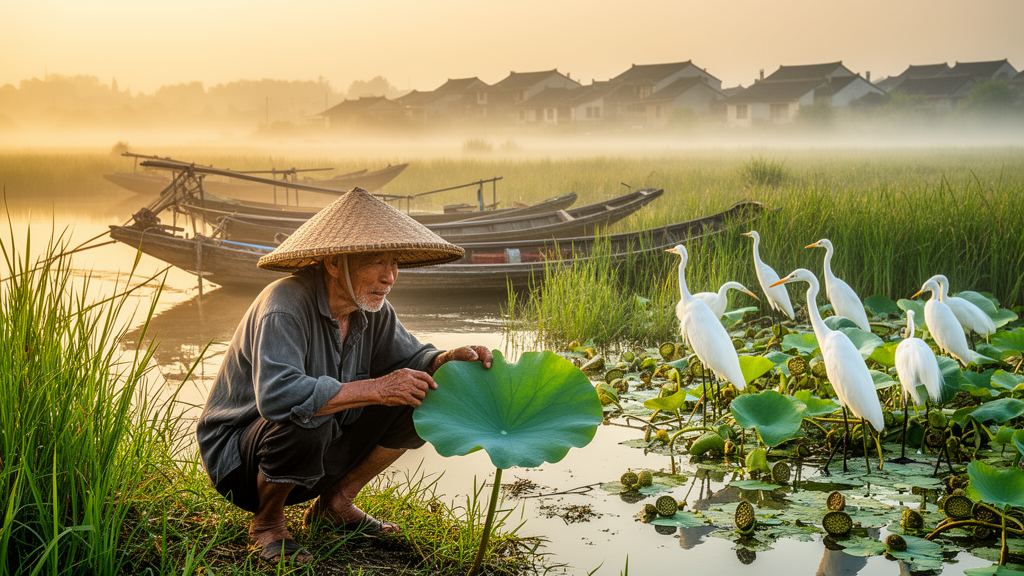
In the rural corners of the Yangtze River Delta, some plants are simply vegetation. Others are woven so deeply into food, medicine, crafts, festivals and family memory that removing them would unravel far more than an ecosystem. Researchers call these cultural keystone species, and a new study published in npj Heritage Science has now mapped them with unusual rigor, fusing village-level surveys with quantitative ecology in a region where such work has rarely been done.
The research, conducted by Siqi Chen of Zhejiang Sci-Tech University and Yujun Zhang of Beijing Forestry University, set out to test whether the concept of cultural keystone species, historically applied to indigenous and minority communities, could be extended to a non-indigenous rural population. The Yangtze River Delta is one of China’s most densely populated and rapidly urbanizing landscapes, making it a critical testing ground for whether biocultural diversity can survive outside remote or minority regions.
At the heart of the study is a participatory survey involving 274 respondents across rural communities in the delta. Participants were asked to identify the plants they used and valued, generating a record of 91 species spanning food, medicine, materials, ornamental and ritual purposes. From this pool, the researchers applied quantitative criteria to classify 42 species as cultural keystone species, meaning their cultural significance far exceeded that of ordinary useful plants.
A clear pattern emerged from the data: species with more documented uses scored higher on cultural importance. This finding supports a long-standing hypothesis in ethnobotany that versatility drives cultural centrality. A plant that serves as food, medicine and material simultaneously embeds itself in more aspects of daily life, and therefore in more memories and traditions, than a single-purpose species.
The social perception analysis added a second layer of insight. When the researchers examined individual-level valuation of cultural keystone species, income emerged as a significant predictor. People with higher incomes tended to place greater cultural value on these species, possibly reflecting greater leisure, education or engagement with heritage narratives. At the community level, however, no socio-demographic variable, including age, gender, education or income, showed a significant association with collective recognition of cultural keystone species. This suggests that while individual appreciation varies with economic circumstances, the community as a whole shares a common cultural baseline for which plants matter.
The third component of the study brought ecology into the picture. The researchers examined the habitats of key species, including Lindera glauca communities and Quercus forests, alongside pond ecosystems. In Lindera glauca communities, patch area was associated with shrub diversity, indicating that larger habitat patches support richer shrub layers. In Quercus forests, no significant associations were detected between the measured environmental variables and diversity patterns. In pond habitats, both road proximity and pond area were related to herbaceous evenness, suggesting that human infrastructure and habitat size jointly shape the distribution of herbaceous plants in these aquatic-terrestrial transition zones.
What distinguishes this study methodologically is the integration of all three analyses through a common survey base and species list. Rather than treating ethnobotany, social perception and ecology as separate silos, the researchers linked plant-use records, community attitudes and habitat data into a single framework. This allows each cultural keystone species to be understood simultaneously as a biological entity, a social symbol and an ecological participant, providing a template for future biocultural assessments elsewhere.
The implications for conservation are substantial. Traditional ecological knowledge has long been recognized as a valuable complement to scientific monitoring, but integrating the two has proven difficult in practice. By demonstrating that local knowledge can be quantified and cross-validated with ecological data, the study offers a pathway for conservation planning that respects cultural values while grounding decisions in measurable habitat conditions. In a delta where land-use change is rapid and traditional rural lifestyles are fading, such integration may be essential for preserving both the species and the knowledge systems that sustain them.
The study also challenges the assumption that cultural keystone species research belongs exclusively to indigenous or minority contexts. The Yangtze River Delta is home to a Han Chinese majority population with deep agricultural roots, and the findings show that cultural keystone species exist and function there just as they do in minority regions. This broadens the geographic and demographic scope of biocultural diversity research and suggests that rural communities worldwide, regardless of ethnic composition, may harbor comparable keystone relationships worth documenting.
As urbanization continues to reshape the Yangtze River Delta, the window for documenting these plant-culture relationships is narrowing. The framework developed by Chen and Zhang offers a replicable model for other regions facing similar pressures, demonstrating that rigorous quantitative methods can capture the cultural weight of species before that weight is lost. In doing so, it bridges a gap that has long separated the social and natural sciences, showing that the plants people love and the ecosystems they inhabit can be studied as one interconnected whole.
Subject of Research: Linking traditional and scientific knowledge to assess cultural keystone species in the Yangtze River Delta
Article Title: Linking traditional and scientific knowledge to assess cultural keystone species in the Yangtze River Delta
Article References: Chen, S., & Zhang, Y. (2026). Linking traditional and scientific knowledge to assess cultural keystone species in the Yangtze River Delta. npj Heritage Science. https://doi.org/10.1038/s40494-026-03020-6
Image Credits: AI Generated
DOI: 10.1038/s40494-026-03020-6
Keywords: ethnobotany, cultural keystone species, Yangtze River Delta, biocultural diversity, traditional ecological knowledge, conservation, heritage science, ecology, Linking, traditional, scientific, knowledge
Cite Scienmag News
Gavin Prescott. (October 15, 2026). Cultural Keystone Species in the Yangtze River Delta: Where Folk Knowledge Meets Ecology. Scienmag. https://scienmag.com/cultural-keystone-species-in-the-yangtze-river-delta-where-folk-knowledge-meets-ecology/
Gavin Prescott. "Cultural Keystone Species in the Yangtze River Delta: Where Folk Knowledge Meets Ecology." Scienmag, 15 October 2026, https://scienmag.com/cultural-keystone-species-in-the-yangtze-river-delta-where-folk-knowledge-meets-ecology/. Accessed 15 October 2026.
Gavin Prescott. "Cultural Keystone Species in the Yangtze River Delta: Where Folk Knowledge Meets Ecology." Scienmag. October 15, 2026. https://scienmag.com/cultural-keystone-species-in-the-yangtze-river-delta-where-folk-knowledge-meets-ecology/


