


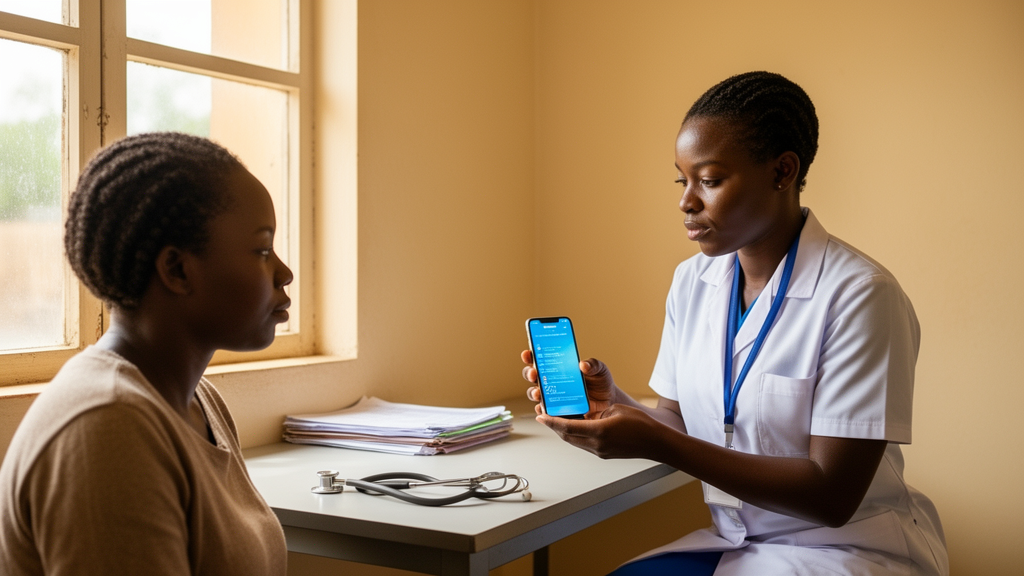
Cervical cancer remains one of the most devastating and preventable killers of women worldwide, and Africa carries a disproportionate share of the burden. In 2022, the continent recorded approximately 125,699 new cases and 80,614 deaths, representing 19 percent of global incidence and 23 percent of global mortality despite a comparatively small share of the world’s population. Nearly 90 percent of these cases occur in settings characterized by low and medium Human Development Index scores, where screening infrastructure is scarce and specialist care is often hundreds of kilometers away. Against this backdrop, a new scoping review published in Frontiers in Digital Health offers the most systematic map yet of how mobile health, or mHealth, technologies are being deployed across the continent to fight the disease — and the picture that emerges is both inspiring and sobering.
The review, conducted by Alexis Harerimana of Durban University of Technology and James Cook University and Gugu Mchunu of Durban University of Technology, followed the methodological framework developed by Arksey and O’Malley and refined by Levac and colleagues. The researchers systematically searched CINAHL, MEDLINE, Scopus, and Web of Science, supplemented by manual searches of Google and Google Scholar for gray literature and preprints. From an initial pool of 550 records, 32 studies published in English between 2016 and 2026 met the inclusion criteria and underwent full data extraction and thematic analysis. The timeframe was deliberately chosen to coincide with the rapid expansion of mobile phone access across Africa and with the rise of cervical cancer prevention on the global agenda, notably the World Health Organization’s Global Strategy to Accelerate the Elimination of Cervical Cancer and its ambitious 90–70–90 targets for 2030.
The technical landscape revealed by the review is remarkably diverse. The 32 studies clustered into five functional categories: messaging, voice communication, and awareness-raising accounted for 14 studies; image-based diagnosis with tele-expert review accounted for 11; digital applications for decision-making and care coordination accounted for 3; baseline and feasibility studies accounted for 3; and provider education and training accounted for 5. Geographically, the evidence was concentrated in East and West Africa, with Kenya contributing the largest share at 9 studies, followed by Ghana, Tanzania, and Nigeria with 4 each, Cameroon and Uganda with 3 each, and Malawi with 2. Single studies originated from Eswatini, South Africa, and Rwanda. The devices used were equally varied: basic mobile phones capable only of SMS and voice calls were the most common at 13 studies, smartphones at 12, computer and cloud-based platforms at 3, and single studies each used a dedicated digital camera, a tablet, and unspecified mobile phones.
Perhaps the most technically striking category involves smartphone-based cervical imaging paired with remote expert review. In this model, a frontline provider — often a nurse or community health volunteer — captures a cervical image during visual inspection with acetic acid using a smartphone camera, then transmits it in real time or asynchronously to an off-site gynecologist, oncologist, or pathologist for diagnostic confirmation and mentorship. In Ghana, 15 community health nurses who completed a two-week course followed by three months of smartphone image-based mentorship screened 169 women, achieving 95 percent overall agreement with an expert reviewer, with a kappa of 0.67. In Tanzania, five providers who completed a six-day course screened 1,072 women, with disagreement with experts falling from approximately 10 percent to under 3 percent within a month, resulting in 96.8 percent overall agreement. When scaled nationally across five regions of Tanzania, 51 providers at 24 facilities screened 10,545 women and concordance remained around 90 percent.
Artificial intelligence is now entering this diagnostic pipeline. In Kenya, Holmström and colleagues used a portable slide scanner to digitize cervical Papanicolaou smears, uploaded the whole-slide images to a cloud server over mobile networks, and deployed a deep-learning system that achieved sensitivity of 95.7 to 100 percent and specificity of 78.4 to 84.7 percent for detecting atypical cervical cells against pathologist assessment. In Zambia, Parham and colleagues developed a 12-level risk scale combining HPV genotyping with AI-based automated visual evaluation of smartphone images, accurately predicting histologically confirmed precancer even among women living with HIV. A study by Hu and colleagues involving 8,204 Zambian women reported automated visual evaluation sensitivity of 85 percent and specificity of 86 percent, with an area under the curve of 0.91. In the Democratic Republic of the Congo, Tendobi and colleagues trained non-specialist providers in smartphone cervicography with remote expert review among 480 women, achieving 66.0 percent sensitivity and 87.8 percent specificity for any cytological lesion, with a negative predictive value of 99.7 percent for high-grade lesions.
On the messaging side, the review found that simple SMS and voice-call interventions produced the most consistent results when targeted at HPV vaccination uptake. Randomized trials in Uganda, Nigeria, and Kenya all reported statistically significant increases in vaccination uptake among caregivers and guardians who received mHealth reminders. In Uganda, the SEARCH study allowed caregivers to choose between SMS and automated voice calls, with 62 percent opting for text and 38 percent for voice, and both sub-modes performed equally well. In Nigeria, the mHealth-HPVac trial used a bulk SMS platform with delivery-confirmation analytics, and 97.4 percent of intended reminders were successfully delivered. By contrast, the effects of one-way messaging on screening attendance were far more variable. A trial in Lagos, Nigeria reported a significant SMS effect, with 51.0 percent uptake versus 35.7 percent in the control arm, while a culturally tailored SMS program in Accra, Ghana and a one-way text messaging trial in Tanzania found no significant improvement in screening attendance.
The review also documented fascinating nuances in how notification modality affects treatment linkage. In western Kenya, Huchko and colleagues found that home visits achieved 45 percent treatment uptake among HPV-positive women, compared to 38 percent for text messages, 38 percent for phone calls, and only 23 percent for clinic-based notification, a difference that was statistically significant. Yet in the same country, Choi and colleagues reported no significant difference in cryotherapy uptake between a standard text message arm and an enhanced text message arm containing additional educational content, suggesting that the channel of notification, rather than the richness of message content, may be the decisive factor. In Cameroon, a randomized trial of telephone-plus-SMS reminders roughly quadrupled the odds of post-treatment follow-up adherence among women treated for cervical precancer, with an adjusted odds ratio of 3.97.
The facilitators and barriers mapped by the review tell a story about infrastructure as much as technology. High mobile phone ownership emerged as the most frequently cited facilitator, with ownership figures reaching 91.4 percent in a remote forest-reserve community in Uganda, 98 percent among women attending public-sector services in South Africa, and 71.3 percent among women attending community screening campaigns in western Kenya. Low cost and real-time expert feedback were almost equally pervasive. Yet the challenges were equally multi-level: sustainability and scalability concerns were reported in 16 studies, structural health-system barriers in 14, and network and connectivity failures in 12. In Cameroon, 56.3 percent of tele-mentoring participants reported connection problems. Privacy and confidentiality concerns clustered in Kenya, Malawi, South Africa, and Uganda, where phone-sharing patterns mean that SMS results about intimate gynecological health can be read or overheard by partners or household members, raising the risk of unintended disclosure in cultures where cervical cancer remains stigmatized.
The review’s authors conclude that mHealth shows substantial promise for cervical cancer prevention and control in Africa, particularly image-based diagnosis with tele-expert review and SMS or audio messaging, which together accounted for over half of the evidence. But they also identify clear gaps: interventions disproportionately focused on screening, with only 3 studies addressing HPV vaccination and just 1 addressing post-treatment follow-up, despite vaccination reminders demonstrating the most consistent positive results. Realizing mHealth’s potential at scale, the authors argue, requires investing in underrepresented stages of the care continuum, addressing connectivity and health-system barriers, and conducting rigorous multi-country research beyond the pilot evidence that currently dominates the field. The gendered digital divide also demands attention, as women in low- and middle-income countries remain less likely than men to own smartphones, use mobile internet, and access related services. What the review ultimately reveals is that the binding constraint on mobile health in Africa is no longer phone access — it is the stability of that access, the privacy of the handset, the reliability of the network, and the readiness of the health system to sustain digital tools once the research funding runs out.
Subject of Research: Text, talk, screen: mapping mHealth interventions for cervical cancer prevention and control in Africa — a scoping review
Article Title: Text, talk, screen: mapping mHealth interventions for cervical cancer prevention and control in Africa — a scoping review
Article References: Harerimana, A., & Mchunu, G. (2026). Text, talk, screen: mapping mHealth interventions for cervical cancer prevention and control in Africa — a scoping review. Frontiers in Digital Health, 8, Article 1947988. https://doi.org/10.3389/fdgth.2026.1947988
Image Credits: AI Generated
DOI: 10.3389/fdgth.2026.1947988
Keywords: mHealth, cervical cancer, Africa, digital health, scoping review, HPV vaccination, telemedicine, Frontiers in Digital Health, Text, talk, screen, mapping
Cite Scienmag News
Nathaniel Bowman. (October 15, 2026). Mobile phones are quietly reshaping cervical cancer care across Africa. Scienmag. https://scienmag.com/mobile-phones-are-quietly-reshaping-cervical-cancer-care-across-africa/
Nathaniel Bowman. "Mobile phones are quietly reshaping cervical cancer care across Africa." Scienmag, 15 October 2026, https://scienmag.com/mobile-phones-are-quietly-reshaping-cervical-cancer-care-across-africa/. Accessed 15 October 2026.
Nathaniel Bowman. "Mobile phones are quietly reshaping cervical cancer care across Africa." Scienmag. October 15, 2026. https://scienmag.com/mobile-phones-are-quietly-reshaping-cervical-cancer-care-across-africa/


