


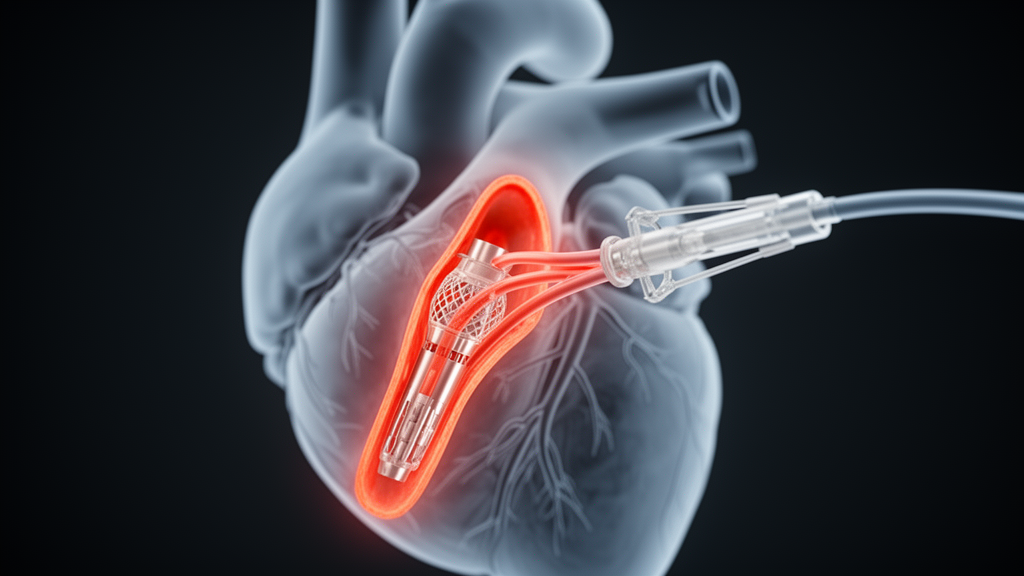
For the thousands of adults living with repaired tetralogy of Fallot, one of the most common congenital heart defects, the long journey after childhood surgery often leads to a second intervention: replacement of the pulmonary valve. Percutaneous pulmonary valve implantation, or PPVI, has become the preferred route for many of these patients, allowing cardiologists to deliver a new valve through a catheter rather than reopening the chest. Yet a rare and potentially fatal complication shadows the procedure. When the new valve expands inside the right ventricular outflow tract, the muscular channel that carries blood from the right ventricle to the lungs, it can press against a coronary artery running close by, choking off the blood supply to the heart muscle itself.
A new case series published in Frontiers in Cardiovascular Medicine on 15 October 2026 documents this danger in three men with repaired tetralogy of Fallot, all considered candidates for PPVI with self-expandable valves. The report, led by Rujira Buntharikpornpun and Supaporn Roymanee of Prince of Songkla University in Thailand, together with Worakan Promphan of Queen Sirikit National Institute of Child Health in Bangkok and Phuoc Duong of Alder Hey Children’s Hospital in Liverpool, shows how meticulous multimodal imaging can expose the risk before it strikes, and how, in two of the three cases, careful planning converted a high-risk situation into a successful implantation.
Coronary artery compression is uncommon but serious. With balloon-expandable valve platforms, the complication has been reported in roughly 5 to 10 percent of PPVI cases. Self-expandable valves, which exert less radial force on the surrounding tissue, are generally believed to carry a lower risk, and many published cohorts have reported zero instances of coronary compression or myocardial infarction. The new report challenges the assumption that this safety margin can be taken for granted. In all three patients, invasive testing during the procedure revealed evidence of coronary compression when the outflow tract was temporarily occluded with a balloon, even though two of the three ultimately received a valve without harm.
The first patient, a 20-year-old man evaluated 13 years after his original repair, illustrates how unusual coronary anatomy can turn a routine valve implantation into a hazard. Cardiac computed tomography revealed a single coronary artery arising from the left posterior-facing sinus, giving rise to the left circumflex, the left anterior descending artery, and two separate branches of the right coronary system. One of those branches followed a retropulmonary course, looping in front of the main pulmonary artery trunk along the valve annular groove before heading toward the right ventricular free wall. The distance between the planned valve landing zone and the nearest coronary artery measured just 1.5 millimeters.
During balloon sizing, the team inflated a 30-millimeter compliant balloon inside the outflow tract while simultaneously injecting contrast into the coronary arteries. At a waist diameter of 21 to 23 millimeters, the right coronary branch was visibly compressed against the expanding balloon. Because the outflow tract measured 25 to 26 millimeters on pre-procedural imaging but only 21 to 23 millimeters on balloon testing, implanting a valve large enough to anchor securely would have required significant oversizing, and no alternative landing position was feasible because the left anterior descending artery lay close to the supra-annular region. The team abandoned the procedure, sparing the patient a potentially catastrophic event.
The second patient, a 21-year-old man, presented a different anatomical puzzle. Computed tomography showed a single coronary artery system from which both the left and right coronary arteries arose, with the entire right coronary artery coursing anomalously in front of the outflow tract, closest to the pulmonary valve annulus. The clearance between the landing zone and the coronary artery was 2.7 millimeters. Balloon interrogation with a 34-millimeter Amplatzer sizing balloon demonstrated reduced flow to the distal right coronary artery at full inflation, with waist diameters of 28.9 and 29.3 millimeters in two planes.
Here, the deciding factor was dimensional distensibility. The valve annular measurement during balloon testing matched the pre-procedural computed tomography almost exactly, suggesting the tissue at that level was relatively non-compliant and would hold a valve without requiring oversizing. The team selected a 28 to 25 millimeter VenusP valve, delivered through a 26 French Gore Dryseal sheath that could double as a retriever in case of emergency. Post-implantation angiography showed normal flow to the distal right coronary artery. Follow-up computed tomography at three months confirmed the valve had conformed to roughly half of the original annular perimeter where the coronary crossed over, with uniform caliber and good distal perfusion. The patient remained asymptomatic, and cardiac magnetic resonance at three years showed no evidence of coronary compression.
The third patient, a 39-year-old man with severe pulmonary regurgitation, added yet another layer of complexity. His original repair had used a transannular patch extending into the main pulmonary artery, with significant calcification occupying up to a quarter of the perimeter at the valvar level. The main pulmonary artery was folded at nearly a right angle to the outflow tract, and the aortic root was dilated with clockwise-rotated coronary ostia. Computed tomography identified the distal main pulmonary artery in close contact with the left main coronary artery, just 2 millimeters from the landing zone. Balloon testing confirmed reduced flow to the left coronary artery at a waist of 24 by 25 millimeters, matching the computed tomography measurement of 25 by 25 millimeters.
Before the procedure, the team had also turned to three-dimensional printing. Using the patient’s computed tomography data, HARN Engineering Solutions fabricated a rigid model in acrylonitrile butadiene styrene, allowing the team to physically place a VenusP valve in both annular and supra-annular positions. The model showed that a supra-annular position would keep the valve’s distal flare much farther from the coronary artery than an annular position, supporting the geometrical assessment, though it could not predict the actual mechanical risk of compression. The team proceeded with a supra-annular placement of a 30 to 25 millimeter valve, avoiding oversizing and preserving future access to the left pulmonary artery for stenting. No ischemic electrocardiographic changes or ventricular dysrhythmias occurred during the procedure, and follow-up imaging at two months and again at three years showed unobstructed coronary flow.
Beyond the individual stories, the case series carries a broader technical message. Prior studies have proposed imaging thresholds for predicting coronary compression, including a coronary-to-landing-zone distance under 2 millimeters, a landing-zone-to-chest-wall distance under 8 millimeters, and the presence of anomalous coronary arteries. In all three patients reported here, the coronary distance fell below 3 millimeters while the chest wall distance exceeded 8 millimeters, yet the outcomes diverged based on tissue compliance and valve positioning rather than distance alone. The authors argue that patients showing coronary compression during balloon interrogation should not be automatically excluded from PPVI if the landing zone has a distinct fixed waist allowing non-oversized valve selection, if a supra-annular position is anatomically viable, and if alternative valve designs can avoid vulnerable compression zones. These preliminary hypotheses, the team acknowledges, will need validation in larger studies, but they suggest that the safety margins established for balloon-expandable valves in surgical conduits may not transfer directly to self-expandable devices in native outflow tract anatomy. Coronary artery compression, the report concludes, remains a persistent concern regardless of normal or abnormal coronary patterns, and vigilant multimodal imaging evaluation combined with operator awareness plays a pivotal role in identifying high-risk patients and preventing these complications proactively.
Subject of Research: Coronary artery compression in percutaneous pulmonary valve implantation: a case series
Article Title: Coronary artery compression in percutaneous pulmonary valve implantation: a case series
Article References: Buntharikpornpun, R., Roymanee, S., Promphan, W., & Duong, P. (2026). Coronary artery compression in percutaneous pulmonary valve implantation: a case series. Frontiers in Cardiovascular Medicine, 13, Article 1917017. https://doi.org/10.3389/fcvm.2026.1917017
Image Credits: AI Generated
DOI: 10.3389/fcvm.2026.1917017
Keywords: Coronary, artery, compression, percutaneous, pulmonary, valve, implantation, case, series, scientific research
Cite Scienmag News
Ophelia Keating. (October 15, 2026). Coronary artery compression in percutaneous pulmonary valve implantation: a case series. Scienmag. https://scienmag.com/coronary-artery-compression-in-percutaneous-pulmonary-valve-implantation-a-case-series/
Ophelia Keating. "Coronary artery compression in percutaneous pulmonary valve implantation: a case series." Scienmag, 15 October 2026, https://scienmag.com/coronary-artery-compression-in-percutaneous-pulmonary-valve-implantation-a-case-series/. Accessed 15 October 2026.
Ophelia Keating. "Coronary artery compression in percutaneous pulmonary valve implantation: a case series." Scienmag. October 15, 2026. https://scienmag.com/coronary-artery-compression-in-percutaneous-pulmonary-valve-implantation-a-case-series/


