


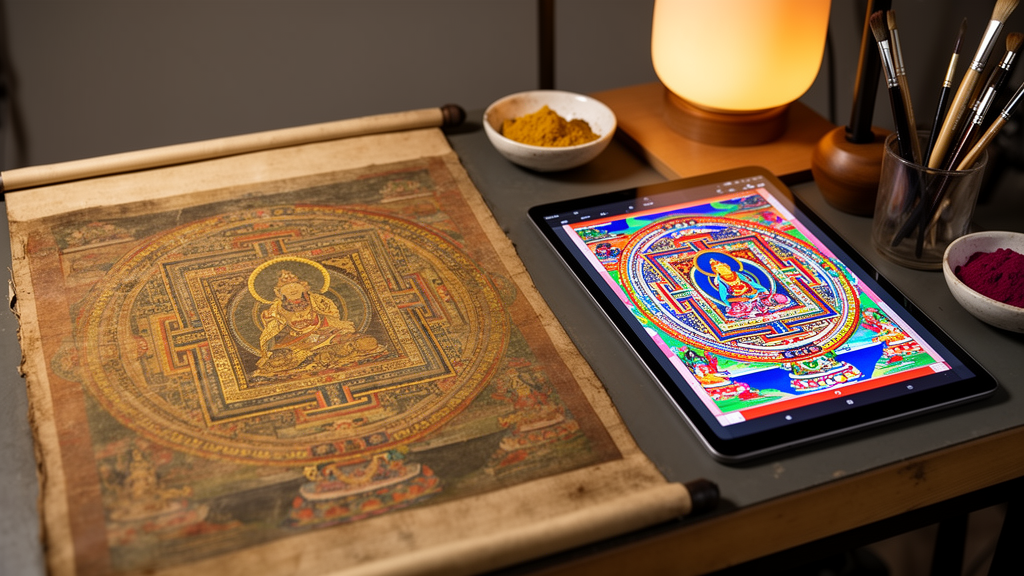
Thangka paintings, the intricate religious scroll art of the Himalayas, have long resisted the ambitions of neural style transfer. Now a team at Northwest Minzu University in Lanzhou has built a transformer-based system that can restyle these sacred images without wrecking the strict geometric scaffolding that gives them meaning. The framework, called DART — Dynamic All-directional Reconstructive Transformer — was published on 29 September 2026 in npj Heritage Science, and it may reshape how museums, conservators and artists approach the digital preservation and creative reuse of cultural heritage imagery.
Neural style transfer, the family of algorithms that repaint one image in the visual language of another, has produced dazzling results on photographs and modern paintings. But Thangka poses a distinctive trap. These works follow rigid compositional rules: central deities, concentric halos, precise registers of landscape and sky. When a general-purpose algorithm restyles a Thangka, it tends to smear those contours, warp the geometry and sprinkle texture artifacts across the heterogeneous surfaces of silk, pigment and gold leaf. For an art form in which geometry itself carries religious significance, structural distortion is not a cosmetic flaw — it destroys the content.
DART attacks the problem with three integrated components. The first is Multi-Directional Strip Attention, or MDSA, an attention mechanism that models long-range directional dependencies. Strip attention slices the image into elongated bands and lets the network compare distant regions along specific orientations — horizontal, vertical and diagonal. That matters for Thangka because the defining structures are directional: the straight borders of a mandala, the radiating lines of a halo, the vertical axis of a seated figure. By attending along strips, the model can keep a contour coherent from one edge of the canvas to the other, rather than treating each pixel patch as an isolated fragment.
The second component, a Dynamic Kernel Feed-forward Network (DKFN), addresses the texture problem. Thangka surfaces are wildly heterogeneous: smooth areas of sky sit beside dense brocade patterns, fine gold outlines and stippled pigment. A conventional feed-forward layer applies the same operation everywhere, which flattens that diversity. DKFN instead adaptively aggregates identity features and multi-scale features, adjusting its processing to match the local character of the surface. In effect, the network learns to treat a smooth gradient differently from a brocade weave, preserving the crispness of each texture rather than blurring them into a generic middle ground.
The third piece is a Structure-Aware Multi-Scale Edge Loss, a training objective that explicitly rewards geometric fidelity. Loss functions define what a network optimizes for; by penalizing errors on edges at multiple scales, this loss pushes the model to preserve fine contours and details while it restyles the image. The result is a system that can change the painterly language of a Thangka — its palette, brushwork and surface treatment — while keeping the underlying drawing intact.
The team evaluated DART on a high-quality Thangka dataset and reported leading overall performance among the general-purpose methods they compared against. But the more striking results came from the stress tests. In cross-domain evaluation on MS-COCO, the standard benchmark of everyday photographs, DART transferred its capabilities without being retrained. A blind user study added subjective evidence: human evaluators, unaware of which system had produced which output, preferred DART’s results. And in qualitative tests on material the model had never seen — Dunhuang murals, the Buddhist cave paintings of Gansu, and European historical paintings — the framework generalized without fine-tuning, suggesting the architecture captures something fundamental about geometry-preserving restyling rather than memorizing the quirks of one dataset.
The implications reach beyond one art form. Digital preservation of heritage imagery is a growing field, and the tools available to it have mostly been borrowed from general-purpose computer vision. Those tools often fail quietly: a restyled mural looks plausible at first glance, but the iconography has drifted. A framework designed to preserve geometry could let conservators experiment with reconstruction and visualization while keeping the drawing — the part that carries the meaning — verifiably unchanged. The authors also frame DART as a practical approach for creative reuse, allowing contemporary artists to restyle heritage imagery for new works without distorting the source material’s structure.
Technically, DART is an end-to-end framework, meaning the whole pipeline from input image to restyled output is trained as one system rather than assembled from separately trained modules. That integration matters because the three components reinforce one another: the directional attention keeps structures coherent, the dynamic kernel network handles the texture diversity, and the edge loss keeps the training focused on geometric fidelity. The architecture is a reconstructive transformer — it rebuilds the image rather than merely filtering it — which gives it the capacity to synthesize new painterly detail while anchoring that detail to the preserved structure.
The work comes from the Key Laboratory of China’s Ethnic Languages and Information Technology of the Ministry of Education at Northwest Minzu University, with additional affiliation through the Gansu Provincial Engineering Research Center of Multi-modal Artificial Intelligence. It was supported in part by the National Natural Science Foundation of China under Grant No. 62366047 and by the Fundamental Research Funds for the Central Universities under Grant No. 31920240060. The funders had no role in study design, data collection, analysis or publication decisions, and the authors declare no competing interests. All materials are available from the corresponding author upon request, and the article is open access under a Creative Commons licence.
For a field that has spent a decade chasing photorealistic restyling, DART’s contribution is a change of priorities: fidelity to structure over spectacle. The system demonstrates that a transformer can be built to respect the compositional logic of an art form rather than impose a generic aesthetic on it. As heritage institutions digitize more of the world’s sacred and historical imagery, frameworks that preserve geometry while transforming style may become the standard tool — not just for Thangka, but for any art where the drawing is the doctrine.
Subject of Research: AI and Cultural Heritage
Article Title: DART: a dynamic all-directional reconstructive transformer for geometry-preserving Thangka style transfer
Article References: Zhang, X., Wang, N., Wang, Z., Yang, Y., Wang, Y., & Zhang, M. (2026). DART: a dynamic all-directional reconstructive transformer for geometry-preserving Thangka style transfer. npj Heritage Science. https://doi.org/10.1038/s40494-026-03007-3
Image Credits: AI Generated
DOI: 10.1038/s40494-026-03007-3
Keywords: Thangka, style transfer, transformer, cultural heritage, computer vision, DART, dynamic, all-directional, reconstructive, geometry-preserving, style, transfer
Cite Scienmag News
Blake Davidson. (October 15, 2026). Transformer Keeps Sacred Thangka Geometry Intact While Restyling Its Art. Scienmag. https://scienmag.com/transformer-keeps-sacred-thangka-geometry-intact-while-restyling-its-art/
Blake Davidson. "Transformer Keeps Sacred Thangka Geometry Intact While Restyling Its Art." Scienmag, 15 October 2026, https://scienmag.com/transformer-keeps-sacred-thangka-geometry-intact-while-restyling-its-art/. Accessed 15 October 2026.
Blake Davidson. "Transformer Keeps Sacred Thangka Geometry Intact While Restyling Its Art." Scienmag. October 15, 2026. https://scienmag.com/transformer-keeps-sacred-thangka-geometry-intact-while-restyling-its-art/


