


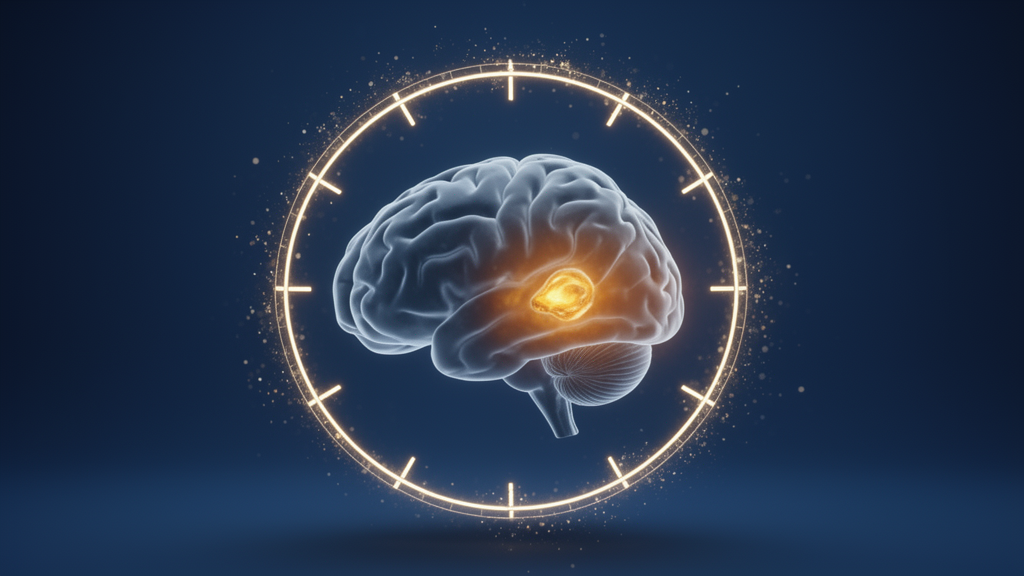
Chronic sleep disturbance and irregular sleep-wake patterns have become so common in modern life that many people treat them as a minor inconvenience. A new longitudinal study published in Translational Psychiatry suggests the cost may be far higher than assumed. Researchers led by Chuan Wang of Naval Medical University and colleagues at Zhejiang University found that fifteen days of experimentally induced circadian rhythm disruption produced measurable gray matter volume loss in the left amygdala, the brain’s principal emotional processing hub. The work, published on 30 September 2026, is described by its authors as the first to systematically investigate the neurobiological effects of acute circadian rhythm disruption, or ACRD, on amygdala integrity and its implications for emotional regulation.
The amygdala has long occupied a central place in affective neuroscience. It sits deep in the medial temporal lobe and coordinates responses to threat, reward, and emotional salience, communicating closely with the prefrontal cortex to regulate how emotions are expressed and controlled. Epidemiological evidence has repeatedly linked circadian rhythm disruption to emotional dysregulation, including heightened susceptibility to depression and anxiety. What remained unclear was whether these disruptions directly alter amygdala morphology and function in otherwise healthy people, and whether such changes track the sleep and affective disturbances that accompany them. Answering that question required a controlled intervention rather than a correlational snapshot.
The study enrolled healthy participants who underwent fifteen days of experimentally induced circadian rhythm disruption. The intervention successfully produced sleep and emotional disturbances, which the researchers documented with standardized questionnaires. Ultra-high field 7 Tesla MRI scans were acquired before and after the intervention to assess gray matter volume and functional connectivity in the amygdala and its subnuclei. The choice of 7 Tesla imaging is technically significant: at this field strength, spatial resolution and contrast are sufficient to resolve the amygdala’s internal architecture, allowing the team to segment the structure into its centromedial, laterobasal, and superficial nuclei rather than treating it as a single undifferentiated blob.
The results revealed a significant reduction in gray matter volume within the left amygdala and its subregions following the disruption period. Reductions appeared across all three segmented nuclei: the centromedial nucleus, which is involved in autonomic and endocrine outputs of emotion; the laterobasal nucleus, which handles communication with cortical and subcortical targets; and the superficial nucleus, which contributes to emotional salience processing. In contrast, no significant gray matter changes were detected in the right amygdala or its corresponding subregions. The authors interpret this asymmetry as evidence of a lateralized effect of ACRD, suggesting the left amygdala is selectively vulnerable to circadian perturbation.
The lateralization finding is notable because prior work on the amygdala in mood disorders has often reported left-sided structural and functional abnormalities. The left amygdala is frequently implicated in the processing of negative emotional stimuli and in the pathophysiology of depression. A circadian disruption protocol that selectively thins gray matter on the left side therefore provides a plausible mechanistic bridge between disturbed biological rhythms and the left-amygdala abnormalities repeatedly observed in mood disorder research. Whether the structural change is driven by cellular stress, altered neurotrophic signaling, or fluid shifts associated with disturbed sleep cannot be determined from MRI alone, but the anatomical specificity argues against a nonspecific imaging artifact.
Crucially, the gray matter reductions in the left amygdala were significantly correlated with worsening scores on the Pittsburgh Sleep Quality Index, or PSQI. This correlation ties the structural change directly to the subjective experience of deteriorating sleep quality during the intervention. Participants whose sleep quality declined the most also showed the greatest amygdala volume loss, indicating that the morphological change is not merely a group-level average but varies meaningfully with individual sleep disturbance. The finding also raises the possibility that amygdala gray matter serves as a sensitive structural marker of circadian-related sleep pathology, one that could in principle be monitored noninvasively.
Functional connectivity analysis added a second layer of evidence. The team observed a nearly significant decrease in connectivity between the left medial prefrontal cortex and the left centromedial amygdala. The medial prefrontal cortex is a key regulatory partner of the amygdala, and the centromedial nucleus is the amygdala’s principal output station for autonomic and endocrine responses. Weakened coupling between these two regions would be expected to impair top-down control over emotional responses, a mechanism long proposed to underlie emotional dysregulation in depression and anxiety. The authors note the connectivity change was nearly significant rather than fully significant, a nuance that reflects the modest sample size typical of ultra-high field intervention studies, but the direction of the effect aligns with the structural findings and with theoretical models of prefrontal-amygdala dysregulation.
One of the most reassuring aspects of the study concerns reversibility. Questionnaire-based symptoms of the rhythm disorder were restored by the thirty-day follow-up, indicating that the subjective sleep and emotional disturbances produced by the intervention resolved once normal rhythms were re-established. The study did not report whether amygdala gray matter volume recovered in parallel, leaving an open question for future work. If the structural change proves reversible, the clinical implications are encouraging: circadian disruption would represent a modifiable risk factor for amygdala integrity rather than a permanent injury. If recovery lags behind symptom resolution, however, the brain may retain structural traces of rhythm disruption even after people report feeling better, which would argue for longer recovery periods and closer monitoring in shift workers and others with chronic rhythm disturbance.
The translational significance of the work extends beyond the laboratory. Acute circadian rhythm disruption is increasingly prevalent due to chronic sleep disturbance, irregular sleep-wake patterns, shift work, jet lag, and late-night screen exposure. A controlled demonstration that fifteen days of rhythm perturbation thins gray matter in the emotional brain, and that the degree of thinning tracks worsening sleep quality, gives clinicians and researchers a concrete neurobiological target. It also connects to a broader literature: related studies have examined amygdala subnuclei connectivity in bipolar disorder, brain structural correlates preceding initial major depressive episodes, and prospective cohort evidence linking circadian rhythm disruption to brain disorder incidence in over 72,000 participants. The new intervention study complements these correlational approaches by establishing temporal precedence and dose-response within individuals.
For the public, the message is direct. The amygdala is not an inert structure that simply responds to whatever life presents; its gray matter volume and its functional dialogue with the prefrontal cortex are dynamically sensitive to the timing of sleep and wakefulness. Fifteen days of circadian perturbation was enough to produce lateralized structural change in healthy brains, and the change correlated with how poorly participants slept. As the authors and their colleagues at the Zhejiang University 7 Tesla Brain Imaging Research Center continue to follow this line of inquiry, the central questions will concern recovery of amygdala volume, the cellular mechanisms driving the gray matter loss, and whether individuals with pre-existing vulnerability show amplified responses. What is already clear is that protecting circadian regularity is not merely about feeling rested; it is about preserving the structural and functional integrity of the brain’s emotional circuitry.
Subject of Research: Neurobiological effects of acute circadian rhythm disruption on amygdala gray matter and functional connectivity
Article Title: Impact of circadian rhythm disruptions on the emotional brain: gray matter and functional connectivity changes in the amygdala
Article References: Wang, C., Liu, D.-Y., Wang, Z.-Y., & Song, X. M. (2026). Impact of circadian rhythm disruptions on the emotional brain: gray matter and functional connectivity changes in the amygdala. Translational Psychiatry. https://doi.org/10.1038/s41398-026-04481-w
Image Credits: AI Generated
DOI: 10.1038/s41398-026-04481-w
Keywords: circadian rhythm disruption, amygdala, gray matter volume, 7 Tesla MRI, functional connectivity, sleep quality, medial prefrontal cortex, emotional regulation, Translational Psychiatry, lateralized brain changes, Impact, circadian
Cite Scienmag News
Cassandra Pierce. (October 15, 2026). Circadian Rhythm Disruption Shrinks Gray Matter in the Brain’s Emotional Center. Scienmag. https://scienmag.com/circadian-rhythm-disruption-shrinks-gray-matter-in-the-brains-emotional-center/
Cassandra Pierce. "Circadian Rhythm Disruption Shrinks Gray Matter in the Brain’s Emotional Center." Scienmag, 15 October 2026, https://scienmag.com/circadian-rhythm-disruption-shrinks-gray-matter-in-the-brains-emotional-center/. Accessed 15 October 2026.
Cassandra Pierce. "Circadian Rhythm Disruption Shrinks Gray Matter in the Brain’s Emotional Center." Scienmag. October 15, 2026. https://scienmag.com/circadian-rhythm-disruption-shrinks-gray-matter-in-the-brains-emotional-center/


