


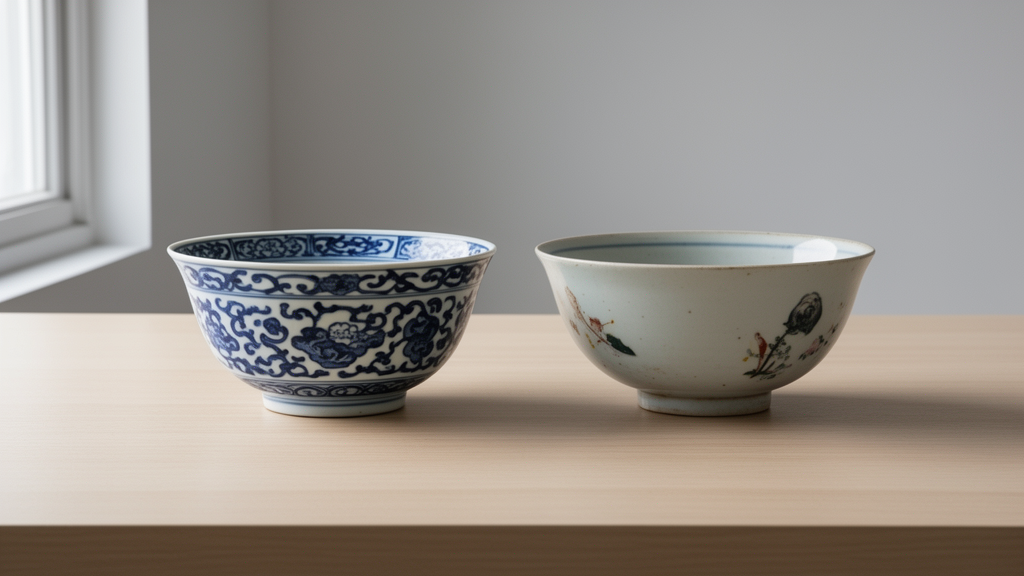
For centuries, the porcelain bowls that streamed out of Ming dynasty kilns carried Chinese craftsmanship across the world’s oceans, filling the holds of trading ships and the cabinets of European collectors. Yet despite their fame, the actual three-dimensional shapes of these bowls have never been systematically measured. A new study published in npj Heritage Science changes that, using digital morphometric techniques to quantify what potters, merchants, and consumers of the fifteenth through seventeenth centuries took largely for granted: the geometry of a bowl.
The research team, led by Shengying Feng of Guangzhou Maritime University together with colleagues including Jinghui Ao and Gangwei Cai, assembled a comparative dataset of 62 porcelain bowls. Thirty-seven of these served as export references, bowls known or presumed to have circulated in maritime trade networks, while twenty-five domestic comparators represented ware made for Chinese home markets. The goal was not to catalog decorative motifs, which have dominated connoisseurial studies for generations, but to capture the underlying skeletal form of each vessel: the curve of its profile, the angle of its walls, the diameter of its rim, and the shape of its foot.
To do this, the researchers combined several digital tools into a reproducible workflow. Profile extraction converted each bowl’s silhouette into measurable data, typological coding assigned standardized categories for features such as rim form and foot shape, AutoCAD scaling normalized the drawings to consistent dimensions, and Rhinoceros-assisted measurement allowed precise three-dimensional readings of key angles. This combination, the authors argue, transforms typology from a subjective exercise of expert eye into a quantitative framework that other researchers can replicate and extend.
The results reveal a striking conservatism in the basic architecture of Ming bowls. Round feet appeared on 88.7 percent of the sampled vessels, meaning 55 of the 62 bowls, and curved bodies characterized 69.4 percent, or 43 vessels. Everted and open rims together accounted for 66.1 percent of the sample, 41 bowls in all. In other words, whether a bowl was destined for a Dutch merchant’s table or a Chinese household’s kitchen, it conformed to a shared morphological grammar rooted in kiln tradition and ceramic physics.
Within that shared framework, however, size variation proved enormous. Rim diameters in the sample ranged from a mere 7.6 centimeters to a generous 41.2 centimeters. The team classified the bowls into three size classes: 20 miniature bowls, 36 regular-sized bowls, and 6 large bowls. This spread suggests that the Ming porcelain industry produced a graduated family of forms from a common template, accommodating everything from individual tea drinking to communal food service.
The most technically revealing measurements came from angular analysis of 60 specimens, two bowls having been excluded from this stage. The researchers distinguished between what they term HFJA, the higher foot joint angle, and LFJA, the lower foot joint angle, angles that describe how the bowl’s body transitions into its foot ring. The higher angle showed a strong concentration, with a mean of 59.0 degrees, a median of 58.0 degrees, and a standard deviation of only 8.3 degrees. The lower angle was far more dispersed, averaging 47.0 degrees with the same figure as its median, and a standard deviation of 10.2 degrees. This asymmetry implies that potters tightly controlled the upper transition where structural stability and throwing consistency demanded it, while allowing greater latitude lower on the vessel.
Comparing export and domestic bowls produced the study’s most consequential finding: export specimens displayed broader variation in size, rim type, and angular values than their domestic counterparts, yet all within the same underlying morphological framework. The authors interpret this pattern as evidence that export production flexed to meet diverse overseas demands, from European table settings to Southeast Asian market preferences, without abandoning the canonical bowl form. Domestic production, by contrast, appears to have operated within a narrower band of convention.
Importantly, the team is careful about what these numbers can and cannot prove. The study explicitly treats production, trade, consumption, and function as contextual associations rather than causal mechanisms. A broader rim or a steeper wall angle cannot by itself demonstrate who made a bowl, where it traveled, or how it was used. What the morphometric framework provides instead is a reproducible evidentiary base, a way of describing form precisely enough that hypotheses about workshop practice, market segmentation, and trade routing can be tested against measurable data rather than impressionistic comparison.
The implications extend well beyond Ming porcelain studies. Archaeologists and heritage scientists have increasingly turned to geometric morphometrics and 3D scanning to characterize ceramic assemblages, but standardized, openly documented workflows remain rare in the study of Chinese trade ceramics. By specifying its extraction, coding, scaling, and measurement procedures in detail, and by publishing summary statistics that others can compare against, this study offers a template for quantitative typology across the vast corpus of Chinese export ware held in museums and excavated from shipwrecks worldwide.
The work also carries a certain poetry: the humble bowl, often overshadowed by celebrated vases and Imperial commissions, turns out to encode measurable evidence of how one of history’s great export industries balanced tradition against market pressure. Nearly nine centuries of scholarship on Chinese porcelain has prized glaze, pigment, and mark, but the new analysis suggests that the answers to questions about globalization, standardization, and craft knowledge may lie in angles and diameters measured to a tenth of a degree. As digital methods continue to enter heritage science, the shapes of everyday objects may prove to be among the most eloquent documents of the early modern world.
Subject of Research: Morphometric typology of Ming dynasty Chinese export and domestic porcelain bowls
Article Title: Morphometric typology of Ming Chinese export and domestic porcelain bowls in trade and production contexts
Article References: Morphometric typology of Ming Chinese export and domestic porcelain bowls in trade and production contexts. (n.d.). https://doi.org/10.1038/s40494-026-02994-7
Image Credits: AI Generated
DOI: 10.1038/s40494-026-02994-7
Keywords: Ming dynasty, porcelain bowls, morphometrics, export ceramics, maritime trade, heritage science, typology, digital measurement, Chinese kilns, rim diameter, foot joint angle, ceramic archaeology
Cite Scienmag News
Courtney Benton. (October 16, 2026). Geometry of Ming Porcelain Bowls Reveals Export and Domestic Design Differences. Scienmag. https://scienmag.com/geometry-of-ming-porcelain-bowls-reveals-export-and-domestic-design-differences/
Courtney Benton. "Geometry of Ming Porcelain Bowls Reveals Export and Domestic Design Differences." Scienmag, 16 October 2026, https://scienmag.com/geometry-of-ming-porcelain-bowls-reveals-export-and-domestic-design-differences/. Accessed 16 October 2026.
Courtney Benton. "Geometry of Ming Porcelain Bowls Reveals Export and Domestic Design Differences." Scienmag. October 16, 2026. https://scienmag.com/geometry-of-ming-porcelain-bowls-reveals-export-and-domestic-design-differences/


