


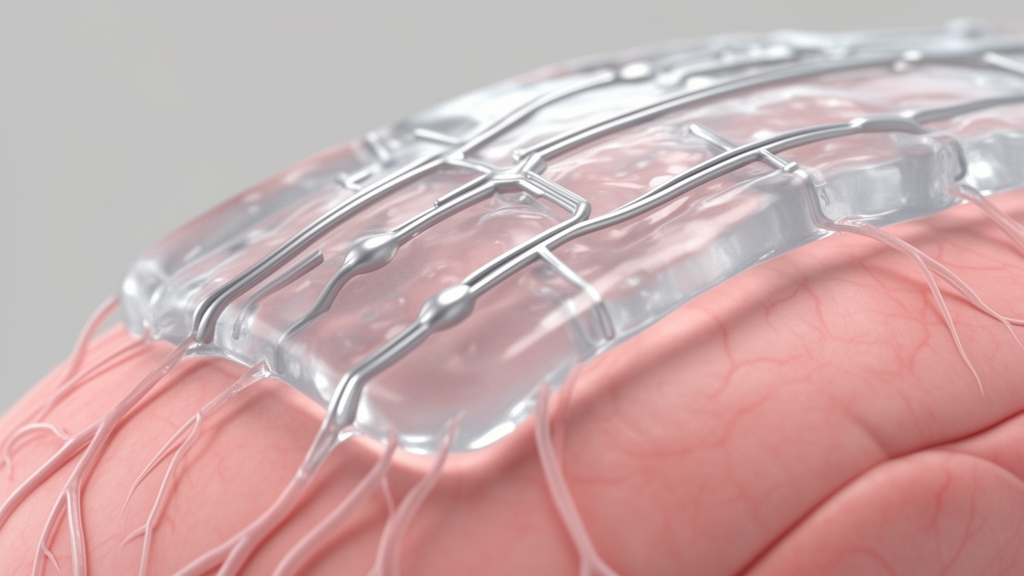
For decades, the electrodes that doctors implant to quiet tremors, dull chronic pain, or read out the brain’s electrical chatter have shared a stubborn flaw: they are stiff. Metal and silicon devices carry moduli measured in gigapascals, while the brain and spinal cord they touch are soft tissues whose stiffness falls between roughly 1 and 100 kilopascals — a mismatch of three to six orders of magnitude. With every heartbeat and breath, the rigid implant frets against living tissue, awakening microglia, driving chronic inflammation, and laying down glial scars and fibrous capsules that raise electrode impedance, attenuate signals, and eventually kill the device. A new review in Materials Today Bio argues that conductive hydrogels — water-rich polymer networks engineered to carry charge — have matured into the leading candidate to dissolve this mechanical mismatch, and it maps, with unusual rigor, exactly how far the evidence still falls short of the clinic.
The review’s first contribution is conceptual discipline. Conductive hydrogels are not one material class, the authors insist, and sloppy labeling obscures real differences in how devices couple to tissue and hardware. Predominantly ionic hydrogels move charge through hydrated cations and anions migrating in water-filled pores, with fixed polymer charges, ion pairing, and hydrogen bonding tuning ion mobility. Predominantly electronic hydrogels rely on percolation pathways of conjugated polymers, carbon nanotubes, MXenes, or metal fillers through which electrons, holes, or polarons shuttle. True mixed ionic-electronic conductors demand both a continuous electronic network and a freely mobile ion phase, coupled across the bulk or at high-surface-area internal interfaces — and the mere presence of water and a conductive filler proves nothing. The authors classify systems only by verified carriers and conduction paths, and they evaluate devices by 1 kHz impedance and phase, electrochemical window, charge storage and injection capacity, noise, signal-to-noise ratio, and hydration aging rather than by bulk conductivity alone.
The numbers behind this framework are striking. A template-directed PEDOT:PSS hydrogel reaches a conductivity of 247 S cm⁻¹ with a 1 kHz impedance of 27.8 Ω and a charge storage capacity of 80 MC cm⁻², holding stable impedance in PBS for seven days and unchanged conductivity for 35 days. A PPy/aramid-nanofiber/PVA hydrogel delivers about 80 S cm⁻¹ alongside a tensile strength of 9.4 MPa. The ICAA interface — a PEG network loaded with MXene, PEDOT:PSS, and tannic acid — achieves a bulk conductivity of 92.43 ± 7.65 S m⁻¹, keeps 1 kHz impedance near 120 Ω after four weeks in 37 °C PBS, and retains a charge injection capacity of 139 μC cm⁻² with negligible change over 100,000 charge-discharge cycles. Yet the review is blunt about what these reports omit: phase angles, CSC values, recording noise, and fully verified electrochemical windows are frequently not reported, and the review warns that mistaking material-level conductivity for a validated chronic neural interface is the field’s most common self-deception.
Adhesion and biocompatibility form the second design pillar. A slow-gelling hydrogel built from exfoliated graphite attaches to nerve adventitia purely through tissue-like viscoelasticity and moderate surface viscosity, maintaining weeks of conformal contact without chemical adhesives while suppressing motion-induced signal loss. The injectable ICAA-C system goes further: tannic acid’s catechol groups bind polymer chains and tissue proteins through hydrogen bonds, hydrophobic interactions, and cation–π interactions, delivering wet bioadhesion while crosslinking densifies the network and caps equilibrium swelling at just 9.22 ± 0.76 percent. Implanted on rat cervical vagus nerve for four weeks, the hydrogel interface showed Iba-1 levels indistinguishable from sham surgery, with less tissue damage, fibrosis, and inflammation than a conventional sutured cuff — whose impedance drifted roughly 9.5-fold higher over the same period. The review stresses, however, that antioxidant assays and histological inflammation endpoints are different things, and that no quantitative DPPH or ABTS data exist for these formulations.
Mechanical engineering at the molecular scale supplies the third pillar. Janus gradient hydrogels, inspired by the hard-inside, soft-outside architecture of nerve bundles, grow a tough megapascal core housing the conductive network beneath a kPa-soft shell that conforms to cortex or nerve adventitia, dispersing interfacial stress as it does. Anisotropic designs built for the spinal cord stretch along one axis to survive repeated flexion, extension, and torsion while preserving conductivity and channel isolation in the perpendicular direction. The review is careful here too: softness reduces micromotion, but biological integration must be proven by model-specific histology and longitudinal electrical data, not inferred from compliance alone. A wearable pressure-sensor hydrogel and a myocardial patch, both cited as cross-domain design analogues, are explicitly barred from supporting neural claims.
Across targets, the chronic evidence is encouraging but uneven. On the cortex, an all-organic ECoG array built on a conductive hydrogel interpenetrating network recorded stably in a rabbit for more than 550 days, with normalized signal-to-noise ratio above 0.94 of its day-one value at day 550 and histology indicating a limited foreign-body response. In the mouse spinal cord, an anisotropic CNT-PVA microelectrode still recorded spontaneous single-unit activity eight months after implantation, though quantitative GFAP and Iba-1 histology covered only the 3-to-30-day window. In peripheral nerve, an injectable hyaluronic-acid self-healing hydrogel altered IL-17 signaling in Schwann cells and improved myelin regeneration 30 days after sciatic crush injury, while a Mg²⁺-releasing hydrogel-filled 3D-printed conduit enhanced axonal regeneration and functional recovery at 12 weeks in a 10 mm rat sciatic defect. A cuff-free kirigami microelectrode bonded by a PAA-NHS/PVA adhesive elicited C-fiber compound action potentials near 1500 μV at 0.4 mA on rat vagus nerve without circumferential isolation, and a self-closing PEDOT-PU cuff induced reversible bradycardia in pigs at 30 Hz.
The review’s most sobering finding is what it could not find. Within its structured search, updated August 26, 2026, no conductive hydrogel neural interface has been implanted in a conventional large-animal model — pig, sheep, dog, or nonhuman primate — for at least six months with simultaneous longitudinal electrophysiology and matched quantitative histopathology. A ClinicalTrials.gov search on September 2, 2026 returned no registered human study of an implanted conductive-hydrogel neural interface; the sole hit was a surface-electrode comparison excluded for lacking any implant. Regulatory classification depends on intended use rather than material: implanted peripheral nerve stimulators for pain relief follow a Class II 510(k) path in the United States, fully implanted spinal cord stimulators require Class III premarket approval, and China’s NMPA now manages invasive brain-computer interface devices as Class III under classification code 12-00. The gap, the authors argue, is a concrete preclinical milestone, not a vague translation cycle.
To close it, the review proposes a NAM-enabled decision-gate pathway — new approach methodologies that reduce and refine animal use. Human iPSC-derived neural cells and organoids screen formulations for viability, maturation, and network electrophysiology; compartmentalized nerve-on-chip systems expose interfaces to extracts, perfusion, and stimulation while reading out axon integrity, myelination, and conduction velocity; mechanism-based toxicity assays rank residual monomers, crosslinkers, CNTs, MXene, PEDOT:PSS fractions, and tannic acid by dose-response; real-time and accelerated degradation models combine hydrolytic, enzymatic, and oxidative aging with cyclic mechanical and electrical loading to define dominant failure modes; and finite-element multiphysics models calibrate electric field, current density, Joule heating, swelling, and mass transport to select device geometry and worst-case stimulation limits. Only then do focused confirmatory animal studies proceed — with species, duration, and endpoints set by the NAM evidence package. The authors concede NAMs cannot yet simulate human-scale surgery, systemic immunity, or years of device-tissue fretting.
The safety ledger behind this pathway is detailed and unsentimental. Residual acrylamide and acrylic acid, reactive crosslinkers and initiators, free or fragmented carbon nanotubes, oxidizing MXene sheets, leachable PSS-rich fractions, diffusible polyphenols, released Fe³⁺ and Mg²⁺ ions, and degradation byproducts all carry exposure routes that current studies rarely quantify; acceptable cell viability, the review notes, demonstrates neither chemical absence nor a safe chronic margin. Extractables and leachables testing aligned with ISO 10993-18, toxicological risk assessment under ISO 10993-17, sterilization validation, batch-consistency control of water content and dopant state, and ≥6-month histological endpoints for permanent implants are the minimum requirements. Device failure, the authors add, usually begins at hydrogel-metal interconnects, packaging interfaces, or wire transitions rather than in the hydrogel itself.
Where does this leave the field? Conductive hydrogels now span brain-computer interfaces, nerve repair conduits, implantable stimulators, and closed-loop platforms that couple sensing, decision rules, and adaptive stimulation — with supramolecular hydrogel probes recording rat prefrontal local field potentials for 16 weeks while delivering neuromodulation in a chronic pain model. Wireless power, self-powered piezoionic sensing, edge AI, and programmable degradation triggered by near-infrared light, ultrasound, enzymes, or pH point toward minimally invasive, autonomous neuromodulation for Parkinson’s disease and refractory pain. But the review’s verdict is clear: peak conductivity on a fresh sample predicts nothing about channel survival at month twelve. Impedance drift, signal-to-noise ratio, swelling, fatigue, material loss, and blinded quantitative histology — measured chronically, on clinically relevant anatomical scales, through NAM-refined studies — are the metrics that will separate material promise from devices ready to change neurological medicine.
Subject of Research: Conductive hydrogel bioelectronics for chronic neuromodulation
Article Title: Conductive hydrogel bioelectronics for chronic neuromodulation: From biomimetic design and bioactive interfaces to integrated neural platforms
Article References: Liu, C., Mao, Y., Ren, Z., Shang, Y., Xu, H., Feng, W., Zhou, J., Zhang, D., Cui, X., & Hu, X. (2026). Conductive hydrogel bioelectronics for chronic neuromodulation: From biomimetic design and bioactive interfaces to integrated neural platforms. Materials Today Bio, 41, Article 103722. https://doi.org/10.1016/j.mtbio.2026.103722
Image Credits: AI Generated
DOI: 10.1016/j.mtbio.2026.103722
Keywords: conductive hydrogels, neural interfaces, chronic neuromodulation, brain-computer interface, mechanical mismatch, PEDOT:PSS, mixed ionic-electronic conduction, peripheral nerve repair, vagus nerve stimulation, new approach methodologies, regulatory pathways, biocompatibility
Cite Scienmag News
Cassandra Pierce. (October 17, 2026). Soft Conductive Hydrogels Are Rewriting the Rules of Chronic Neural Implants. Scienmag. https://scienmag.com/soft-conductive-hydrogels-are-rewriting-the-rules-of-chronic-neural-implants/
Cassandra Pierce. "Soft Conductive Hydrogels Are Rewriting the Rules of Chronic Neural Implants." Scienmag, 17 October 2026, https://scienmag.com/soft-conductive-hydrogels-are-rewriting-the-rules-of-chronic-neural-implants/. Accessed 17 October 2026.
Cassandra Pierce. "Soft Conductive Hydrogels Are Rewriting the Rules of Chronic Neural Implants." Scienmag. October 17, 2026. https://scienmag.com/soft-conductive-hydrogels-are-rewriting-the-rules-of-chronic-neural-implants/


