


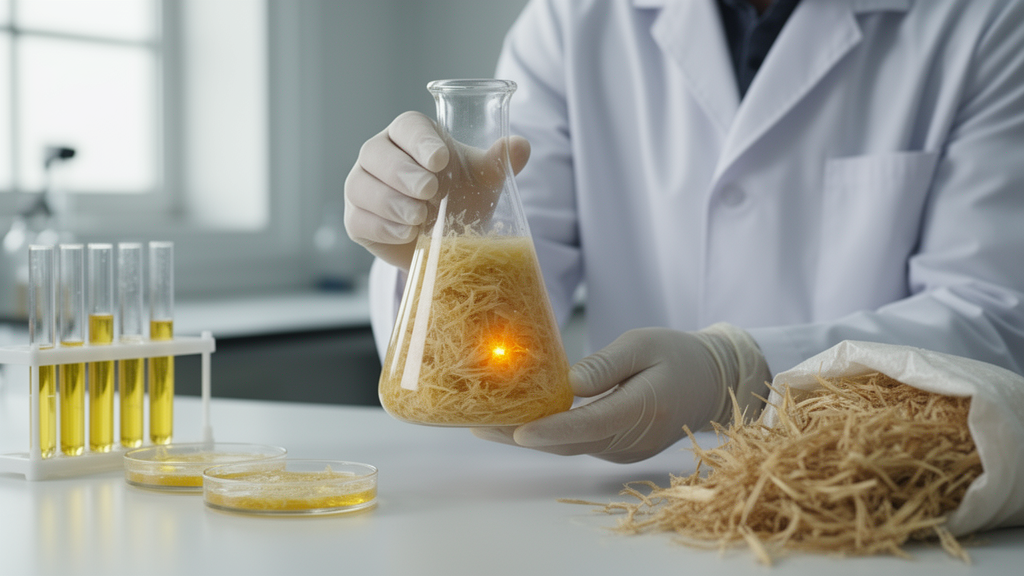
In a finding that could reshape how the world thinks about agricultural waste, researchers in West Bengal, India have shown that an ordinary soil bacterium can devour sugarcane bagasse — the fibrous mountain of leftovers left behind after juice is pressed from cane — and convert it into riboflavin, the vitamin B2 that sits on pharmacy shelves and in fortified breakfast cereals around the globe. The study, led by Indrani Paul of Brainware University in Kolkata with colleagues at Sister Nivedita University and the National Institute of Technology Durgapur, is the first reported case of riboflavin production from waste sugarcane bagasse using the bacterium Microbacterium proteolyticum, and it arrives with a striking bonus: the microbe required no genetic engineering whatsoever.
The strain at the heart of the work, designated BWBTDIPO1 and deposited in GenBank under accession number PQ517523, was isolated from a waste-dumping zone in Kolkata. That provenance matters. Bacteria that thrive in garbage dumps are often exposed to complex, recalcitrant organic matter, and the team suspected such an environment might select for organisms capable of dismantling lignocellulose — the tough composite of lignin, cellulose, and hemicellulose that makes plant waste so resistant to decay and so expensive to process industrially. Their hunch proved correct. When the researchers offered the bacterium ground, sterilized sugarcane bagasse as its sole carbon source in submerged fermentation, the microbe grew vigorously and secreted riboflavin into the surrounding medium.
The numbers are compelling. Over a 78-hour fermentation at 30 degrees Celsius and 120 rpm, the bacterium achieved a specific growth rate of 0.325 per hour, corresponding to a generation time of roughly 2.13 hours, and produced 397 ± 15.8 milligrams of riboflavin per liter of culture — equivalent to 19.85 ± 2.0 milligrams of the vitamin for every gram of bagasse consumed. The team screened four mineral salt medium formulations to find the optimal recipe, and yeast extract peptone mineral salt medium, or YPMSM, emerged as the clear winner. The authors attribute this to the synergistic nutritional boost provided by yeast extract and peptone, which supply vitamins, nucleotides, peptides, and growth factors that support flavin biosynthesis and the enzymatic machinery needed to break down the biomass.
The growth curve told a classic batch-fermentation story with a twist. The bacterium lingered in a lag phase until about the sixteenth hour — a period the researchers interpret as physiological adaptation to the complex, lignin-rich substrate — then exploded into exponential growth between hours 18 and 40, before settling into a stationary phase. Riboflavin production tracked this trajectory closely, accelerating sharply after hour 18 and continuing into the late exponential and early stationary phases before peaking at hour 78. This pattern suggests the vitamin is produced through a combination of growth-associated and non-growth-associated mechanisms, a detail the authors say will be critical for timing cell harvesting and product recovery in any future industrial scale-up.
Confirming that the yellow-green metabolite really was riboflavin required a two-pronged analytical approach. Ultraviolet-visible spectrophotometry of the acidified ethanol extract revealed absorption peaks at 226 and 266 nanometers, matching the signature of riboflavin’s isoalloxazine chromophore. Thin-layer chromatography on silica gel plates, using a methanol-to-water mobile phase of 70:30, produced a retention factor of 0.83 — identical to that of a commercially purchased riboflavin standard run alongside the sample. Earlier work by the same group had already achieved a higher yield of 459.31 milligrams per liter using Luria Bertani broth, a glucose-rich synthetic medium, but the current process substitutes a zero-cost agricultural waste for that expensive feedstock, dramatically improving the economics even at a slightly lower titer.
Perhaps the most technically revealing portion of the study concerns what happened to the bagasse itself. The researchers subjected treated and untreated biomass to a battery of compositional assays. Alkali lignin solubilization increased measurably after bacterial treatment, with optical density at 465 nanometers rising from 0.359 in untreated samples to 0.443 in treated ones. Acid hydrolysis revealed a dramatic 65.33 ± 3.4 percent reduction in acid-insoluble lignin — the most condensed and structurally resistant lignin fraction — falling from 0.75 grams of residual dry biomass to just 0.26 grams. Meanwhile, the dinitrosalicylic acid assay showed reducing sugar concentrations more than tripling, from 0.205 to 0.617 milligrams per milliliter, direct evidence that the bacterium was hydrolyzing cellulose and hemicellulose polymers into fermentable monosaccharides such as glucose, xylose, and arabinose.
Physicochemical characterization painted the same picture at the molecular and microscopic scales. Fourier-transform infrared spectroscopy revealed shifts and disappearances in peaks associated with lignin-carbohydrate complexes: the aromatic skeletal vibration near 1,634 wavenumbers shifted to 1,607, the crystalline cellulose CH2 wagging peak at 1,317 vanished entirely, and a new peak appeared at 1,244 wavenumbers, consistent with disruption of aryl-alkyl ether linkages binding hemicellulose to lignin. X-ray diffraction showed a sharper, more intense cellulose diffraction peak in treated samples, indicating that removal of amorphous lignin and hemicellulose had exposed the crystalline cellulose microfibrils beneath. Field-emission scanning electron microscopy provided the most visceral confirmation: where untreated bagasse displayed a dense, smooth, intact fibrillar architecture, the bacterially treated material was riddled with erosion, fragmentation, pore formation, and pronounced cracking.
To explain these observations mechanistically, the team turned to computational biology. Using KEGG global metabolic pathway mapping, they constructed a hypothetical framework for how the bacterium might be routing biomass-derived carbon through its metabolism. The analysis suggests three interconnected routes: lignin-derived aromatic compounds funneled into the tricarboxylic acid cycle, cellulose hydrolyzed to cellobiose and glucose before entering glycolysis, and hemicellulose-derived pentose sugars like xylose and arabinose assimilated through the pentose phosphate pathway. The authors are careful to emphasize that these pathways are predictive annotations, not experimentally validated mechanisms, and will require genomic, transcriptomic, proteomic, metabolomic, and enzyme-activity studies to confirm. Still, the architecture is consistent with lignocellulose degradation strategies documented in other bacteria and provides a plausible explanation for how biomass carbon ends up as riboflavin.
The significance of the work extends well beyond one bacterium and one vitamin. Global riboflavin production still relies heavily on chemical synthesis routes that demand multistep reactions, expensive catalysts, and energy-intensive operations, while most biological production depends on genetically modified organisms such as engineered Escherichia coli and Corynebacterium glutamicum. A wild-type strain that achieves competitive yields from free agricultural waste sidesteps both problems. India, one of the world’s leading sugarcane producers, generates enormous quantities of bagasse annually, and disposing of it poses persistent environmental challenges. Coupling that waste stream to nutraceutical manufacturing embodies the waste-to-wealth vision of the circular bioeconomy, and the authors note the approach aligns with broader sustainability goals.
Considerable work remains before a Kolkata dump-dwelling microbe can feed a factory. The researchers themselves flag the next steps: whole-genome sequencing to identify the genes governing both lignocellulose degradation and flavin biosynthesis, process optimization to push yields higher, techno-economic analysis, and life cycle assessment to verify the environmental credentials at scale. They also point out that the strain produced its riboflavin without any external supplementation of cofactors or amino acids, a simplicity that bodes well for cost-sensitive industrial adoption. If those efforts succeed, the humble bagasse pile behind every sugarcane juice cart could become a feedstock for one of the world’s most widely consumed vitamins — proof that sometimes the most valuable chemistry is already happening, quietly, in the dirt of a garbage dump.
Subject of Research: Bacterial bioconversion of sugarcane bagasse waste into riboflavin (vitamin B2)
Article Title: Sustainable bioconversion of sugarcane bagasse into valorizable riboflavin by Microbacterium proteolyticum BWBTDIPO1, characterization and in-silico mechanistic pathway prediction
Article References: Paul, I., Kali, S., Saha, S., Guha, P., Dasgupta, S., & Halder, G. (2026). Sustainable bioconversion of sugarcane bagasse into valorizable riboflavin by Microbacterium proteolyticum BWBTDIPO1, characterization and in-silico mechanistic pathway prediction. Frontiers in Chemical Engineering, 8, Article 1895508. https://doi.org/10.3389/fceng.2026.1895508
Image Credits: AI Generated
DOI: 10.3389/fceng.2026.1895508
Keywords: riboflavin, vitamin B2, sugarcane bagasse, Microbacterium proteolyticum, lignocellulosic biomass, submerged fermentation, biorefinery, waste-to-wealth, circular bioeconomy, KEGG pathway analysis, FTIR, biodegradation
Cite Scienmag News
Denise Maddox. (October 17, 2026). Waste Sugarcane Bagasse Turned Into Vitamin B2 by a Bacteria Found in a Kolkata Dump. Scienmag. https://scienmag.com/waste-sugarcane-bagasse-turned-into-vitamin-b2-by-a-bacteria-found-in-a-kolkata-dump/
Denise Maddox. "Waste Sugarcane Bagasse Turned Into Vitamin B2 by a Bacteria Found in a Kolkata Dump." Scienmag, 17 October 2026, https://scienmag.com/waste-sugarcane-bagasse-turned-into-vitamin-b2-by-a-bacteria-found-in-a-kolkata-dump/. Accessed 17 October 2026.
Denise Maddox. "Waste Sugarcane Bagasse Turned Into Vitamin B2 by a Bacteria Found in a Kolkata Dump." Scienmag. October 17, 2026. https://scienmag.com/waste-sugarcane-bagasse-turned-into-vitamin-b2-by-a-bacteria-found-in-a-kolkata-dump/


