


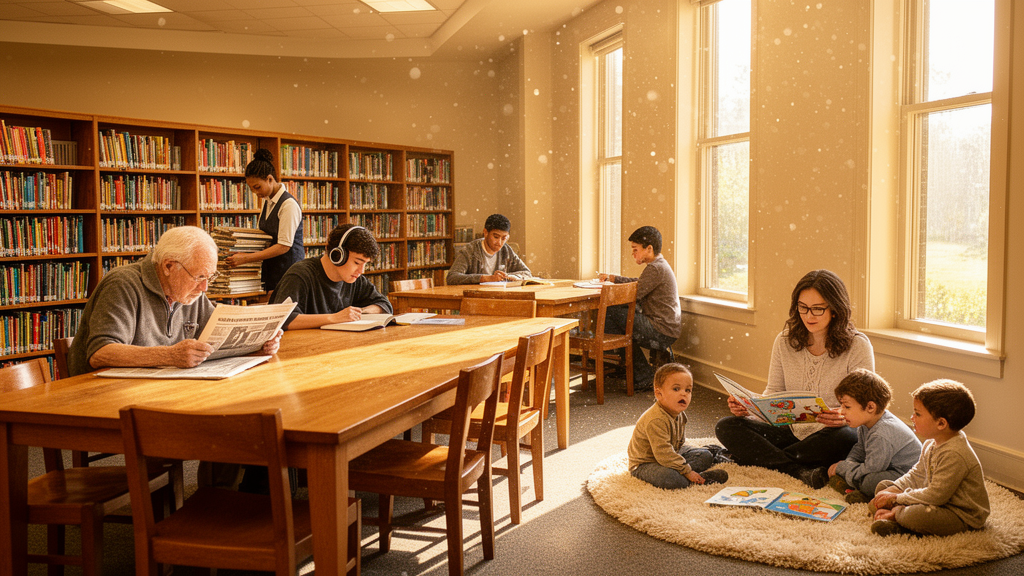
Public libraries rarely make headlines for conflict. In an era when swimming pools, public transport and parks are frequently the backdrop of disputes over shared urban space, the local library stands out as a place where strangers with wildly different needs somehow coexist in near silence. A new study published in Geographica Helvetica argues that this calm is not an accident of architecture or luck, but the product of an elaborate, largely invisible system of behavioral norms that the researchers call a library etiquette. According to Melike Peterson of the University of Bremen, Alexa Färber and Marion Hamm of the University of Vienna, community in libraries is not a pre-existing condition but something continuously produced, negotiated and policed through distributed practices of care.
The paper draws on two independent research projects conducted in Bremen, Germany, and Vienna, Austria. In Bremen, Peterson carried out 23 guided interviews with library visitors between 2020 and 2021 in the central library and two branch libraries, recruiting participants through notices and through the library teams themselves, with the aim of a mix of ages, genders and social and migration backgrounds. In Vienna, Hamm conducted two years of participant observation in a main library and a branch between 2022 and 2025, accompanied three librarians through entire working weeks, and joined Färber and a social designer in running four zine workshops with staff, administrators and visitors, supplemented by nine interviews with library managers and city officials. Both projects combined participant observation, informal conversations, qualitative interviews and document analysis in a focused ethnographic approach.
The theoretical stakes are higher than the quiet subject matter might suggest. The authors deliberately avoid essentialized notions of community, a term that carries troubling historical baggage in the German-speaking world, where its ideological prominence during the Nazi era lent it exclusionary and racist connotations that persist today. Instead they build on Talja Blokland’s understanding of community as a culture of urban practice, and specifically on her concept of familiar publicness: repeated fleeting encounters and lasting engagements create a context in which symbols can be produced and understood, and in which accumulated experiential knowledge can generate a feeling of community. Belonging in this sense is not tied to social identity but to a kind of ease, an absence of any necessity to strain or actively intervene.
What the Bremen interviews reveal is how strongly visitors themselves articulate this ease as a collective achievement. Many described the library not primarily through its functions but through a feeling of belonging bound to repeated co-presence and shared rules of behavior. One visitor spoke of the common good, for which everyone has to give up a little something. Another described a collectivity she was not always entirely happy with, but to which one perhaps has to adapt somewhat. Others emphasized a loose, indirect feeling of community arising from shared interests, something rather unconscious that connects people without requiring constant conversation.
This vocabulary of adaptation points to the core mechanism the researchers identify: self-regulation as a form of care. One visitor explained that in the library one learns not always to think me, me, me, but also to pay attention to the we. When she meets friends in the library and things get loud, the group deliberately seeks out noisy corners where their volume is no problem for others. Reading the built space correctly, knowing which areas suit which behavior, becomes a prerequisite both for pursuing one’s own use and for sustaining a feeling of belonging. Another visitor framed rule-following as mutual responsibility: he keeps the rules so that he can find his way, so that he is accepted, and so that he can convey that same feeling to others, while stressing that he remains free to decide what he wants to do there, as long as his behavior remains compatible with the implicit expectations, because only that way does it work here.
Crucially, visitors interpret this order as inclusive rather than coercive. One interviewee insisted that the rules have nothing to do with your passport, your origin or your library card; they apply to everyone, and the control is not personal but for the place, so that everyone can be here, for the community. This perceived even-handedness helps visitors reframe frustration: when others behave in borderline ways, many respondents attribute it to individual circumstances, such as someone with severe psychological problems or someone under the influence of alcohol, rather than to a breakdown of the social order. Transgressors are often tolerated rather than expelled, with librarians seen as stepping in discreetly so that things do not get out of hand.
Yet the responsibility for maintaining this order is strikingly unequal. Visitors largely accept that explicit rule communication and conflict management belong to the staff. One visitor said she does not address misbehaving strangers herself, preferring to watch rather than get into an argument, because that is perhaps better coming from the staff, which she saw as their mandate or task. The researchers read this division of labor as central to the logic of library etiquette: visitors embody the etiquette habitually in their own conduct, while assigning librarians the job of making that order visible, securing it and enforcing it in cases of conflict. Community thus appears not as a given social structure but as the outcome of everyday, often invisible processes of coordination in which care work is distributed unevenly across actors.
On the staff side, the Vienna material shows how librarians produce, moderate and stabilize togetherness as a professional ethic. Programmatically, community is addressed explicitly: Austria’s 2024 federal library development plan states that libraries strengthen the local community and that a community forms in the library for all that recognizes differences and is open to the new. Yet in everyday practice librarians are notably reserved about the word itself. Asked directly about community, two branch librarians agreed only when prompted with the idea of many small communities in the library, describing people with different needs, some wanting quiet, others being loud, and characterizing their work as a constant weighing up, a matter of keeping the balance. Librarians describe their professional stance as a reliable, restrained presence, a kind of being-there, and frame their friendliness as the private part of professional work, aimed at creating a pleasant climate.
The guiding maxim of this flexible regulation, repeated in varied forms, is whatever does not disturb is allowed. House rules technically restrict drinks, phone calls and food, but librarians handle the coffee machine, eating and mobile phones pragmatically as long as no one is disturbed, viewing everything from the human side. Even conflict is folded into this relational order. When a group of teenage boys entered a small branch, raised the noise level and moved chairs around, a colleague admonished them firmly but kindly; later the researcher observed the same boys standing around the dishwasher as a staff member showed them how to load it correctly. Rule enforcement was transformed into instruction and social inclusion, signaling that the boys were welcome while demonstrating practically how the ground rule works. Similar indirect steering appears in micro-practices, such as requiring tea bags and sugar to be collected at the desk to ensure considerate use of the tea kitchen.
The authors conclude that libraries are sites of a specific urban socialization in which people try out and rehearse community. The etiquette works because care is distributed: visitors practice consideration as long as their sense of comfort holds, and transfer responsibility for the etiquette to librarians precisely when comfort would require active effort, which Blokland’s definition of feeling at ease explicitly excludes. This ambivalence has costs. The researchers note that the idealization of libraries’ community-building potential also produces subtle exclusions, and they ask what feeling at ease means for those who use the library without a membership card, sleep there or warm up inside, and for city residents who never enter at all. How open library etiquette remains in any given case, they argue, depends on the negotiable conceptions of democratic urban society available at that place, making the quiet library not a refuge from politics but one of its most delicate everyday stages.
Subject of Research: How library etiquette and distributed care practices produce community in public libraries
Article Title: Öffentliche Büchereien als Orte von Gemeinschaft? Wie Bücherei-Etikette die Sorge für das Miteinander verteilt
Article References: Peterson, M., Färber, A., & Hamm, M. (2026). Öffentliche Büchereien als Orte von Gemeinschaft? Wie Bücherei-Etikette die Sorge für das Miteinander verteilt. Geographica Helvetica, 81(3), 407-419. https://doi.org/10.5194/gh-81-407-2026
Image Credits: AI Generated
Keywords: public libraries, community, library etiquette, care practices, urban sociality, ethnography, Bremen, Vienna, social infrastructure, belonging, librarians, urban studies
Cite Scienmag News
Violet Maxwell. (October 9, 2026). The Quiet Rules That Make Public Libraries Feel Like Community. Scienmag. https://scienmag.com/the-quiet-rules-that-make-public-libraries-feel-like-community/
Violet Maxwell. "The Quiet Rules That Make Public Libraries Feel Like Community." Scienmag, 9 October 2026, https://scienmag.com/the-quiet-rules-that-make-public-libraries-feel-like-community/. Accessed 9 October 2026.
Violet Maxwell. "The Quiet Rules That Make Public Libraries Feel Like Community." Scienmag. October 9, 2026. https://scienmag.com/the-quiet-rules-that-make-public-libraries-feel-like-community/


